{"ajaxurl":"https:\/\/models118.co.uk\/wp-admin\/admin-ajax.php?lang=en_GB","nonce":"639ff23817","homeUrl":"https:\/\/models118.co.uk\/","shopUrl":"https:\/\/models118.co.uk\/shop\/","cartUrl":"https:\/\/models118.co.uk\/cart-en-gb\/","checkoutUrl":"https:\/\/models118.co.uk\/checkout\/","skipCart":true,"collectionLimit":12,"i18n":{"addedToCart":"Added to basket","addToWishlist":"Add to wishlist","addedToWishlist":"Added to wishlist","removeFromWishlist":"Remove from wishlist","removedFromWishlist":"Removed from wishlist","undo":"Undo","error":"Something went wrong","loading":"Loading...","outOfStock":"Out of stock","viewCart":"View basket","proceedToCheckout":"Proceed to checkout","addedToCollection":"Added to your collection","reserved":"Added to your collection","soldOut":"Sold out","invalidEmail":"Please enter a valid email address","connectionError":"Connection error. Please try again.","tocToggle":"On this page","close":"Close","inCartTooltip":"Already in your basket \u2013 open your basket to check out","loginToSave":"Sign in to save this model","waitlistNotify":"Notify me","waitlistOnList":"On the waiting list \u2713","waitlistJoined":"You're on the waiting list. We'll email you the moment this model is available again.","waitlistRemoved":"Done \u2014 you're off the waiting list for this model.","waitlistRateLimit":"Too many attempts \u2014 please try again shortly","waitlistTurnstile":"We couldn't complete the check \u2014 please try again","waitlistError":"Sorry, something went wrong. Please try again in a moment."},"wishlist":{"loggedIn":false,"loginUrl":"https:\/\/models118.co.uk\/my-account\/","addAction":"models118_wishlist_add","removeAction":"models118_wishlist_remove"},"waitlist":{"loggedIn":false,"subscribeAction":"models118_waitlist_subscribe","toggleAction":"models118_waitlist_toggle","stateAction":"models118_waitlist_state"},"stats":{"models":2665,"brands":215,"manufacturers":129,"collectors":10000},"product":{"id":1706867,"sku":"120601205","condition":"new","availability":"in_stock","name":"Maserati Tipo 61 #5 Camoradi S. Moss \/ D. Gurney 1000km Nurburgring Winner 1960 Minichamps 1:12","brand":"Maserati","manufacturer":"Minichamps","scale":"1:12","material":"Diecast","price":488.33,"regularPrice":488.33,"isOnSale":false,"savingsAmount":0,"stockQty":1,"stockStatus":"very_low","isDiscontinued":false,"image":"https:\/\/models118.co.uk\/wp-content\/uploads\/2026\/10\/maserati-tipo-61-5-camoradi-s-moss-d-gurney-1000km-nurburgring-winner-1960-minichamps-1-12-120601205-1-1-300x200.jpg","permalink":"https:\/\/models118.co.uk\/maserati-tipo-61-5-camoradi-s-moss-d-gurney-1000km-nurburgring-winner-1960-minichamps-1-12-120601205\/"}}
Cookies on Models118
We use cookies to remember your preferences, understand how the shop is used and show you models and offers that suit your interests. What you allow is up to you, and you can change it at any time.
Always active
The technical storage or access is strictly necessary for the legitimate purpose of enabling the use of a specific service explicitly requested by the subscriber or user, or for the sole purpose of carrying out the transmission of a communication over an electronic communications network.
The technical storage or access is necessary for the legitimate purpose of storing preferences that are not requested by the subscriber or user.
The technical storage or access that is used exclusively for statistical purposes.
The technical storage or access is required to create user profiles to send advertising, or to track the user on a website or across several websites for similar marketing purposes.
Maserati Tipo 61 #5 Camoradi S. Moss / D. Gurney 1000km Nurburgring Winner 1960 Minichamps 1:12
New arrival
1/8
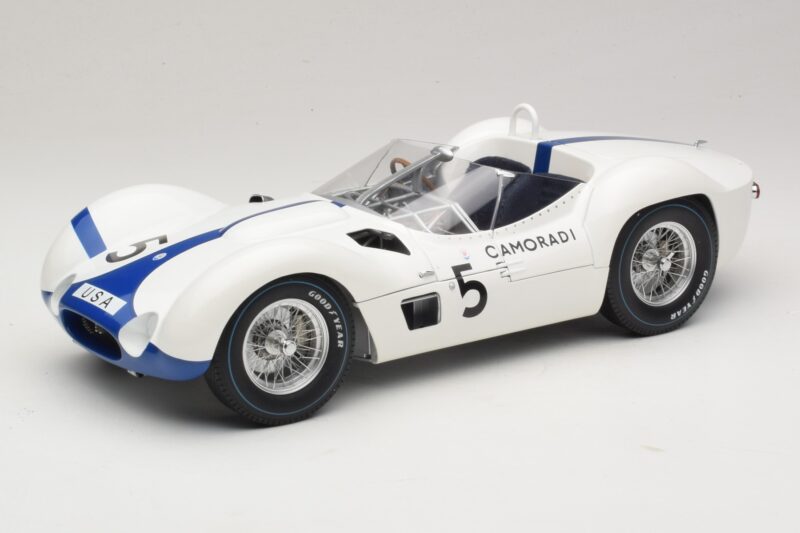
Minichamps' 1:12 diecast Maserati Tipo 61 #5 recreates the Camoradi car that Stirling Moss and Dan Gurney took to victory in the 1960 Nürburgring 1000km. Opening parts and a large-scale body make it a commanding display piece for collectors of front-engined sports-racing cars, and a natural partner to the #98 Shelby car from the same range.
About the Maserati Tipo 61 #5 Camoradi S. Moss / D. Gurney 1000km Nurburgring Winner 1960 Minichamps 1:12
TL;DR: The Minichamps Maserati Tipo 61 #5 in 1:12 is a diecast replica of the Camoradi car driven by Stirling Moss and Dan Gurney to victory in the 1960 Nürburgring 1000km. Opening parts, a large-scale body and a tubular-frame prototype shape make it a commanding centrepiece for 1960s sports-racing collections.
Stirling Moss and Dan Gurney shared the wheel of this car when it won the 1960 Nürburgring 1000km, a pairing of British and American talent in an American-entered Maserati. Minichamps casts the Camoradi Tipo 61 at 1:12, a size where a front-engined prototype of 1960 stops looking like a model and starts looking like an artefact.
Minichamps Maserati Tipo 61 at 1:12 in Diecast
Scale, Mass and Opening Parts
At 1:12 the Tipo 61 is large enough that detail is carried by the casting itself rather than merely suggested by it. Diecast adds the weight a collector expects at this size, and the model feels like a considered object rather than a toy when lifted from its base. Opening parts are confirmed for this model, so the body is built to articulate, which suits a car whose engineering is its main attraction. Zinc alloy brings a trade-off: wider shut lines than a sealed resin shell would hold, and a body that rewards careful handling because large panels carry leverage. Support the model from underneath when moving it rather than by the bodywork, and check that the bodywork sits true and square when closed.
Livery, Number and Period Finish
The #5 on a sports-racing car of 1960 is the whole identity of the piece, so judge the number roundels, the paint transitions and the lettering for crispness first. Period racing finishes were functional rather than showroom-polished, and a good replica reflects that: even colour, sharp edges to the numerals, and no fuzziness where one tone meets another. On a large body any flaw shows from further away, which makes the 1:12 format a stern test of finishing quality, and a worthwhile one.
The Birdcage Frame and the 1960 Nürburgring 1000km
Why the Tipo 61 Earned Its Nickname
The Tipo 61 is known as the Birdcage because of the dense lattice of small-diameter tubes that formed its spaceframe, an unusual structure that made the car light and stiff. It was front-engined at a time when rear-engined layouts were beginning to dominate, which gives the shape its long bonnet and set-back cockpit. Those proportions are what a model has to get right: the length of the nose, the low screen and the way the tail falls away.
Moss, Gurney and the Camoradi Entry
Camoradi, the team that entered this car, was American-run, and the Nürburgring win of 1960 paired Moss and Gurney in a celebrated sports-car result. The model records that single weekend, so it works best as a dated, specific piece rather than a generic Tipo 61. For British collectors, Moss supplies an easy emotional hook: the 1000km at the Nürburgring is exactly the sort of long, demanding event in which his reputation was built. Period photographs of the winning car are the best reference for stance and livery, and a short check against them takes only minutes.
Building a Birdcage Pair on the Shelf
The sensible way to collect this subject is as a pair. Put the #5 Camoradi car beside the #98 Shelby car from the same Minichamps 1:12 range and the shelf shows two different 1960 liveries on one car type, which is more informative than two unrelated racers. Allow generous space: a 1:12 front-engined racer needs a wide, deep shelf and a display case sized to match. Keep the model clear of direct sun, dust it with a soft brush, and retain the packaging and any documentation, as British collectors place real value on completeness. A buyer who wants to buy a single large-scale 1960s racer with a clear race story will find this one easy to justify.
Create a free account and claim 5% off your first order — from hundreds of collectible 1:18, 1:43 and 1:12 models by Porsche, Mercedes-Benz, BMW and more.