{"ajaxurl":"https:\/\/models118.co.uk\/wp-admin\/admin-ajax.php?lang=en_GB","nonce":"a4c944ccd6","homeUrl":"https:\/\/models118.co.uk\/","shopUrl":"https:\/\/models118.co.uk\/shop\/","cartUrl":"https:\/\/models118.co.uk\/cart-en-gb\/","checkoutUrl":"https:\/\/models118.co.uk\/checkout\/","skipCart":true,"collectionLimit":12,"i18n":{"addedToCart":"Added to basket","addToWishlist":"Add to wishlist","addedToWishlist":"Added to wishlist","removeFromWishlist":"Remove from wishlist","removedFromWishlist":"Removed from wishlist","undo":"Undo","error":"Something went wrong","loading":"Loading...","outOfStock":"Out of stock","viewCart":"View basket","proceedToCheckout":"Proceed to checkout","addedToCollection":"Added to your collection","reserved":"Added to your collection","soldOut":"Sold out","invalidEmail":"Please enter a valid email address","connectionError":"Connection error. Please try again.","tocToggle":"On this page","close":"Close","inCartTooltip":"Already in your basket \u2013 open your basket to check out","loginToSave":"Sign in to save this model","waitlistNotify":"Notify me","waitlistOnList":"On the waiting list \u2713","waitlistJoined":"You're on the waiting list. We'll email you the moment this model is available again.","waitlistRemoved":"Done \u2014 you're off the waiting list for this model.","waitlistRateLimit":"Too many attempts \u2014 please try again shortly","waitlistTurnstile":"We couldn't complete the check \u2014 please try again","waitlistError":"Sorry, something went wrong. Please try again in a moment."},"wishlist":{"loggedIn":false,"loginUrl":"https:\/\/models118.co.uk\/my-account\/","addAction":"models118_wishlist_add","removeAction":"models118_wishlist_remove"},"waitlist":{"loggedIn":false,"subscribeAction":"models118_waitlist_subscribe","toggleAction":"models118_waitlist_toggle","stateAction":"models118_waitlist_state"},"stats":{"models":2665,"brands":215,"manufacturers":129,"collectors":10000},"product":{"id":1703959,"sku":"940113631","condition":"new","availability":"in_stock","name":"Lotus Super Seven Black Maxichamps 1:43","brand":"Lotus","manufacturer":"Maxichamps","scale":"1:43","material":"Diecast","price":50,"regularPrice":50,"isOnSale":false,"savingsAmount":0,"stockQty":2,"stockStatus":"very_low","isDiscontinued":false,"image":"https:\/\/models118.co.uk\/wp-content\/uploads\/2026\/10\/lotus-super-seven-black-maxichamps-1-43-940113631-1-1-300x200.jpg","permalink":"https:\/\/models118.co.uk\/lotus-super-seven-black-maxichamps-1-43-940113631\/"}}
Cookies on Models118
We use cookies to remember your preferences, understand how the shop is used and show you models and offers that suit your interests. What you allow is up to you, and you can change it at any time.
Always active
The technical storage or access is strictly necessary for the legitimate purpose of enabling the use of a specific service explicitly requested by the subscriber or user, or for the sole purpose of carrying out the transmission of a communication over an electronic communications network.
The technical storage or access is necessary for the legitimate purpose of storing preferences that are not requested by the subscriber or user.
The technical storage or access that is used exclusively for statistical purposes.
The technical storage or access is required to create user profiles to send advertising, or to track the user on a website or across several websites for similar marketing purposes.
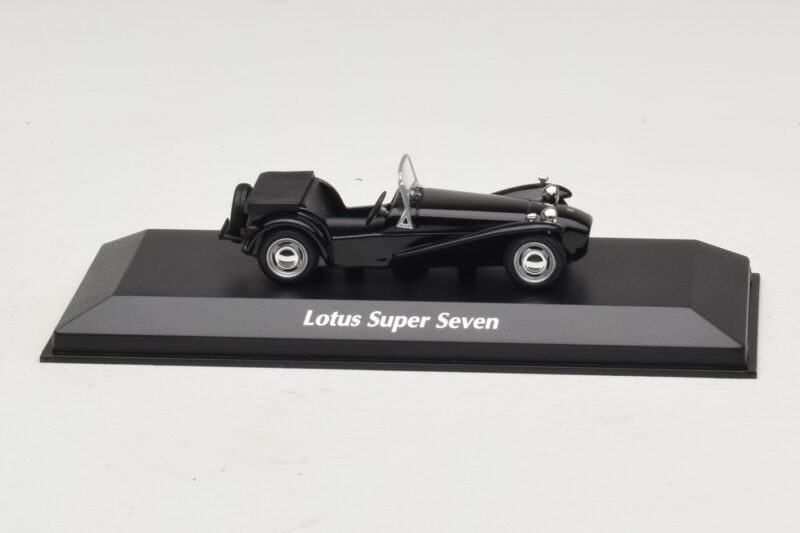
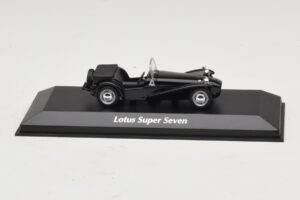
Maxichamps' 1:43 diecast Lotus Super Seven in black captures the 1968 British open-top roadster in a sealed one-piece body. The appeal is in the stripped-back profile and the exposed cockpit, and the diecast casting is sturdy enough to handle. A small but characterful addition for collectors of lightweight British sports cars and 1960s roadsters.
TL;DR: The Maxichamps Lotus Super Seven Black is a 1:43 diecast replica of the 1968 British open-top roadster. The body is a sealed one-piece casting, so the appeal lies in its stripped-back profile, black paint and exposed cockpit. It suits collectors of lightweight British sports cars and compact 1960s roadsters.
Colin Chapman's brief for the Seven was simple: take away everything the driver did not need. The result is a car with almost no bodywork to speak of, which makes it an unusual subject in miniature. The Maxichamps Lotus Super Seven in 1:43 gives that stripped-down shape a black finish and a sealed diecast body that stands up well to handling.
Maxichamps Lotus Super Seven 1:43 and Its Exposed Cockpit
An Open Car Shows Its Interior
With no roof and a minimal windscreen, a Seven reveals its cockpit from almost every angle above. That puts the seats, steering wheel and dash on view in a way a closed saloon never does, and it makes the interior a point of comparison between models. Look at the seat shapes, the wheel diameter and whether the cockpit edge is sharp. Remember the body itself is a sealed casting with nothing opening; what you see is fixed in place. The upside is robustness, because a thin open-car body without hinges is less likely to loosen or wobble with handling, and a one-piece casting keeps the narrow bodywork clean along its edges.
Black Paint on a Bare-Bones Shape
Black is the hardest solid colour to judge. It swallows detail, and it reveals every reflection. On this model it helps to examine the finish under a diffuse light rather than a spotlight: the surface should flatten into an even gloss if the paint is well applied, while swirls or dust marks show if it is not. Bright trim stands out against black, which means the grille, lamps and wheel faces do a lot of work visually. Given the car's lightness in real life, it is a small oddity that a metal model of it still feels dense in the hand for its size.
Lightweight Thinking from Chapman to Caterham
The Seven Idea
Chapman is credited with the maxim to simplify, then add lightness, and the Seven is its purest expression. Lotus launched the car in 1957, and by 1968 it had been through several revisions while keeping its essential shape: an open cockpit and a narrow body wrapped around a minimal frame. It was sold in kit and assembled forms, which fed a culture of owner-tinkering that still surrounds the type. A model from the later part of that run shows the car after a decade of development, so it sits comfortably on a shelf of 1960s British roadsters.
The Seven's Long Afterlife
Lotus sold the production rights to Caterham in 1973, and the design has been built in some form ever since, which explains why the Seven's profile is so familiar to British enthusiasts. For a collector this has a practical consequence: the silhouette is easy to recognise at a glance, so even a small 1:43 piece reads instantly on a shelf. Later Caterham cars look very similar, so check the year and the name on a given model before assuming what it represents. This one is specifically a 1968 Lotus, and that clarity helps when building a roadster run across eras.
Where a Seven Fits on the Shelf
Small, light and open, the Super Seven pairs naturally with other British roadsters of the 1960s, and it contrasts with larger grand tourers by sheer minimalism. At 1:43 it is among the smallest pieces in any cabinet, so display it near the front where its narrow shape is not hidden by taller neighbours. A clear lid or case matters more than usual, since an open cockpit collects dust in the seats. Handle it by the base. Do not poke the cockpit with a finger, because the small printed or applied details are the most fragile parts. If you are comparing it with other open-top models, judge the stance and the cockpit finish first, and remember that a sealed casting trades moving panels for durability. Buy it for the shape and the history, and it will not disappoint.
Create a free account and claim 5% off your first order — from hundreds of collectible 1:18, 1:43 and 1:12 models by Porsche, Mercedes-Benz, BMW and more.
{"id":1703959,"name":"Lotus Super Seven Black Maxichamps 1:43","price":"£<\/span>50.00<\/bdi><\/span>","image":"https:\/\/models118.co.uk\/wp-content\/uploads\/2026\/10\/lotus-super-seven-black-maxichamps-1-43-940113631-1-1-400x400.jpg","permalink":"https:\/\/models118.co.uk\/lotus-super-seven-black-maxichamps-1-43-940113631\/","brand":"Lotus"}