Last one
Used

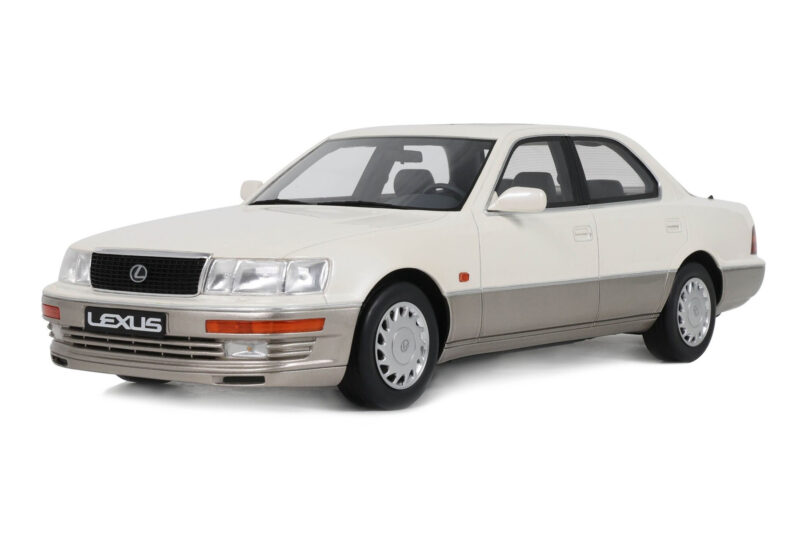
TL;DR: Otto's 1:18 Lexus LS400 XF10 reproduces the flagship sedan that launched the Lexus brand in 1989, cast as a sealed resin shell in Diamond White Pearl. The LS400's smooth, understated proportions and refined engineering reputation are told entirely through the exterior, since the body is a single fixed casting.
Toyota launched the LS400 in 1989 under its new Lexus brand, aiming directly at Mercedes-Benz's S-Class and BMW's 7 Series with a car built around obsessive engineering refinement rather than badge heritage. Its smooth, understated styling deliberately avoided flash in favour of proportion and finish, and Diamond White Pearl was one of the launch colours that suited that quiet confidence.
Toyota's engineers famously pursued near-obsessive standards of refinement while developing the LS400, reportedly testing prototypes for wind noise, vibration and mechanical smoothness to a degree established luxury manufacturers had never matched at the time. The result was a car that felt engineered from first principles rather than badge-engineered from an existing platform, its 1UZ-FE V8 renowned for quiet, seamless power delivery. That reputation for engineering rigour, rather than styling drama, became the founding identity of the entire Lexus brand, and the LS400's understated exterior was very much a deliberate reflection of that priority.
Launching a completely new luxury brand against Mercedes-Benz and BMW, both with decades of flagship-sedan reputation behind them, was a considerable gamble, and the LS400's success in doing exactly that reshaped the luxury sedan market through the 1990s. Buyers who might never have considered a Japanese flagship sedan found themselves reconsidering, drawn by a combination of refinement, reliability and value the established German makers had not previously needed to compete against so directly. That shift in the market's expectations is arguably the LS400's most lasting legacy.
The LS400's styling relies on subtle surface tension and consistent proportion rather than sharp creases, which makes any inconsistency in a casting's panel lines unusually easy to spot. Otto builds this XF10 as a single sealed resin body, with no bonnet or boot built to open, holding smooth, continuous surfaces across the long bonnet and boot lines without a hinge break to interrupt the flow. That construction suits a car whose original design language was itself about restraint, letting the shape's proportion do the visual work.
Pearl finishes carry a subtlety that flat or standard metallic paints lack, shifting slightly in tone depending on the angle of light rather than reflecting a single consistent shade. Resin holds that layered pearl effect convincingly, and under a raking light the LS400's long, smooth panels show the finish shifting gently from white toward a faint warmth, exactly the quiet sophistication the original colour aimed for. It is a considerably harder finish to reproduce accurately than a flat white, and getting that subtle shift right is where this casting distinguishes itself.
At just under five metres long, the LS400 is a genuinely large sedan, and at 1:18 that translates to a model of real physical presence, longer than most sports coupes reproduced at the same scale and demanding a correspondingly generous stretch of shelf space. That size is worth planning for before buying, since a flagship saloon this scale can dominate a smaller cabinet row rather than sit comfortably alongside more compact subjects. The LS400's long, low proportions and understated detailing reward being viewed from a slight distance, where the overall silhouette reads clearly, rather than from extremely close inspection looking for surface drama the original design never intended to offer. Comparing this casting against contemporary photography, the smooth transition from bonnet to windscreen and the restrained chrome detailing around the grille hold up as faithful to the XF10's understated original specification.
This LS400 works well as an anchor piece within a display covering 1990s flagship sedans, offering a genuine contrast to contemporary Mercedes or BMW models built around a very different design philosophy. Its sealed body and consistent pearl finish keep the presentation clean across the car's long, unbroken panel lines, and its size means it benefits from a slightly more generous shelf position than a compact coupe would need. At this tier, resin construction gives the subtle pearl effect considerably more depth than a basic die-cast alternative would achieve on panels this large and plain. For a collector interested in how a genuinely new luxury brand challenged decades of established competition, this model tells that story convincingly.