Last one
Used
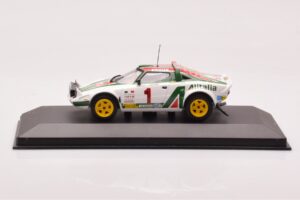
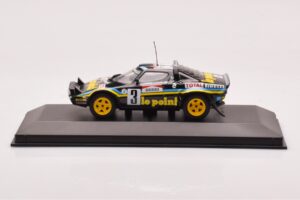
Lancia Stratos #1 S. Munari / S. Maiga Rally Monte Carlo 1977 Minichamps 1:43
Only 1 left
Price:
£48.00
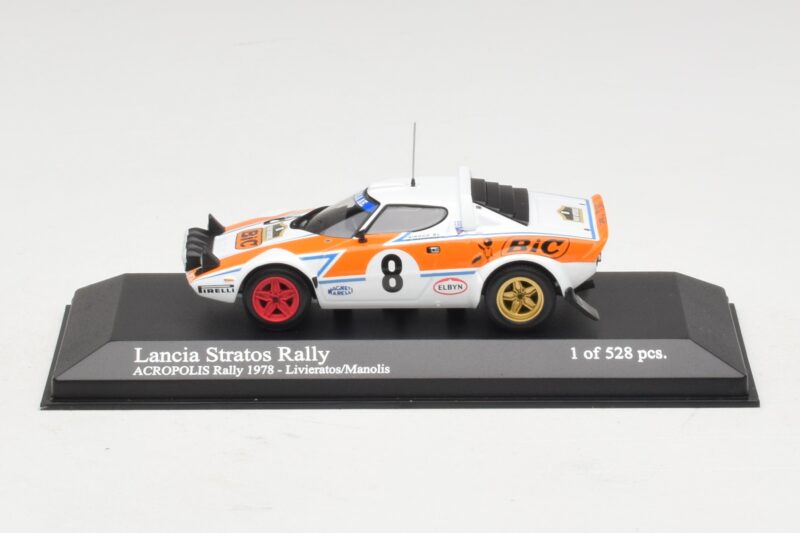
TL;DR: Minichamps' 1:43 Lancia Stratos reproduces car number 8, driven by Livieratos and Manolis, at the 1978 Acropolis Rally. The sealed diecast body carries the wedge-shaped Bertone design through a livery built for one of the World Rally Championship's harshest events.
Rough, rock-strewn and brutally hot, the Acropolis Rally earned its 'rally of the gods' reputation by breaking cars that performed perfectly everywhere else. A Stratos entered there had to survive conditions its mid-engine rally-bred chassis was never specifically designed around, which is part of what makes this particular livery an interesting subject.
This Stratos arrives as a sealed, one-piece diecast casting, with doors and engine cover moulded into the body rather than hinged. On a rally liveried subject that construction choice pays off directly: sponsor graphics and number panels run continuously across the flanks without a shutline breaking the design, and the tampo-printed decals sit flat rather than standing proud at their edges. The wedge-shaped nose and flush glazing, hallmarks of Bertone's original design, come through as crisp, unbroken surfaces. Wheel offset and the flared arch line, both distinctive on the real car, are held accurately rather than approximated, a detail that matters on a shape this compact.
Zinc alloy construction gives the casting genuine heft for its compact footprint, and the Stratos's naturally short wheelbase means this model takes up noticeably less shelf space at 1:43 than most period rally subjects. Paint sits on a hard metal shell deep enough to hold the livery's colours evenly under direct light, important on a car carrying this many graphic elements across its body. The roof-mounted intake and side scoops, both genuine Stratos features, are reproduced as raised, defined details rather than smoothed into the bodywork, and the model's compact length makes it an easy fit alongside other 1970s rally subjects built to the same scale.
This model reproduces car number 8, crewed by Livieratos and Manolis, at the 1978 Acropolis Rally, an event whose reputation for mechanical attrition was earned on rock-strewn Greek mountain roads baked by summer heat. Entries that finished the Acropolis at all, let alone competitively, earned a measure of respect regardless of final position. Greece's rough roads were never a natural habitat for a low, wide wedge-shaped car designed with faster European forest and tarmac stages in mind, which makes a well-documented Acropolis entry a genuinely different kind of subject within a Stratos collection.
The Stratos HF's mid-mounted Ferrari-derived V6 and purpose-built rally chassis, developed specifically to replace the ageing Fulvia in top-level competition, gave it the ground clearance and structural rigidity that rough events like the Acropolis demanded. Lancia's factory team had already proven the car's toughness by winning the World Rally Championship manufacturers' title in three consecutive years through the mid-1970s. That three-year title run, a feat few rally cars before or since have matched, is the backdrop against which every subsequent Stratos livery, including this one, should be read.
An Acropolis entry sits usefully apart from the forest-stage and tarmac liveries more commonly reproduced from the Stratos's career, offering a different visual story, dust tones, different sponsor graphics, within the same mechanical subject. For a collector already running a Stratos theme, this livery adds genuine variety rather than duplicating ground already covered. At 1:43, several such liveries fit comfortably on one shelf, and the result reads less like a repeated casting and more like a proper season survey. That breadth, several events and liveries built from one chassis, is exactly what makes the Stratos such a rewarding single-marque subject to pursue at this scale.