{"ajaxurl":"https:\/\/models118.co.uk\/wp-admin\/admin-ajax.php?lang=en_GB","nonce":"a2e6fbeffa","homeUrl":"https:\/\/models118.co.uk\/","shopUrl":"https:\/\/models118.co.uk\/shop\/","cartUrl":"https:\/\/models118.co.uk\/cart-en-gb\/","checkoutUrl":"https:\/\/models118.co.uk\/checkout\/","skipCart":true,"collectionLimit":12,"i18n":{"addedToCart":"Added to basket","addToWishlist":"Add to wishlist","addedToWishlist":"Added to wishlist","removeFromWishlist":"Remove from wishlist","removedFromWishlist":"Removed from wishlist","undo":"Undo","error":"Something went wrong","loading":"Loading...","outOfStock":"Out of stock","viewCart":"View basket","proceedToCheckout":"Proceed to checkout","addedToCollection":"Added to your collection","reserved":"Added to your collection","soldOut":"Sold out","invalidEmail":"Please enter a valid email address","connectionError":"Connection error. Please try again.","tocToggle":"On this page","close":"Close","inCartTooltip":"Already in your basket \u2013 open your basket to check out","loginToSave":"Sign in to save this model","waitlistNotify":"Notify me","waitlistOnList":"On the waiting list \u2713","waitlistJoined":"You're on the waiting list. We'll email you the moment this model is available again.","waitlistRemoved":"Done \u2014 you're off the waiting list for this model.","waitlistRateLimit":"Too many attempts \u2014 please try again shortly","waitlistTurnstile":"We couldn't complete the check \u2014 please try again","waitlistError":"Sorry, something went wrong. Please try again in a moment."},"wishlist":{"loggedIn":false,"loginUrl":"https:\/\/models118.co.uk\/my-account\/","addAction":"models118_wishlist_add","removeAction":"models118_wishlist_remove"},"waitlist":{"loggedIn":false,"subscribeAction":"models118_waitlist_subscribe","toggleAction":"models118_waitlist_toggle","stateAction":"models118_waitlist_state"},"stats":{"models":2369,"brands":214,"manufacturers":129,"collectors":10000},"product":{"id":133504,"sku":"08317Y","condition":"new","availability":"out_of_stock","name":"Lamborghini Miura SV Yellow Kyosho 1:18","brand":"Lamborghini","manufacturer":"Kyosho","scale":"1:18","material":"Diecast","price":137.5,"regularPrice":137.5,"isOnSale":false,"savingsAmount":0,"stockQty":0,"stockStatus":"out_of_stock","isDiscontinued":true,"image":"https:\/\/models118.co.uk\/wp-content\/uploads\/2026\/03\/lamborghini-miura-sv-yellow-kyosho-1-18-300x200.jpg","permalink":"https:\/\/models118.co.uk\/lamborghini-miura-sv-yellow-kyosho-1-18-08317y\/"}}
Cookies on Models118
We use cookies to remember your preferences, understand how the shop is used and show you models and offers that suit your interests. What you allow is up to you, and you can change it at any time.
Always active
The technical storage or access is strictly necessary for the legitimate purpose of enabling the use of a specific service explicitly requested by the subscriber or user, or for the sole purpose of carrying out the transmission of a communication over an electronic communications network.
The technical storage or access is necessary for the legitimate purpose of storing preferences that are not requested by the subscriber or user.
The technical storage or access that is used exclusively for statistical purposes.
The technical storage or access is required to create user profiles to send advertising, or to track the user on a website or across several websites for similar marketing purposes.
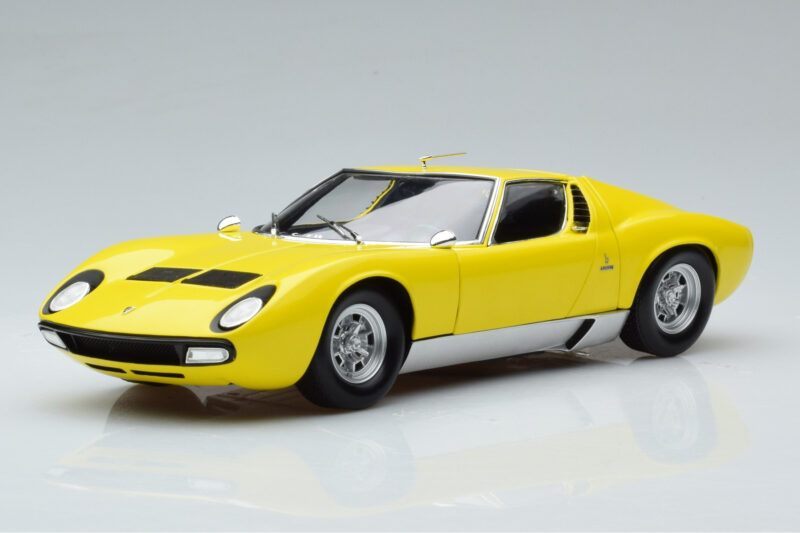
Kyosho's 1:18 diecast Lamborghini Miura SV recreates the final and most powerful Miura in yellow, with the SV's distinctive eyelash-free headlights and widened rear haunches. Zinc alloy construction gives genuine heft, and opening doors and bonnet reveal a detailed cabin and engine bay. A strong centrepiece for any Bertone-era Italian supercar shelf, priced at Kyosho's usual mid-tier diecast level rather than boutique resin money.
TL;DR: Kyosho's 1:18 diecast reproduces the Lamborghini Miura SV, the final and most powerful Miura variant, finished in yellow with the SV's wider rear haunches and eyelash-free headlights. Zinc alloy construction and opening panels suit collectors building a Bertone-era Italian supercar shelf at a mid-tier diecast price point.
The Miura SV closed out Lamborghini's first supercar with its most aggressive specification, and Kyosho's diecast keeps faith with that brief. Strip away the yellow paintwork and the details separating an SV from earlier Miura variants are all present, right down to the widened rear track.
Kyosho's Diecast Miura SV in Yellow
Correct SV Details: No Eyelashes, Wider Arches
Lamborghini's final Miura update dropped the chrome eyelash trim that framed the headlights on earlier cars, and Kyosho's tooling reflects that change accurately, giving this yellow example the cleaner, more purposeful nose that defines the SV visually. The rear haunches sit wider too, housing broader rear tyres than the standard Miura wore, and the diecast body captures that flare without looking bolted-on. Vents behind the doors and the reshaped engine cover carry through as well, details that separate a genuine SV tribute from a generic Miura shape wearing SV badging.
Weight, Shut Lines and Paint Under Light
Lift the model from its packaging and the zinc alloy body announces itself immediately, a density that plastic-bodied toys simply cannot match. Door and bonnet shut lines sit tight and even along the wing edges, and the yellow paint holds real depth under direct light rather than looking flat or chalky. Opening doors reveal a cabin trimmed to a standard well above entry-level diecast, and the bonnet lifts to show engine bay detail rather than a blanked-off panel. None of this rivals hand-built resin at the sharpest end of the market, but for diecast at this price it holds up to close inspection.
The Miura SV's Place in Supercar History
Bertone's Wedge and the Final Evolution
Marcello Gandini's design for Bertone gave the Miura a shape still credited with starting the modern supercar template: engine behind the driver, low nose, and proportions built around drama rather than practicality. The SV arrived as the final development of that shape, with a stiffer chassis, more power from the V12, and the wider rear track this model reproduces to accommodate broader tyres. Lamborghini built the SV in far smaller numbers than the standard Miura, and the model's role in the range explains why collectors treat it as the most desirable version of the car that arguably invented the supercar category, ahead of anything Ferrari or Maserati offered at the same moment. Kyosho's choice to tool the SV specifically, rather than a generic Miura shape with different decals, reflects that same collector logic.
Collecting the Miura at 1:18
Shelf Role Among Classic Sports Cars
At roughly 22 centimetres long, the Miura SV sits comfortably among other 1:18 classic sports cars without dominating a shelf the way a modern supercar casting would. It works well paired with contemporary Ferrari or Maserati coupes from the same decade, letting a collector build a mid-century Italian GT run rather than a single showpiece. Kyosho's diecast sits above pocket-money toy cars and below the sealed-resin tier that trades opening features for sharper paint, a fair mid-tier position for a car this significant.
Display, Handling and Long-Term Care
Keep the model out of direct sunlight, since prolonged exposure can dull the yellow finish over years of display, and dust the bodywork with a soft brush rather than a cloth that could mark the paint. Opening the doors and bonnet occasionally keeps the hinges moving freely rather than stiffening in one position. Collectors who also run a 1:43 shelf will notice how much more engine and cabin detail this 1:18 scale can carry; the smaller format suits breadth across a whole model range, while 1:18 suits a handful of cars a collector wants to study closely.
Create a free account and claim 5% off your first order — from hundreds of collectible 1:18, 1:43 and 1:12 models by Porsche, Mercedes-Benz, BMW and more.