{"ajaxurl":"https:\/\/models118.co.uk\/wp-admin\/admin-ajax.php?lang=en_GB","nonce":"d9bf684b57","homeUrl":"https:\/\/models118.co.uk\/","shopUrl":"https:\/\/models118.co.uk\/shop\/","cartUrl":"https:\/\/models118.co.uk\/cart-en-gb\/","checkoutUrl":"https:\/\/models118.co.uk\/checkout\/","skipCart":true,"collectionLimit":12,"i18n":{"addedToCart":"Added to basket","addToWishlist":"Add to wishlist","addedToWishlist":"Added to wishlist","removeFromWishlist":"Remove from wishlist","removedFromWishlist":"Removed from wishlist","undo":"Undo","error":"Something went wrong","loading":"Loading...","outOfStock":"Out of stock","viewCart":"View basket","proceedToCheckout":"Proceed to checkout","addedToCollection":"Added to your collection","reserved":"Reserved!","soldOut":"Sold out","invalidEmail":"Please enter a valid email address","connectionError":"Connection error. Please try again.","loginToSave":"Sign in to save this model","waitlistNotify":"Notify me","waitlistOnList":"On the waiting list \u2713","waitlistJoined":"You're on the waiting list. We'll email you the moment this model is available again.","waitlistRemoved":"Done \u2014 you're off the waiting list for this model.","waitlistRateLimit":"Too many attempts \u2014 please try again shortly","waitlistTurnstile":"We couldn't complete the check \u2014 please try again","waitlistError":"Sorry, something went wrong. Please try again in a moment."},"wishlist":{"loggedIn":false,"loginUrl":"https:\/\/models118.co.uk\/my-account\/","addAction":"models118_wishlist_add","removeAction":"models118_wishlist_remove"},"waitlist":{"loggedIn":false,"subscribeAction":"models118_waitlist_subscribe","toggleAction":"models118_waitlist_toggle","stateAction":"models118_waitlist_state"},"stats":{"models":2141,"brands":206,"manufacturers":127,"collectors":10000},"product":{"id":452547,"sku":"100060012","condition":"used","availability":"out_of_stock","name":"Honda Racing Team RA106 #12 J. Button F1 2006 Minichamps 1:18","brand":"Honda","manufacturer":"Minichamps","scale":"1:18","material":"Diecast","price":139,"regularPrice":139,"isOnSale":false,"savingsAmount":0,"stockQty":0,"stockStatus":"out_of_stock","isDiscontinued":true,"image":"https:\/\/models118.co.uk\/wp-content\/uploads\/2026\/06\/f1-honda-racing-team-ra106-jenson-button-2006-minichamps-1-18-300x200.jpg","permalink":"https:\/\/models118.co.uk\/honda-racing-team-ra106-12-j-button-f1-2006-minichamps-1-18-100060012\/"}}
Cookies on Models118
We use cookies to remember your preferences, understand how the shop is used and show you models and offers that suit your interests. What you allow is up to you, and you can change it at any time.
Always active
The technical storage or access is strictly necessary for the legitimate purpose of enabling the use of a specific service explicitly requested by the subscriber or user, or for the sole purpose of carrying out the transmission of a communication over an electronic communications network.
The technical storage or access is necessary for the legitimate purpose of storing preferences that are not requested by the subscriber or user.
The technical storage or access that is used exclusively for statistical purposes.
The technical storage or access is required to create user profiles to send advertising, or to track the user on a website or across several websites for similar marketing purposes.
Honda Racing Team RA106 #12 J. Button F1 2006 Minichamps 1:18
Sold out
1/6
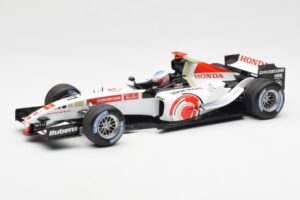
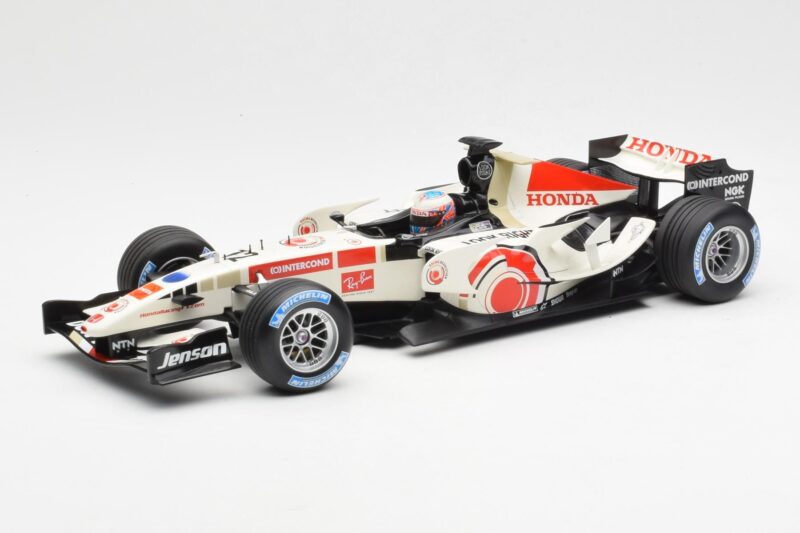
Minichamps' 1:18 diecast Honda RA106 recreates Jenson Button's breakthrough car from the rain-affected 2006 Hungarian Grand Prix, his first Formula 1 victory after 113 starts. Finished in Honda Racing's white, blue and red livery with car number 12, it marks the works team's most competitive season before financial pressure ended the project two years later. Diecast construction with a detailed cockpit and separately fitted aerodynamic parts keeps the livery and finish sharp at 1:18 scale.
1 / 6
[{"index":0,"id":"445523","thumb":"https:\/\/models118.co.uk\/wp-content\/uploads\/2026\/06\/f1-honda-racing-team-ra106-jenson-button-2006-minichamps-1-18-300x200.jpg","medium":"https:\/\/models118.co.uk\/wp-content\/uploads\/2026\/06\/f1-honda-racing-team-ra106-jenson-button-2006-minichamps-1-18-800x533.jpg","full":"https:\/\/models118.co.uk\/wp-content\/uploads\/2026\/06\/f1-honda-racing-team-ra106-jenson-button-2006-minichamps-1-18.jpg","srcset":"https:\/\/models118.co.uk\/wp-content\/uploads\/2026\/06\/f1-honda-racing-team-ra106-jenson-button-2006-minichamps-1-18-800x533.jpg 800w, https:\/\/models118.co.uk\/wp-content\/uploads\/2026\/06\/f1-honda-racing-team-ra106-jenson-button-2006-minichamps-1-18-64x43.jpg 64w, https:\/\/models118.co.uk\/wp-content\/uploads\/2026\/06\/f1-honda-racing-team-ra106-jenson-button-2006-minichamps-1-18-300x200.jpg 300w, https:\/\/models118.co.uk\/wp-content\/uploads\/2026\/06\/f1-honda-racing-team-ra106-jenson-button-2006-minichamps-1-18.jpg 1800w","sizes":"(max-width: 1023px) 400px, 640px","srcsetAvif":"https:\/\/models118.co.uk\/wp-content\/uploads\/2026\/06\/f1-honda-racing-team-ra106-jenson-button-2006-minichamps-1-18-800x533.jpg.avif 800w, https:\/\/models118.co.uk\/wp-content\/uploads\/2026\/06\/f1-honda-racing-team-ra106-jenson-button-2006-minichamps-1-18-64x43.jpg.avif 64w, https:\/\/models118.co.uk\/wp-content\/uploads\/2026\/06\/f1-honda-racing-team-ra106-jenson-button-2006-minichamps-1-18-300x200.jpg.avif 300w, https:\/\/models118.co.uk\/wp-content\/uploads\/2026\/06\/f1-honda-racing-team-ra106-jenson-button-2006-minichamps-1-18.jpg.avif 1800w","srcsetWebp":"https:\/\/models118.co.uk\/wp-content\/uploads\/2026\/06\/f1-honda-racing-team-ra106-jenson-button-2006-minichamps-1-18-800x533.jpg.webp 800w, https:\/\/models118.co.uk\/wp-content\/uploads\/2026\/06\/f1-honda-racing-team-ra106-jenson-button-2006-minichamps-1-18-64x43.jpg.webp 64w, https:\/\/models118.co.uk\/wp-content\/uploads\/2026\/06\/f1-honda-racing-team-ra106-jenson-button-2006-minichamps-1-18-300x200.jpg.webp 300w, https:\/\/models118.co.uk\/wp-content\/uploads\/2026\/06\/f1-honda-racing-team-ra106-jenson-button-2006-minichamps-1-18.jpg.webp 1800w","alt":"Honda Racing Team RA106 #12 J. Button F1 2006 Minichamps 1:18 100060012 Diecast"},{"index":1,"id":445550,"thumb":"https:\/\/models118.co.uk\/wp-content\/uploads\/2026\/06\/f1-honda-racing-team-ra106-jenson-button-2006-minichamps-1-18-1-300x200.jpg","medium":"https:\/\/models118.co.uk\/wp-content\/uploads\/2026\/06\/f1-honda-racing-team-ra106-jenson-button-2006-minichamps-1-18-1-800x533.jpg","full":"https:\/\/models118.co.uk\/wp-content\/uploads\/2026\/06\/f1-honda-racing-team-ra106-jenson-button-2006-minichamps-1-18-1.jpg","srcset":"https:\/\/models118.co.uk\/wp-content\/uploads\/2026\/06\/f1-honda-racing-team-ra106-jenson-button-2006-minichamps-1-18-1-800x533.jpg 800w, https:\/\/models118.co.uk\/wp-content\/uploads\/2026\/06\/f1-honda-racing-team-ra106-jenson-button-2006-minichamps-1-18-1-64x43.jpg 64w, https:\/\/models118.co.uk\/wp-content\/uploads\/2026\/06\/f1-honda-racing-team-ra106-jenson-button-2006-minichamps-1-18-1-300x200.jpg 300w, https:\/\/models118.co.uk\/wp-content\/uploads\/2026\/06\/f1-honda-racing-team-ra106-jenson-button-2006-minichamps-1-18-1.jpg 1800w","sizes":"(max-width: 1023px) 400px, 640px","srcsetAvif":"https:\/\/models118.co.uk\/wp-content\/uploads\/2026\/06\/f1-honda-racing-team-ra106-jenson-button-2006-minichamps-1-18-1-800x533.jpg.avif 800w, https:\/\/models118.co.uk\/wp-content\/uploads\/2026\/06\/f1-honda-racing-team-ra106-jenson-button-2006-minichamps-1-18-1-64x43.jpg.avif 64w, https:\/\/models118.co.uk\/wp-content\/uploads\/2026\/06\/f1-honda-racing-team-ra106-jenson-button-2006-minichamps-1-18-1-300x200.jpg.avif 300w, https:\/\/models118.co.uk\/wp-content\/uploads\/2026\/06\/f1-honda-racing-team-ra106-jenson-button-2006-minichamps-1-18-1.jpg.avif 1800w","srcsetWebp":"https:\/\/models118.co.uk\/wp-content\/uploads\/2026\/06\/f1-honda-racing-team-ra106-jenson-button-2006-minichamps-1-18-1-800x533.jpg.webp 800w, https:\/\/models118.co.uk\/wp-content\/uploads\/2026\/06\/f1-honda-racing-team-ra106-jenson-button-2006-minichamps-1-18-1-64x43.jpg.webp 64w, https:\/\/models118.co.uk\/wp-content\/uploads\/2026\/06\/f1-honda-racing-team-ra106-jenson-button-2006-minichamps-1-18-1-300x200.jpg.webp 300w, https:\/\/models118.co.uk\/wp-content\/uploads\/2026\/06\/f1-honda-racing-team-ra106-jenson-button-2006-minichamps-1-18-1.jpg.webp 1800w","alt":"Honda Racing Team RA106 #12 J. Button F1 2006 Minichamps 1:18 100060012 Diecast \u2014 photo 2 of 6"},{"index":2,"id":445577,"thumb":"https:\/\/models118.co.uk\/wp-content\/uploads\/2026\/06\/f1-honda-racing-team-ra106-jenson-button-2006-minichamps-1-18-2-300x200.jpg","medium":"https:\/\/models118.co.uk\/wp-content\/uploads\/2026\/06\/f1-honda-racing-team-ra106-jenson-button-2006-minichamps-1-18-2-800x533.jpg","full":"https:\/\/models118.co.uk\/wp-content\/uploads\/2026\/06\/f1-honda-racing-team-ra106-jenson-button-2006-minichamps-1-18-2.jpg","srcset":"https:\/\/models118.co.uk\/wp-content\/uploads\/2026\/06\/f1-honda-racing-team-ra106-jenson-button-2006-minichamps-1-18-2-800x533.jpg 800w, https:\/\/models118.co.uk\/wp-content\/uploads\/2026\/06\/f1-honda-racing-team-ra106-jenson-button-2006-minichamps-1-18-2-64x43.jpg 64w, https:\/\/models118.co.uk\/wp-content\/uploads\/2026\/06\/f1-honda-racing-team-ra106-jenson-button-2006-minichamps-1-18-2-300x200.jpg 300w, https:\/\/models118.co.uk\/wp-content\/uploads\/2026\/06\/f1-honda-racing-team-ra106-jenson-button-2006-minichamps-1-18-2.jpg 1800w","sizes":"(max-width: 1023px) 400px, 640px","srcsetAvif":"https:\/\/models118.co.uk\/wp-content\/uploads\/2026\/06\/f1-honda-racing-team-ra106-jenson-button-2006-minichamps-1-18-2-800x533.jpg.avif 800w, https:\/\/models118.co.uk\/wp-content\/uploads\/2026\/06\/f1-honda-racing-team-ra106-jenson-button-2006-minichamps-1-18-2-64x43.jpg.avif 64w, https:\/\/models118.co.uk\/wp-content\/uploads\/2026\/06\/f1-honda-racing-team-ra106-jenson-button-2006-minichamps-1-18-2-300x200.jpg.avif 300w, https:\/\/models118.co.uk\/wp-content\/uploads\/2026\/06\/f1-honda-racing-team-ra106-jenson-button-2006-minichamps-1-18-2.jpg.avif 1800w","srcsetWebp":"https:\/\/models118.co.uk\/wp-content\/uploads\/2026\/06\/f1-honda-racing-team-ra106-jenson-button-2006-minichamps-1-18-2-800x533.jpg.webp 800w, https:\/\/models118.co.uk\/wp-content\/uploads\/2026\/06\/f1-honda-racing-team-ra106-jenson-button-2006-minichamps-1-18-2-64x43.jpg.webp 64w, https:\/\/models118.co.uk\/wp-content\/uploads\/2026\/06\/f1-honda-racing-team-ra106-jenson-button-2006-minichamps-1-18-2-300x200.jpg.webp 300w, https:\/\/models118.co.uk\/wp-content\/uploads\/2026\/06\/f1-honda-racing-team-ra106-jenson-button-2006-minichamps-1-18-2.jpg.webp 1800w","alt":"Honda Racing Team RA106 #12 J. Button F1 2006 Minichamps 1:18 100060012 Diecast \u2014 photo 3 of 6"},{"index":3,"id":445604,"thumb":"https:\/\/models118.co.uk\/wp-content\/uploads\/2026\/06\/f1-honda-racing-team-ra106-jenson-button-2006-minichamps-1-18-3-300x200.jpg","medium":"https:\/\/models118.co.uk\/wp-content\/uploads\/2026\/06\/f1-honda-racing-team-ra106-jenson-button-2006-minichamps-1-18-3-800x533.jpg","full":"https:\/\/models118.co.uk\/wp-content\/uploads\/2026\/06\/f1-honda-racing-team-ra106-jenson-button-2006-minichamps-1-18-3.jpg","srcset":"https:\/\/models118.co.uk\/wp-content\/uploads\/2026\/06\/f1-honda-racing-team-ra106-jenson-button-2006-minichamps-1-18-3-800x533.jpg 800w, https:\/\/models118.co.uk\/wp-content\/uploads\/2026\/06\/f1-honda-racing-team-ra106-jenson-button-2006-minichamps-1-18-3-64x43.jpg 64w, https:\/\/models118.co.uk\/wp-content\/uploads\/2026\/06\/f1-honda-racing-team-ra106-jenson-button-2006-minichamps-1-18-3-300x200.jpg 300w, https:\/\/models118.co.uk\/wp-content\/uploads\/2026\/06\/f1-honda-racing-team-ra106-jenson-button-2006-minichamps-1-18-3.jpg 1800w","sizes":"(max-width: 1023px) 400px, 640px","srcsetAvif":"https:\/\/models118.co.uk\/wp-content\/uploads\/2026\/06\/f1-honda-racing-team-ra106-jenson-button-2006-minichamps-1-18-3-800x533.jpg.avif 800w, https:\/\/models118.co.uk\/wp-content\/uploads\/2026\/06\/f1-honda-racing-team-ra106-jenson-button-2006-minichamps-1-18-3-64x43.jpg.avif 64w, https:\/\/models118.co.uk\/wp-content\/uploads\/2026\/06\/f1-honda-racing-team-ra106-jenson-button-2006-minichamps-1-18-3-300x200.jpg.avif 300w, https:\/\/models118.co.uk\/wp-content\/uploads\/2026\/06\/f1-honda-racing-team-ra106-jenson-button-2006-minichamps-1-18-3.jpg.avif 1800w","srcsetWebp":"https:\/\/models118.co.uk\/wp-content\/uploads\/2026\/06\/f1-honda-racing-team-ra106-jenson-button-2006-minichamps-1-18-3-800x533.jpg.webp 800w, https:\/\/models118.co.uk\/wp-content\/uploads\/2026\/06\/f1-honda-racing-team-ra106-jenson-button-2006-minichamps-1-18-3-64x43.jpg.webp 64w, https:\/\/models118.co.uk\/wp-content\/uploads\/2026\/06\/f1-honda-racing-team-ra106-jenson-button-2006-minichamps-1-18-3-300x200.jpg.webp 300w, https:\/\/models118.co.uk\/wp-content\/uploads\/2026\/06\/f1-honda-racing-team-ra106-jenson-button-2006-minichamps-1-18-3.jpg.webp 1800w","alt":"Honda Racing Team RA106 #12 J. Button F1 2006 Minichamps 1:18 100060012 Diecast \u2014 photo 4 of 6"},{"index":4,"id":445631,"thumb":"https:\/\/models118.co.uk\/wp-content\/uploads\/2026\/06\/f1-honda-racing-team-ra106-jenson-button-2006-minichamps-1-18-4-300x200.jpg","medium":"https:\/\/models118.co.uk\/wp-content\/uploads\/2026\/06\/f1-honda-racing-team-ra106-jenson-button-2006-minichamps-1-18-4-800x533.jpg","full":"https:\/\/models118.co.uk\/wp-content\/uploads\/2026\/06\/f1-honda-racing-team-ra106-jenson-button-2006-minichamps-1-18-4.jpg","srcset":"https:\/\/models118.co.uk\/wp-content\/uploads\/2026\/06\/f1-honda-racing-team-ra106-jenson-button-2006-minichamps-1-18-4-800x533.jpg 800w, https:\/\/models118.co.uk\/wp-content\/uploads\/2026\/06\/f1-honda-racing-team-ra106-jenson-button-2006-minichamps-1-18-4-64x43.jpg 64w, https:\/\/models118.co.uk\/wp-content\/uploads\/2026\/06\/f1-honda-racing-team-ra106-jenson-button-2006-minichamps-1-18-4-300x200.jpg 300w, https:\/\/models118.co.uk\/wp-content\/uploads\/2026\/06\/f1-honda-racing-team-ra106-jenson-button-2006-minichamps-1-18-4.jpg 1800w","sizes":"(max-width: 1023px) 400px, 640px","srcsetAvif":"https:\/\/models118.co.uk\/wp-content\/uploads\/2026\/06\/f1-honda-racing-team-ra106-jenson-button-2006-minichamps-1-18-4-800x533.jpg.avif 800w, https:\/\/models118.co.uk\/wp-content\/uploads\/2026\/06\/f1-honda-racing-team-ra106-jenson-button-2006-minichamps-1-18-4-64x43.jpg.avif 64w, https:\/\/models118.co.uk\/wp-content\/uploads\/2026\/06\/f1-honda-racing-team-ra106-jenson-button-2006-minichamps-1-18-4-300x200.jpg.avif 300w, https:\/\/models118.co.uk\/wp-content\/uploads\/2026\/06\/f1-honda-racing-team-ra106-jenson-button-2006-minichamps-1-18-4.jpg.avif 1800w","srcsetWebp":"https:\/\/models118.co.uk\/wp-content\/uploads\/2026\/06\/f1-honda-racing-team-ra106-jenson-button-2006-minichamps-1-18-4-800x533.jpg.webp 800w, https:\/\/models118.co.uk\/wp-content\/uploads\/2026\/06\/f1-honda-racing-team-ra106-jenson-button-2006-minichamps-1-18-4-64x43.jpg.webp 64w, https:\/\/models118.co.uk\/wp-content\/uploads\/2026\/06\/f1-honda-racing-team-ra106-jenson-button-2006-minichamps-1-18-4-300x200.jpg.webp 300w, https:\/\/models118.co.uk\/wp-content\/uploads\/2026\/06\/f1-honda-racing-team-ra106-jenson-button-2006-minichamps-1-18-4.jpg.webp 1800w","alt":"Honda Racing Team RA106 #12 J. Button F1 2006 Minichamps 1:18 100060012 Diecast \u2014 photo 5 of 6"},{"index":5,"id":445658,"thumb":"https:\/\/models118.co.uk\/wp-content\/uploads\/2026\/06\/f1-honda-racing-team-ra106-jenson-button-2006-minichamps-1-18-5-300x200.jpg","medium":"https:\/\/models118.co.uk\/wp-content\/uploads\/2026\/06\/f1-honda-racing-team-ra106-jenson-button-2006-minichamps-1-18-5-800x533.jpg","full":"https:\/\/models118.co.uk\/wp-content\/uploads\/2026\/06\/f1-honda-racing-team-ra106-jenson-button-2006-minichamps-1-18-5.jpg","srcset":"https:\/\/models118.co.uk\/wp-content\/uploads\/2026\/06\/f1-honda-racing-team-ra106-jenson-button-2006-minichamps-1-18-5-800x533.jpg 800w, https:\/\/models118.co.uk\/wp-content\/uploads\/2026\/06\/f1-honda-racing-team-ra106-jenson-button-2006-minichamps-1-18-5-64x43.jpg 64w, https:\/\/models118.co.uk\/wp-content\/uploads\/2026\/06\/f1-honda-racing-team-ra106-jenson-button-2006-minichamps-1-18-5-300x200.jpg 300w, https:\/\/models118.co.uk\/wp-content\/uploads\/2026\/06\/f1-honda-racing-team-ra106-jenson-button-2006-minichamps-1-18-5.jpg 1800w","sizes":"(max-width: 1023px) 400px, 640px","srcsetAvif":"https:\/\/models118.co.uk\/wp-content\/uploads\/2026\/06\/f1-honda-racing-team-ra106-jenson-button-2006-minichamps-1-18-5-800x533.jpg.avif 800w, https:\/\/models118.co.uk\/wp-content\/uploads\/2026\/06\/f1-honda-racing-team-ra106-jenson-button-2006-minichamps-1-18-5-64x43.jpg.avif 64w, https:\/\/models118.co.uk\/wp-content\/uploads\/2026\/06\/f1-honda-racing-team-ra106-jenson-button-2006-minichamps-1-18-5-300x200.jpg.avif 300w, https:\/\/models118.co.uk\/wp-content\/uploads\/2026\/06\/f1-honda-racing-team-ra106-jenson-button-2006-minichamps-1-18-5.jpg.avif 1800w","srcsetWebp":"https:\/\/models118.co.uk\/wp-content\/uploads\/2026\/06\/f1-honda-racing-team-ra106-jenson-button-2006-minichamps-1-18-5-800x533.jpg.webp 800w, https:\/\/models118.co.uk\/wp-content\/uploads\/2026\/06\/f1-honda-racing-team-ra106-jenson-button-2006-minichamps-1-18-5-64x43.jpg.webp 64w, https:\/\/models118.co.uk\/wp-content\/uploads\/2026\/06\/f1-honda-racing-team-ra106-jenson-button-2006-minichamps-1-18-5-300x200.jpg.webp 300w, https:\/\/models118.co.uk\/wp-content\/uploads\/2026\/06\/f1-honda-racing-team-ra106-jenson-button-2006-minichamps-1-18-5.jpg.webp 1800w","alt":"Honda Racing Team RA106 #12 J. Button F1 2006 Minichamps 1:18 100060012 Diecast \u2014 photo 6 of 6"}]
Honda Racing Team RA106 #12 J. Button F1 2006 Minichamps 1:18
Current price:£139.00
Out of production
This model is currently sold out.Enter your email and we'll let you know when it's back in stock.
About the Honda Racing Team RA106 #12 J. Button F1 2006 Minichamps 1:18
TL;DR: Minichamps' 1:18 diecast reproduces the Honda RA106 that Jenson Button raced to his first Formula 1 victory at the rain-affected 2006 Hungarian Grand Prix. Finished in Honda Racing's livery with car number 12, it marks a genuine breakthrough season for both driver and manufacturer.
Maiden wins do not come often in Formula 1, and Jenson Button waited six seasons for his. Minichamps captures the Honda RA106 exactly as it looked that wet Sunday in Budapest, a car worth owning for the story alone. That single result reshaped how Honda's short-lived works project is remembered, turning a car that might otherwise be a footnote into a genuine collector's target.
Minichamps' Honda RA106 in 1:18 Diecast
Honda Racing Livery and Number 12 Graphics
Honda Racing's white, blue and red scheme covers the RA106 in clean, well-separated panels, with car number 12 sitting correctly on the nose and sidepods for Button's 2006 entry. Minichamps keeps the smaller sponsor decals along the sidepod flanks and rear wing legible rather than reduced to an indistinct printed block, and the factory Honda badge on the nose reads sharply even at this scale. That level of registration matters most on a livery built from flat panels rather than complex graphics.
Construction and Cockpit Detail
The zinc alloy body has a reassuring weight in the hand, with the front wing, mirrors and aerial fitted separately to keep those slender aerodynamic elements in proportion rather than moulded thick into the main casting. The cockpit shows a modelled steering wheel and harness, and the raised airbox above the driver's head reflects the 2.4-litre V8 that replaced the previous decade's V10s for 2006. Checking that airbox shape and the sidepod undercut against period photographs is the quickest way to judge how faithfully a Formula 1 diecast has captured its subject.
Button's Breakthrough Season with Honda
A Maiden Win at the Hungarian Grand Prix
Button started the 2006 Hungarian Grand Prix from a lowly grid position after a mechanical issue in qualifying, then worked through a rain-hit race to take his first Grand Prix victory after 113 starts. Rain fell intermittently through the afternoon, scrambling tyre strategy for the whole field, and Button's Honda emerged from the chaos ahead of faster cars that had started higher on the grid. It remains one of the more celebrated breakthroughs in modern Formula 1.
Honda's Works Return to Formula 1
Honda returned to Formula 1 as a full works constructor for 2006 after buying out the BAR team it had previously supplied engines to, based at Brackley in England. The works effort ran only through 2008 before Honda withdrew amid the global financial crisis, and the same Brackley team went on to become Brawn GP in 2009, winning the championship with Button still in the cockpit. That connection gives the RA106 a slightly unusual place in Formula 1 history: a works team's promising early season that fed into a completely different, and far more successful, outfit under new ownership.
A Season-Defining Car for a Button or Honda Collection
For a Button collection, the RA106 is close to essential: it is the car that turned a respected but winless midfield driver into a Grand Prix winner, three years before his championship season arrived in different colours. For a Honda collection, it captures the works team at its most competitive, before the financial pressures that ended the project. At roughly 20 centimetres, the model sits comfortably alongside other mid-2000s V8-era single-seaters, and pairing it with a Brawn GP or later McLaren Button model traces a driver's career across three very different liveries. Judging the model's fidelity is straightforward with a well-documented subject like this one: check the airbox intake, the sidepod undercut, and the rear wing endplate shape against period photography, since those are the panels a rushed tampo-print job most often gets wrong. Kept out of direct sunlight, the printed graphics should hold their colour for years, with routine dusting the only upkeep a display cabinet demands.
Create a free account and claim 10% off your first order — from hundreds of collectible 1:18, 1:43 and 1:12 models by Porsche, Mercedes-Benz, BMW and more.
{"id":452547,"name":"Honda Racing Team RA106 #12 J. Button F1 2006 Minichamps 1:18","price":"£<\/span>139.00<\/bdi><\/span>","image":"https:\/\/models118.co.uk\/wp-content\/uploads\/2026\/06\/f1-honda-racing-team-ra106-jenson-button-2006-minichamps-1-18-400x400.jpg","permalink":"https:\/\/models118.co.uk\/honda-racing-team-ra106-12-j-button-f1-2006-minichamps-1-18-100060012\/","brand":"Honda"}