Used

Ford Focus RS WRC #4 R. Kresta / J. Tomanek Rally Monte Carlo 2005 Minichamps 1:43
Only 2 left
Price:
£89.00
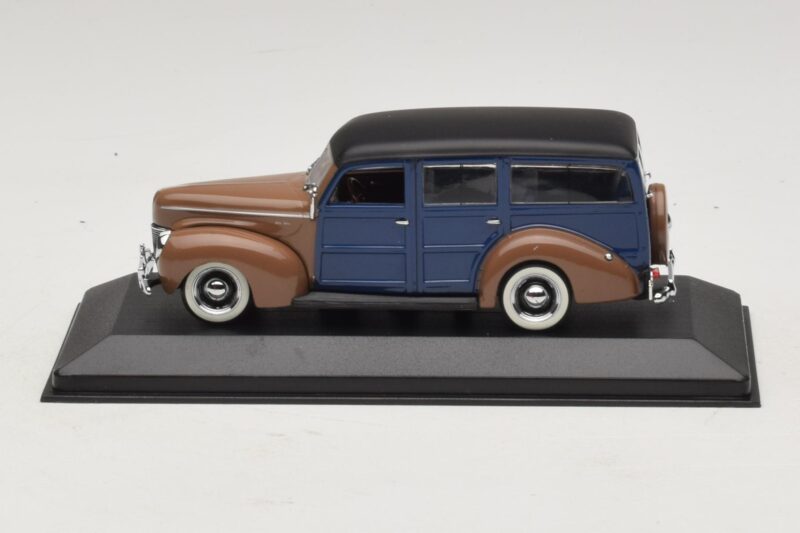
TL;DR: Minichamps' 1:43 diecast Ford V8 De Luxe Woody Station Wagon in Brown and Blue reproduces the 1940 estate built around Ford's flathead V8 and coachbuilt timber bodywork. The sealed zinc alloy shell holds crisp wood-grain panelling rather than opening doors, an unusual body style for most 1940s Ford shelves.
Ford's flathead V8 democratised eight-cylinder power for ordinary American buyers through the 1930s, and by 1940 that engine sat beneath one of the most distinctive body styles Ford ever offered: a station wagon with genuine structural timber framing rather than painted steel pretending otherwise, built in limited numbers even by the standards of the period.
Ford's flathead V8, introduced in 1932, brought V8 power within reach of mainstream buyers at a time when eight cylinders had been the preserve of luxury marques, and by 1940 it had matured into a reliable, well-understood engine underpinning the entire De Luxe range. The Woody wagon body took that mechanical foundation and paired it with genuine structural timber framing, typically ash or maple, supplied and fitted by specialist coachbuilders rather than produced entirely in-house on Ford's own body-in-white lines. That construction method made the wagon considerably more expensive and labour-intensive to build than a standard steel-bodied saloon, and production numbers stayed correspondingly low, making a well-preserved original wagon a genuinely scarce survivor today.
The Brown and Blue combination on this casting reflects the two-tone approach period wagons commonly used to separate the timber-effect panelling from the painted steel sections, front fenders, roof and lower body typically finished in a solid colour while the wood-grain sides carried their own distinct treatment. Getting that separation clean matters enormously on this subject, since a poorly defined boundary between paint and wood-grain effect undermines the entire visual point of a woody wagon. Minichamps keeps the two finishes distinct rather than letting one bleed into the other, preserving the two-tone character the real car depended on.
With no opening doors, tailgate or bonnet on this casting, the wood-grain panelling has to carry its own convincing texture entirely through moulding and paint rather than through a glimpse of genuine structural framing behind an opened door. Minichamps defines each simulated wood panel with distinct grain lines and separate panel sections rather than a single repeating pattern stretched across the body, which is what makes a diecast woody read as a considered subject rather than a novelty. The estate's long, slab-sided profile stays cleanly defined from nose to tailgate, with the roofline sitting appropriately high for genuine load-carrying practicality rather than styled purely for looks.
Chrome trim around the windscreen, headlamp surrounds and bumpers provides the metallic contrast a wood-effect body needs to avoid looking uniformly flat, and Minichamps applies that trim with clean, consistent edges rather than letting it blur into the surrounding paintwork. The wheels follow the era's narrower profile with the correct hubcap style for a 1940 De Luxe, and the running boards along each flank carry through the same careful separation between finishes that defines the rest of the body.
Most 1940s American diecast ranges lean toward saloons and coupes, which makes a genuine woody wagon a distinctive, less commonly represented body style worth seeking out for anyone building a rounded pre-war American shelf. Its estate profile and unusual two-finish construction give it a visual identity that no saloon from the same era can match, and it pairs naturally with a Model A coupe from the same manufacturer to trace Ford's body-style range across more than a decade. Priced in line with other detailed 1:43 vintage subjects, it suits collectors who value variety of body type over chasing a single marque's saloon lineup exclusively, and it earns its shelf space through genuine rarity of subject rather than through motorsport pedigree.






Save £14.00