{"ajaxurl":"https:\/\/models118.co.uk\/wp-admin\/admin-ajax.php?lang=en_GB","nonce":"a4c944ccd6","homeUrl":"https:\/\/models118.co.uk\/","shopUrl":"https:\/\/models118.co.uk\/shop\/","cartUrl":"https:\/\/models118.co.uk\/cart-en-gb\/","checkoutUrl":"https:\/\/models118.co.uk\/checkout\/","skipCart":true,"collectionLimit":12,"i18n":{"addedToCart":"Added to basket","addToWishlist":"Add to wishlist","addedToWishlist":"Added to wishlist","removeFromWishlist":"Remove from wishlist","removedFromWishlist":"Removed from wishlist","undo":"Undo","error":"Something went wrong","loading":"Loading...","outOfStock":"Out of stock","viewCart":"View basket","proceedToCheckout":"Proceed to checkout","addedToCollection":"Added to your collection","reserved":"Added to your collection","soldOut":"Sold out","invalidEmail":"Please enter a valid email address","connectionError":"Connection error. Please try again.","tocToggle":"On this page","close":"Close","inCartTooltip":"Already in your basket \u2013 open your basket to check out","loginToSave":"Sign in to save this model","waitlistNotify":"Notify me","waitlistOnList":"On the waiting list \u2713","waitlistJoined":"You're on the waiting list. We'll email you the moment this model is available again.","waitlistRemoved":"Done \u2014 you're off the waiting list for this model.","waitlistRateLimit":"Too many attempts \u2014 please try again shortly","waitlistTurnstile":"We couldn't complete the check \u2014 please try again","waitlistError":"Sorry, something went wrong. Please try again in a moment."},"wishlist":{"loggedIn":false,"loginUrl":"https:\/\/models118.co.uk\/my-account\/","addAction":"models118_wishlist_add","removeAction":"models118_wishlist_remove"},"waitlist":{"loggedIn":false,"subscribeAction":"models118_waitlist_subscribe","toggleAction":"models118_waitlist_toggle","stateAction":"models118_waitlist_state"},"stats":{"models":2665,"brands":215,"manufacturers":129,"collectors":10000},"product":{"id":1703993,"sku":"940084101","condition":"new","availability":"in_stock","name":"Ford Escort Mk2 Orange Maxichamps 1:43","brand":"Ford","manufacturer":"Maxichamps","scale":"1:43","material":"Diecast","price":42,"regularPrice":42,"isOnSale":false,"savingsAmount":0,"stockQty":2,"stockStatus":"very_low","isDiscontinued":false,"image":"https:\/\/models118.co.uk\/wp-content\/uploads\/2026\/10\/ford-escort-mk2-orange-maxichamps-1-43-940084101-1-1-300x200.jpg","permalink":"https:\/\/models118.co.uk\/ford-escort-mk2-orange-maxichamps-1-43-940084101\/"}}
Cookies on Models118
We use cookies to remember your preferences, understand how the shop is used and show you models and offers that suit your interests. What you allow is up to you, and you can change it at any time.
Always active
The technical storage or access is strictly necessary for the legitimate purpose of enabling the use of a specific service explicitly requested by the subscriber or user, or for the sole purpose of carrying out the transmission of a communication over an electronic communications network.
The technical storage or access is necessary for the legitimate purpose of storing preferences that are not requested by the subscriber or user.
The technical storage or access that is used exclusively for statistical purposes.
The technical storage or access is required to create user profiles to send advertising, or to track the user on a website or across several websites for similar marketing purposes.
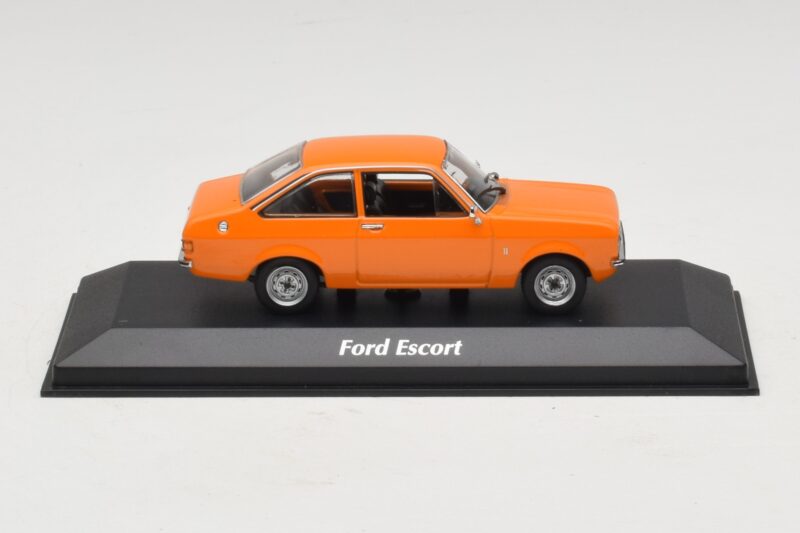
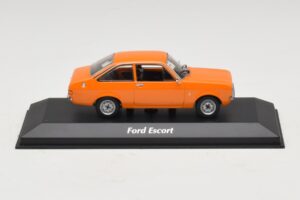
Maxichamps' 1:43 Ford Escort Mk2 in orange is a diecast saloon with a sealed one-piece body, reproducing the square-cut 1975 shape. Its large flat panels make the paint depth and shut lines easy to judge. At around 9 cm it adds a plain, honest 1970s family car to a shelf of sports models, with the weight of zinc alloy behind it.
TL;DR: The Maxichamps Ford Escort Mk2 Orange is a 1:43 diecast saloon from the 1975 generation, cast as a sealed one-piece body. Its flat panels and square glasshouse make paint depth and shut lines the points to judge, and at around 9 cm it suits a compact 1970s Ford display.
Few shapes say 1970s Britain as plainly as the Mk2 Escort. Square, upright and unfussy, it replaced the Mk1 in 1975 and kept rear-wheel drive until the front-drive Mk3 arrived at the turn of the decade. Maxichamps captures it at 1:43 in orange, a colour that suits straight-edged bodywork far better than it would a rounded car.
Maxichamps Ford Escort Mk2 in Orange
A Square-Cut Saloon From 1975
The Mk2 was built on the Mk1's underpinnings but wore a crisper, boxier body with a large glasshouse and a flat, wide front. Production ran into 1980, so the shape was everywhere on British roads for the rest of the decade, as family transport and, in other forms, as a club rally car. This model represents the road saloon. Its appeal as a miniature is partly that familiarity; for plenty of collectors it is the car that was parked outside the house.
Flat Panels and Where the Paint Shows
A boxy car is harder to flatter than a curvy one. There are no sweeping curves to hide a thin finish, so large flat panels give the orange every chance to show its depth, or its weakness. Look along the bonnet and roof in raking light. A well-applied finish reads as a smooth, continuous surface, and the casting underneath should show no ripples or sink marks. Check the orange for consistency from one side to the other; a shift in tone along the body suggests uneven application. The generous glass area is the other place a finish shows its quality, so study the window frames too. Diecast helps here, since a metal shell is rigid enough to keep wide panels true.
Zinc Alloy and a Fixed Shell at 1:43
Why Boxy Cars Suit Diecast
Straight edges and flat sides are friendly to pressure casting. A die forms them cleanly, with fewer of the fine compound curves where a metal casting loses crispness against resin. That is one reason a square-bodied saloon like the Escort often looks more convincing in diecast than a heavily curved sports car does at the same scale. The weight is a bonus: a body this size in zinc alloy has a pleasing density, and it will not warp or flex on a shelf over the years.
Inspecting Glass, Grille and Wheels
This model has no opening panels, so inspection is all external. Start with the grille and headlamp area, the face of the car, then check the glazing for a flush fit and clean edges. Wheels and tyres come next: the offset and the stance say more about accuracy than any single detail. Badges at this scale are printed rather than fitted, so judge them by legibility and registration. Because everything is fixed, there is nowhere for a flaw to hide, which is exactly why a flat-sided car rewards careful buying. A sealed shell is also robust to handle.
A Starting Point for a Rear-Drive Ford Shelf
At 1:43 the Escort measures somewhere around 9 cm, so several can share a shelf without crowding. The later front-drive Escort and the Capri of the same period are natural companions for anyone tracing Ford's 1970s family cars, and the colour contrast between an orange car and a darker neighbour makes a lively row. This is an accessible diecast rather than a hand-finished resin, so expect clean casting and tidy printing, not separately fitted micro parts. For collectors who remember the real thing, or want a plain 1970s saloon beside their sports models, it fills a gap sports-car shelves often have. Keep it away from strong direct sunlight, and a closed case stops dust gathering in the panel lines.
Create a free account and claim 5% off your first order — from hundreds of collectible 1:18, 1:43 and 1:12 models by Porsche, Mercedes-Benz, BMW and more.