{"ajaxurl":"https:\/\/models118.co.uk\/wp-admin\/admin-ajax.php?lang=en_GB","nonce":"55d93b5436","homeUrl":"https:\/\/models118.co.uk\/","shopUrl":"https:\/\/models118.co.uk\/shop\/","cartUrl":"https:\/\/models118.co.uk\/cart-en-gb\/","checkoutUrl":"https:\/\/models118.co.uk\/checkout\/","skipCart":true,"collectionLimit":12,"i18n":{"addedToCart":"Added to basket","addToWishlist":"Add to wishlist","addedToWishlist":"Added to wishlist","removeFromWishlist":"Remove from wishlist","removedFromWishlist":"Removed from wishlist","undo":"Undo","error":"Something went wrong","loading":"Loading...","outOfStock":"Out of stock","viewCart":"View basket","proceedToCheckout":"Proceed to checkout","addedToCollection":"Added to your collection","reserved":"Added to your collection","soldOut":"Sold out","invalidEmail":"Please enter a valid email address","connectionError":"Connection error. Please try again.","tocToggle":"On this page","close":"Close","inCartTooltip":"Already in your basket \u2013 open your basket to check out","loginToSave":"Sign in to save this model","waitlistNotify":"Notify me","waitlistOnList":"On the waiting list \u2713","waitlistJoined":"You're on the waiting list. We'll email you the moment this model is available again.","waitlistRemoved":"Done \u2014 you're off the waiting list for this model.","waitlistRateLimit":"Too many attempts \u2014 please try again shortly","waitlistTurnstile":"We couldn't complete the check \u2014 please try again","waitlistError":"Sorry, something went wrong. Please try again in a moment."},"wishlist":{"loggedIn":false,"loginUrl":"https:\/\/models118.co.uk\/my-account\/","addAction":"models118_wishlist_add","removeAction":"models118_wishlist_remove"},"waitlist":{"loggedIn":false,"subscribeAction":"models118_waitlist_subscribe","toggleAction":"models118_waitlist_toggle","stateAction":"models118_waitlist_state"},"stats":{"models":2281,"brands":213,"manufacturers":128,"collectors":10000},"product":{"id":614289,"sku":"100768432","condition":"used","availability":"out_of_stock","name":"Ford Escort II RS1800 #32 K. Ludwig N\u00fcrburgring Winner 1976 Minichamps 1:18","brand":"Ford","manufacturer":"Minichamps","scale":"1:18","material":"Diecast","price":194.17,"regularPrice":194.17,"isOnSale":false,"savingsAmount":0,"stockQty":0,"stockStatus":"out_of_stock","isDiscontinued":true,"image":"https:\/\/models118.co.uk\/wp-content\/uploads\/2026\/06\/ford-escort-ii-rs-1800-n32-kludwig-nbr-winner-1976-minichamps-1-18-300x200.jpg","permalink":"https:\/\/models118.co.uk\/ford-escort-ii-rs1800-32-k-ludwig-nurburgring-winner-1976-minichamps-1-18-100768432\/"}}
Cookies on Models118
We use cookies to remember your preferences, understand how the shop is used and show you models and offers that suit your interests. What you allow is up to you, and you can change it at any time.
Always active
The technical storage or access is strictly necessary for the legitimate purpose of enabling the use of a specific service explicitly requested by the subscriber or user, or for the sole purpose of carrying out the transmission of a communication over an electronic communications network.
The technical storage or access is necessary for the legitimate purpose of storing preferences that are not requested by the subscriber or user.
The technical storage or access that is used exclusively for statistical purposes.
The technical storage or access is required to create user profiles to send advertising, or to track the user on a website or across several websites for similar marketing purposes.
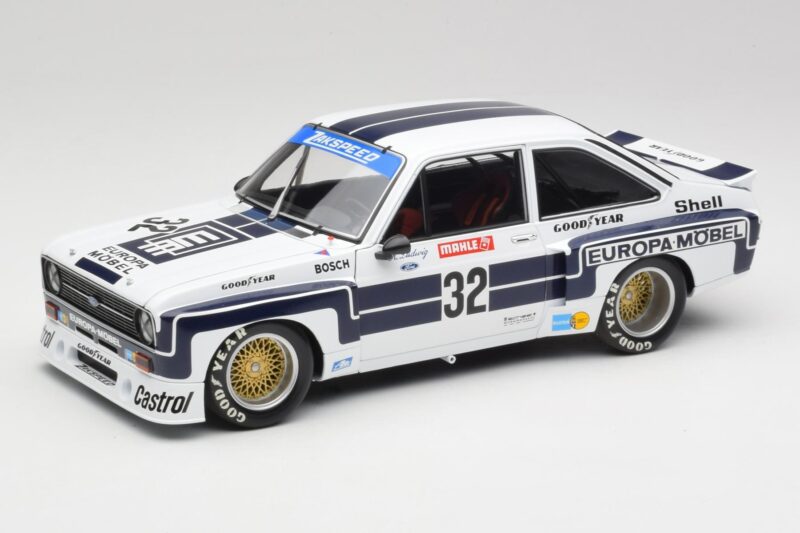
Ford Escort II RS1800 #32 K. Ludwig Nürburgring Winner 1976 Minichamps 1:18
Sold out
1/8
Minichamps' 1:18 diecast Ford Escort RS1800 reproduces Klaus Ludwig's 1976 Nürburgring-winning touring car, race number 32, built for circuit competition rather than rallying. Ludwig went on to become one of Germany's most decorated racing drivers, and this early win marks a formative step in that career. A strong pairing piece alongside rally-liveried Escorts for anyone tracking the RS1800's dual life on both stages and circuits.
About the Ford Escort II RS1800 #32 K. Ludwig Nürburgring Winner 1976 Minichamps 1:18
TL;DR: Minichamps' 1:18 diecast Ford Escort RS1800 reproduces Klaus Ludwig's 1976 Nürburgring-winning touring car, race number 32, built for circuit competition rather than forest-stage rallying. Ludwig later became one of Germany's most decorated drivers, and this early win marks a formative step in that trajectory.
The same Escort RS1800 that dominated rally forests also raced on circuits, and this diecast reproduces the touring car Klaus Ludwig drove to victory at the Nürburgring in 1976, years before his name became synonymous with German motorsport success at the very highest level.
The RS1800 as a Touring Car
Group Racing Regulations and Circuit Preparation
Circuit-prepared Escort RS1800s ran under different regulations from their rallying siblings, tuned for sustained lap-after-lap performance on smooth tarmac rather than the shock loading and suspension travel a forest stage demands. The Cosworth-developed BDA engine that powered the rally cars carried over, but circuit preparation focused development on sustained high-rev reliability and aerodynamic balance rather than off-road durability, a different engineering brief from the same basic mechanical package. Circuit racing in the mid-1970s also saw manufacturers and privateer teams experiment with aerodynamic aids and weight distribution changes that rally regulations restricted, giving touring car Escorts a subtly different visual character even where the bodyshell started from the same production line.
Klaus Ludwig's Formative Season
Klaus Ludwig's career would eventually stretch across DTM titles and outright Le Mans victories decades later, but in 1976 he was still establishing himself in national and international touring car competition. Winning at the Nürburgring in an Escort RS1800 placed him on a car that, while not a full factory works effort in the way Ford's rally programme was, still demanded the kind of precise, consistent driving that would define his later career at the top level of German motorsport.
Minichamps' Diecast Rendering of a Circuit Racer
Livery, Bonnet Detail and Circuit Aero
The livery on this diecast carries race number 32 in a circuit-racing scheme distinct from the rally graphics seen on works Boreham cars, a visual cue that separates this touring car variant at a glance. Lifting the bonnet reveals a detailed engine bay standing in for the circuit-tuned BDA unit, and the model's ride height reflects the lower, stiffer setup a circuit car ran compared with its rally-spec cousins built for suspension travel over rough ground. Diecast construction suits this subject in the same way it suits the rally version, letting the opening bonnet show off circuit-specific engine detail that a sealed resin casting would keep hidden.
Pairing a Circuit Escort with a Rally Escort
Displayed alongside a rally-liveried RS1800, this touring car shows how differently Ford's competition department, and independent teams running the same chassis, prepared the Escort for two entirely different disciplines using largely the same starting point. At around 22 centimetres, the model shares its footprint with the rally version, making direct comparison easy on a single shelf, stance, ride height and livery style all telling a different part of the RS1800's story depending on which discipline the car was built for. Buyers assembling a full RS1800 story often place both variants at opposite ends of a themed shelf, using contrasting liveries to draw the eye across the display before the shared underlying chassis becomes apparent on closer inspection.
Diecast Detail and Collecting Context for Circuit Racers
Why Circuit Liveries Reward Close Comparison
Circuit racing liveries from this period tend toward simpler, bolder graphics than rally cars, designed to be legible at speed on a closed circuit rather than to survive a season of mud and gravel. That difference is worth studying up close, since it reveals how two teams running the same underlying car made very different visual and engineering choices for their respective disciplines.
Long-Term Display Considerations
As with any diecast circuit car, keep the model out of direct sunlight to preserve the livery's contrast, and handle it by the body rather than the bonnet or doors to keep the opening hinges working smoothly across years of display.
Create a free account and claim 10% off your first order — from hundreds of collectible 1:18, 1:43 and 1:12 models by Porsche, Mercedes-Benz, BMW and more.
{"id":614289,"name":"Ford Escort II RS1800 #32 K. Ludwig N\u00fcrburgring Winner 1976 Minichamps 1:18","price":"£<\/span>194.17<\/bdi><\/span>","image":"https:\/\/models118.co.uk\/wp-content\/uploads\/2026\/06\/ford-escort-ii-rs-1800-n32-kludwig-nbr-winner-1976-minichamps-1-18-400x400.jpg","permalink":"https:\/\/models118.co.uk\/ford-escort-ii-rs1800-32-k-ludwig-nurburgring-winner-1976-minichamps-1-18-100768432\/","brand":"Ford"}