{"ajaxurl":"https:\/\/models118.co.uk\/wp-admin\/admin-ajax.php?lang=en_GB","nonce":"2258313ba7","homeUrl":"https:\/\/models118.co.uk\/","shopUrl":"https:\/\/models118.co.uk\/shop\/","cartUrl":"https:\/\/models118.co.uk\/cart-en-gb\/","checkoutUrl":"https:\/\/models118.co.uk\/checkout\/","skipCart":true,"collectionLimit":12,"i18n":{"addedToCart":"Added to basket","addToWishlist":"Add to wishlist","addedToWishlist":"Added to wishlist","removeFromWishlist":"Remove from wishlist","removedFromWishlist":"Removed from wishlist","undo":"Undo","error":"Something went wrong","loading":"Loading...","outOfStock":"Out of stock","viewCart":"View basket","proceedToCheckout":"Proceed to checkout","addedToCollection":"Added to your collection","reserved":"Added to your collection","soldOut":"Sold out","invalidEmail":"Please enter a valid email address","connectionError":"Connection error. Please try again.","tocToggle":"On this page","close":"Close","inCartTooltip":"Already in your basket \u2013 open your basket to check out","loginToSave":"Sign in to save this model","waitlistNotify":"Notify me","waitlistOnList":"On the waiting list \u2713","waitlistJoined":"You're on the waiting list. We'll email you the moment this model is available again.","waitlistRemoved":"Done \u2014 you're off the waiting list for this model.","waitlistRateLimit":"Too many attempts \u2014 please try again shortly","waitlistTurnstile":"We couldn't complete the check \u2014 please try again","waitlistError":"Sorry, something went wrong. Please try again in a moment."},"wishlist":{"loggedIn":false,"loginUrl":"https:\/\/models118.co.uk\/my-account\/","addAction":"models118_wishlist_add","removeAction":"models118_wishlist_remove"},"waitlist":{"loggedIn":false,"subscribeAction":"models118_waitlist_subscribe","toggleAction":"models118_waitlist_toggle","stateAction":"models118_waitlist_state"},"stats":{"models":2269,"brands":214,"manufacturers":129,"collectors":10000},"product":{"id":1688595,"sku":"180758003","condition":"new","availability":"in_stock","name":"Ford Capri RS3100 #3 K. Ludwig Hockenheimring DRM 1975 Minichamps 1:18","brand":"Ford","manufacturer":"Minichamps","scale":"1:18","material":"Diecast","price":185.83,"regularPrice":185.83,"isOnSale":false,"savingsAmount":0,"stockQty":1,"stockStatus":"very_low","isDiscontinued":false,"image":"https:\/\/models118.co.uk\/wp-content\/uploads\/2026\/10\/ford-capri-rs3100-3-k-ludwig-hockenheimring-drm-1975-minichamps-1-18-180758003-1-1-300x200.jpg","permalink":"https:\/\/models118.co.uk\/ford-capri-rs3100-3-k-ludwig-hockenheimring-drm-1975-minichamps-1-18-180758003\/"}}
Cookies on Models118
We use cookies to remember your preferences, understand how the shop is used and show you models and offers that suit your interests. What you allow is up to you, and you can change it at any time.
Always active
The technical storage or access is strictly necessary for the legitimate purpose of enabling the use of a specific service explicitly requested by the subscriber or user, or for the sole purpose of carrying out the transmission of a communication over an electronic communications network.
The technical storage or access is necessary for the legitimate purpose of storing preferences that are not requested by the subscriber or user.
The technical storage or access that is used exclusively for statistical purposes.
The technical storage or access is required to create user profiles to send advertising, or to track the user on a website or across several websites for similar marketing purposes.
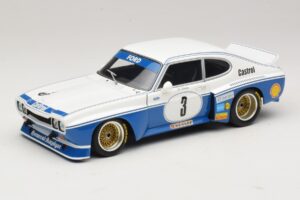
Ford Capri RS3100 #3 K. Ludwig Hockenheimring DRM 1975 Minichamps 1:18
New arrival
1/8
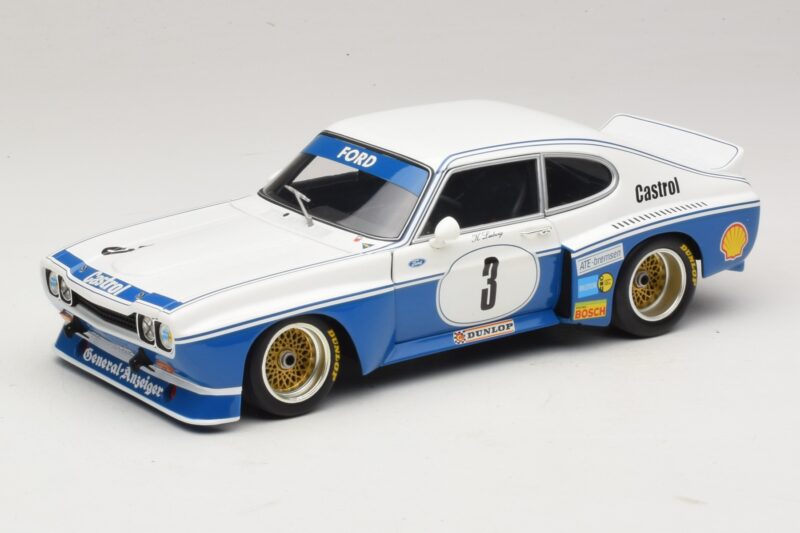
Minichamps' 1:18 diecast Ford Capri RS3100 reproduces Klaus Ludwig's #3 entry at the 1975 Deutsche Rennsport Meisterschaft round at Hockenheimring. Opening doors, bonnet and boot reveal period racing detail, while the wide-arch Group 2 bodywork is cast with the crisp edges diecast construction allows. A strong pick for a 1970s German touring car or early Ludwig career display.
About the Ford Capri RS3100 #3 K. Ludwig Hockenheimring DRM 1975 Minichamps 1:18
TL;DR: Minichamps' 1:18 diecast Ford Capri RS3100 reproduces Klaus Ludwig's #3 entry from the 1975 Deutsche Rennsport Meisterschaft round at Hockenheimring, with opening doors, bonnet and boot and the wide-arch Group 2 bodywork that defined mid-1970s German touring car racing.
Long before Klaus Ludwig became a touring car and Le Mans legend, he was cutting his teeth in Germany's Deutsche Rennsport Meisterschaft behind the wheel of cars like this Capri RS3100. Minichamps' rendition of his #3 Hockenheim entry captures an early chapter of a career that would eventually span decades and multiple disciplines of motorsport.
Minichamps' Diecast Build of the RS3100 Racer
Opening Panels and Cockpit Detail
The bonnet lifts to reveal the 3.1-litre Cologne V6 set well back in the bay, a configuration the real RS3100 used to balance the car for Group 2 competition. Doors open on functional hinges to show a stripped cabin with roll cage and racing seat, while the boot lid lifts to expose the fuel cell rather than ordinary luggage space. The panel gaps stay tight when everything is closed, a sign of careful tooling rather than a rushed homologation-special casting. Separately fitted mirrors, door handles and a quick-fill fuel cap add a further layer of three-dimensional detail that moulded-in equivalents cannot match. Even the windscreen surround and wiper detail hold their shape cleanly, small touches that separate a considered diecast from a mass-produced one.
Group 2 Arches and DRM Livery
Wide wheel arches, needed to clear the racing tyres Group 2 rules permitted, are cast with sharp definition rather than softened edges. The model carries real weight for its size, the signature of zinc alloy construction, and that mass translates into a paint finish with genuine depth under a display lamp. Ludwig's #3 livery, including period sponsor graphics and the DRM-era number treatment, is applied with clean registration across the flared bodywork. The wheels and period-correct tyre tread pattern fill those arches convincingly, avoiding the undersized look that affects many budget touring car models at this scale. The ride height sits correctly low, rather than the slightly raised stance some diecast touring cars default to.
Klaus Ludwig's Early Career and the DRM Era
Deutsche Rennsport Meisterschaft and Group 2 Racing
The Deutsche Rennsport Meisterschaft was West Germany's premier touring and sports car series through the 1970s, run largely to Group 2 regulations that rewarded manufacturers willing to homologate larger engines and wider bodywork. The Capri RS3100, developed by Ford Köln for exactly this kind of competition, was a regular and competitive presence on DRM grids, facing off against BMW's 3.0 CSL and a growing field of similarly homologated rivals. For a privateer or semi-works entry like this one, simply qualifying competitively against factory-backed opposition was itself an achievement worth recording. Group 2's homologation rules, demanding real road-going production before a car could race, meant every RS3100 on the grid traced back to a genuine production run rather than a pure prototype.
Hockenheimring and a Career That Followed
Hockenheimring, with its long main straight and stadium section, was one of the DRM's signature venues and a fitting stage for this #3 entry. Klaus Ludwig would go on to become one of German motorsport's most decorated drivers, later famous for Zakspeed's turbocharged Capris, multiple DTM titles, and outright wins at Le Mans. This early Hockenheim outing marks a formative step in that long résumé, and one that rewards a collector who enjoys tracing a driver's career back to its roots rather than only its headline victories. Comparing this early Capri outing against his later Zakspeed machinery shows just how far German touring car technology moved in only a handful of seasons.
Collection Context
This Hockenheim entry sits well alongside the Zandvoort-liveried works RS3100 and Allan Moffat's Australian Touring Car Championship car, each representing the same homologation special fighting on a different continent during the mid-1970s. At 1:18, the Capri's flared arches and compact three-door shape give it a distinct silhouette next to larger GT models on the same shelf. For collectors weighing diecast against resin alternatives, the diecast route here offers durable opening panels and period livery accuracy at a price that leaves room for building out a fuller DRM-era grid. Pairing several liveries from the same season is one of the more satisfying ways to build a themed touring car display without needing an unlimited budget.
Create a free account and claim 5% off your first order — from hundreds of collectible 1:18, 1:43 and 1:12 models by Porsche, Mercedes-Benz, BMW and more.