{"ajaxurl":"https:\/\/models118.co.uk\/wp-admin\/admin-ajax.php?lang=en_GB","nonce":"8893ea4881","homeUrl":"https:\/\/models118.co.uk\/","shopUrl":"https:\/\/models118.co.uk\/shop\/","cartUrl":"https:\/\/models118.co.uk\/cart-en-gb\/","checkoutUrl":"https:\/\/models118.co.uk\/checkout\/","skipCart":true,"collectionLimit":12,"i18n":{"addedToCart":"Added to basket","addToWishlist":"Add to wishlist","addedToWishlist":"Added to wishlist","removeFromWishlist":"Remove from wishlist","removedFromWishlist":"Removed from wishlist","undo":"Undo","error":"Something went wrong","loading":"Loading...","outOfStock":"Out of stock","viewCart":"View basket","proceedToCheckout":"Proceed to checkout","addedToCollection":"Added to your collection","reserved":"Added to your collection","soldOut":"Sold out","invalidEmail":"Please enter a valid email address","connectionError":"Connection error. Please try again.","tocToggle":"On this page","close":"Close","inCartTooltip":"Already in your basket \u2013 open your basket to check out","loginToSave":"Sign in to save this model","waitlistNotify":"Notify me","waitlistOnList":"On the waiting list \u2713","waitlistJoined":"You're on the waiting list. We'll email you the moment this model is available again.","waitlistRemoved":"Done \u2014 you're off the waiting list for this model.","waitlistRateLimit":"Too many attempts \u2014 please try again shortly","waitlistTurnstile":"We couldn't complete the check \u2014 please try again","waitlistError":"Sorry, something went wrong. Please try again in a moment."},"wishlist":{"loggedIn":false,"loginUrl":"https:\/\/models118.co.uk\/my-account\/","addAction":"models118_wishlist_add","removeAction":"models118_wishlist_remove"},"waitlist":{"loggedIn":false,"subscribeAction":"models118_waitlist_subscribe","toggleAction":"models118_waitlist_toggle","stateAction":"models118_waitlist_state"},"stats":{"models":2369,"brands":214,"manufacturers":129,"collectors":10000},"product":{"id":302674,"sku":"08416PW-G","condition":"new","availability":"out_of_stock","name":"Ferrari F40 Pearl White Kyosho 1:18","brand":"Ferrari","manufacturer":"Kyosho","scale":"1:18","material":"Diecast","price":279.17,"regularPrice":279.17,"isOnSale":false,"savingsAmount":0,"stockQty":0,"stockStatus":"out_of_stock","isDiscontinued":true,"image":"https:\/\/models118.co.uk\/wp-content\/uploads\/2026\/03\/ferrari-f40-pearl-white-kyosho-1-18-300x200.jpg","permalink":"https:\/\/models118.co.uk\/ferrari-f40-pearl-white-kyosho-1-18-08416pw-g\/"}}
Cookies on Models118
We use cookies to remember your preferences, understand how the shop is used and show you models and offers that suit your interests. What you allow is up to you, and you can change it at any time.
Always active
The technical storage or access is strictly necessary for the legitimate purpose of enabling the use of a specific service explicitly requested by the subscriber or user, or for the sole purpose of carrying out the transmission of a communication over an electronic communications network.
The technical storage or access is necessary for the legitimate purpose of storing preferences that are not requested by the subscriber or user.
The technical storage or access that is used exclusively for statistical purposes.
The technical storage or access is required to create user profiles to send advertising, or to track the user on a website or across several websites for similar marketing purposes.
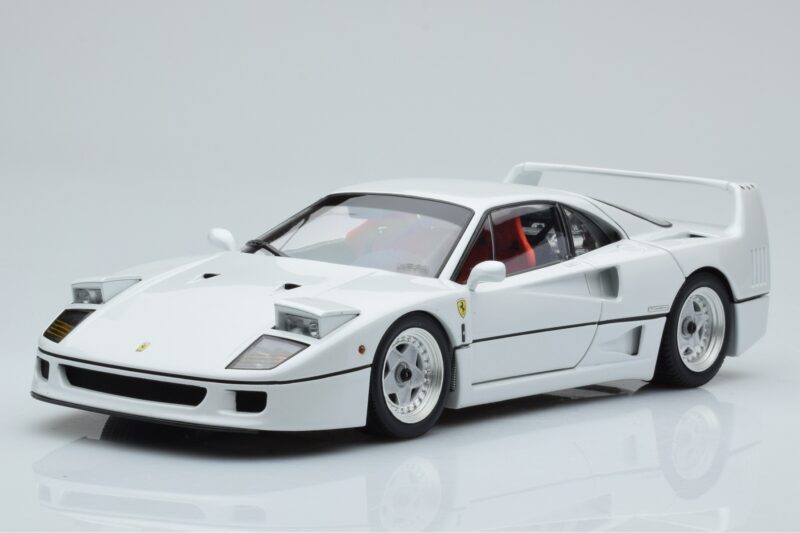
Kyosho's 1:18 diecast Ferrari F40 trades the familiar Rosso Corsa for a striking pearl white finish over the 1987 supercar's carbon-kevlar composite bodywork. Opening doors reveal a stripped-back cabin, and the twin-turbo V8's engine cover lifts for inspection. A distinctive colourway for collectors who want their F40 to stand apart from the usual red-on-red display shelf.
TL;DR: Kyosho's 1:18 diecast Ferrari F40 reproduces the 1987 supercar in a rare pearl white finish, with opening doors, a lifting engine cover over the twin-turbo V8, and correctly proportioned carbon-kevlar composite bodywork. A standard-tier diecast that stands apart from the usual Rosso Corsa F40 display.
The F40 was the last car Enzo Ferrari personally approved before his death, a raw, turbocharged statement built with minimal compromise. Kyosho's pearl white diecast trades the model's familiar red for something rarer, without losing any of its aggressive stance.
Kyosho's 1:18 F40 in an Unusual Pearl White
A Colourway That Breaks From Rosso Corsa Convention
Most F40 diecast and resin replicas on the market lean on Rosso Corsa, the colour most closely associated with the car, so a pearl white example stands out immediately on a shelf full of red supercars. The finish carries a subtle metallic shimmer under direct light that a flat white would lack, and Kyosho applies it evenly across the car's sharply creased panels, panels originally designed more for aerodynamic function than for showing off paint depth.
Opening Features Over the Twin-Turbo V8
The doors lift on gas-strut-style hinges to reveal a deliberately sparse cabin, no carpeting, exposed door pulls, matching the F40's famously stripped-out interior philosophy. Around the back, the engine cover lifts to expose the twin-turbocharged V8, moulded with visible intake plumbing and turbo housings rather than a blanked-off panel. That opening rear deck is where a diecast interpretation earns its keep over a sealed resin alternative, since the F40's engine bay was as much a talking point as its styling.
The F40's Place as Ferrari's Uncompromising 1980s Flagship
Enzo's Last Approved Car
Enzo Ferrari personally signed off on the F40 shortly before his death in 1988, making it the final car to carry his direct approval, a fact that gives the model a genuine sense of closure within Ferrari's history. It was conceived as a no-compromise driver's car, built to mark the company's fortieth anniversary with minimal concession to comfort or refinement.
Carbon-Kevlar Construction and Raw Performance
Ferrari built the F40's body from composite carbon-kevlar panels over a tubular steel and composite chassis, keeping weight down to extract maximum performance from its twin-turbocharged V8. The car was widely reported at launch as one of the first road cars capable of exceeding 200mph, a claim that cemented its reputation as an uncompromising performance flagship rather than a comfortable grand tourer.
Colour Rarity as a Collecting Consideration
Colour choice matters more on a subject this well-known than it does on an obscure model, because collectors already have a mental image of what an F40 looks like, and a pearl white example deliberately works against that expectation. That makes it a stronger conversation piece within a themed Ferrari display than another red example would be, particularly if red F40s already dominate the shelf. It's worth noting that colour rarity in a diecast doesn't necessarily track colour rarity on the original cars; a small number of pearl white F40s did leave the factory, but exact production splits by colour aren't something a collector should treat as verified fact without documentation. Judge this piece on its own execution: the paint depth, the panel gaps around the opening doors and engine cover, and the correctness of the wheel and brake detail, all of which hold up well here regardless of colour rarity.
Where a Pearl White F40 Sits on the Shelf
A pearl white F40 works best as a deliberate contrast piece, placed beside a Rosso Corsa example of the same car to show how differently the design reads under a lighter finish, or within a wider 1980s Ferrari supercar theme alongside a Testarossa or 288 GTO. Its unusual colourway won't suit every collector's taste, since red remains the colour most associated with the car for good reason, but for someone who already owns a red F40 or simply wants their Ferrari shelf to avoid looking monochrome, this is a genuinely considered alternative.
Create a free account and claim 5% off your first order — from hundreds of collectible 1:18, 1:43 and 1:12 models by Porsche, Mercedes-Benz, BMW and more.
{"id":302674,"name":"Ferrari F40 Pearl White Kyosho 1:18","price":"£<\/span>279.17<\/bdi><\/span>","image":"https:\/\/models118.co.uk\/wp-content\/uploads\/2026\/03\/ferrari-f40-pearl-white-kyosho-1-18-400x400.jpg","permalink":"https:\/\/models118.co.uk\/ferrari-f40-pearl-white-kyosho-1-18-08416pw-g\/","brand":"Ferrari"}