Used

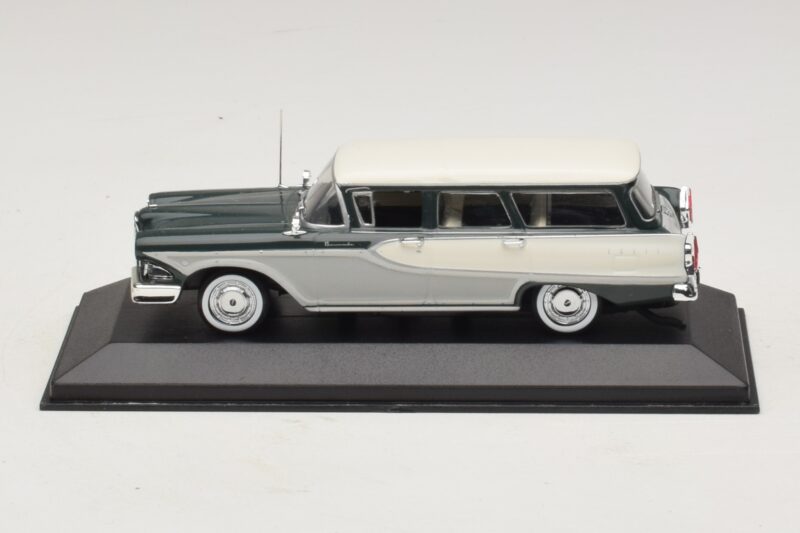
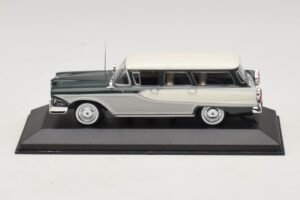
TL;DR: Minichamps' 1:43 diecast Edsel Bermuda Station Wagon reproduces the dark green and white 1958 wagon from Ford's short-lived Edsel brand. The body is a sealed one-piece casting, with crisp shut lines and two-tone paint that capture a design remembered more for its failure than its engineering.
The Edsel name has become automotive shorthand for commercial failure, yet the cars themselves were never the disaster the brand's collapse suggests. Minichamps treats the Bermuda wagon with the same care given to more celebrated contemporaries, reproducing a model most collections of 1950s Americana still lack.
At 1:43, Minichamps has built a reputation for treating even obscure American subjects with the same discipline applied to its European catalogue, and the Bermuda wagon benefits from that consistency. The body is diecast in zinc alloy and cast as a single sealed shell, with no doors, bonnet or tailgate built to open. That construction choice lets the tooling hold tighter tolerances across the wagon's long roofline and glasshouse than a hinged body could manage at this small scale.
Run a finger along the tailgate line and it tracks as one continuous groove rather than a gap with any give in it, a tolerance only a fixed casting can deliver this cleanly. The dark green and white two-tone split follows the factory division precisely, with a crisp edge between colours rather than a soft gradient, which is where cheaper diecast at this scale tends to show its limits. Chrome trim around the windows and the distinctive period grille is picked out separately rather than left as unpainted metal, a detail that lifts the finish well beyond entry-tier expectations.
For a wagon body, proportion is everything, and Minichamps keeps the roofline, beltline and rear overhang in correct relation to one another, which is harder to achieve at 1:43 than it sounds given how little surface area a casting this size actually has to work with.
Ford launched Edsel as an entirely new mid-priced brand for 1958, positioned between Ford and Mercury in the company's lineup and backed by one of the largest marketing campaigns the American industry had ever mounted. The launch coincided with a recession and a shift toward smaller cars that the brand's styling, dominated by its vertical grille, did nothing to help. Sales collapsed almost immediately, and Ford discontinued the entire brand by the end of 1960, barely three years after it began.
The Bermuda, Edsel's station wagon offering, shared its chassis and running gear with contemporary Ford and Mercury wagons, which meant the mechanical case for the car was never really in question. What killed Edsel was timing and perception rather than any fundamental engineering fault, and that disconnect is part of why the name still gets invoked whenever a product launch goes wrong. Few Bermudas survive in original condition today, since limited sales numbers meant limited production in the first place.
That rarity is precisely what makes a well-executed scale replica valuable to a collector of 1950s Americana. Where a Ford or Chevrolet wagon of the same year is comparatively easy to find in diecast, an accurate Edsel Bermuda fills a genuine gap most American-car shelves are missing.
At 1:43, the Bermuda sits at a familiar footprint, close to 10cm, making it easy to group alongside contemporary Ford, Mercury and Lincoln wagons from the same showroom era without needing dedicated shelf space. For a collector building a themed run of 1958 American output, this wagon supplies the commercial-failure counterpoint to the era's success stories, a car that looked conventional on paper yet became a cautionary tale regardless. The sealed body construction, standard at this scale and price point, keeps the model affordable without compromising the proportions that define the car. Buyers researching Minichamps' wider 1950s American catalogue will find the Bermuda worth the search, since few other manufacturers bother reproducing it.