Used

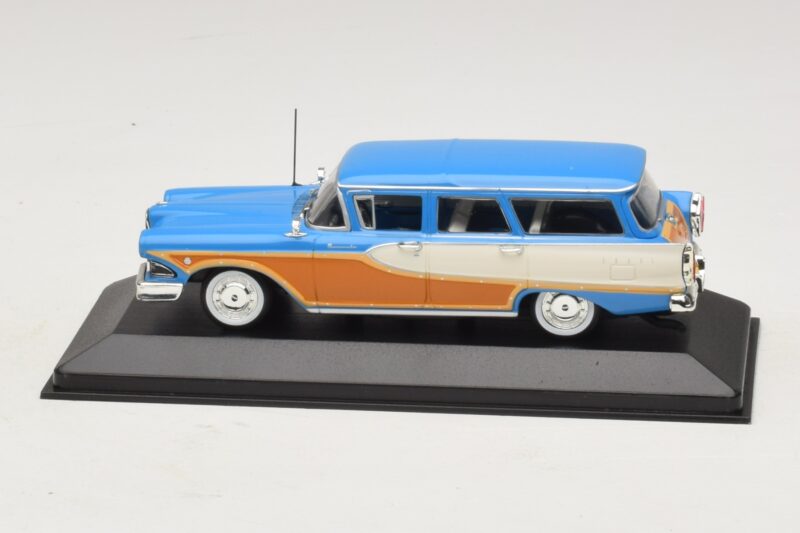
TL;DR: Minichamps' 1:43 diecast Edsel Bermuda Station Wagon in Caribbean Turquoise reproduces one of the rarer body styles from Ford's short-lived, commercially disastrous Edsel brand of 1958. The body is a sealed one-piece casting, so the model's story plays out entirely in its stance, chrome and that unmistakable horse-collar grille.
Ford launched the Edsel brand in 1957 with enormous expectations and a distinctive vertical grille that quickly earned unflattering comparisons to a horse collar. The Bermuda wagon, offered for the brand's short run, is among its rarer surviving body styles today. Minichamps' 1:43 Caribbean Turquoise casting preserves that controversial grille and the period's exuberant chrome detailing.
This casting has no opening doors, bonnet or tailgate, a construction choice that puts the entire burden of accuracy onto the exterior surfacing, and Minichamps answers that challenge well. The shut lines around the doors and rear tailgate run as single, consistent grooves rather than the slightly uneven gaps a hinged mechanism would require, giving the body a cleaner, more unified silhouette than an opening version could achieve at this scale. The horse-collar grille, the single most argued-over design element of the entire Edsel range, is cast with crisp vertical ribs and correctly proportioned chrome surround. Caribbean Turquoise sits deep and even across the long wagon flanks, catching light cleanly along the pronounced tailfins at the rear.
Minichamps' 1:43 diecast work typically favours faithful exterior proportion over interior theatre, and this Bermuda follows that pattern, the wraparound windscreen, slim chrome window surrounds and the wagon's load-area glazing are all rendered with the kind of clean edge definition that rewards close inspection under a display light. Wheel covers carry period-correct detailing, and the two-tone paint treatment common to Edsel wagons of this era is handled with a clean separation line rather than an overlapping blur. At this scale, that level of exterior finish is exactly where a collector's attention naturally goes.
Ford invested heavily in launching Edsel as a distinct mid-market brand for 1958, positioned between its mainstream Ford models and the upscale Mercury and Lincoln lines, complete with its own dealer network and an unusually aggressive advertising campaign that promised a genuinely new kind of car. The reality disappointed buyers almost immediately: styling, headlined by that divisive grille, proved polarising rather than appealing, and build quality issues compounded the brand's early struggles. The Bermuda wagon, one of several body styles Ford offered across the range, shared the same controversial front-end treatment as Edsel's saloons, giving it the brand's full visual identity in estate form.
Edsel lasted only a few model years before Ford discontinued the brand entirely, and the name became a lasting byword for a commercial product that fails to meet expectations, a reputation that has followed Edsel through decades of automotive writing since. That very failure is part of what makes surviving Edsels, and models of them, genuinely interesting collector subjects today, relatively low production numbers at the time mean fewer examples survive, and the brand's notorious history gives even a humble wagon a story worth telling on a shelf.
At 1:43, the Bermuda's long wagon body and pronounced tailfins translate into a compact but visually busy footprint, well suited to a shelf arrangement built around full-size 1950s American cars at the same scale. It sits naturally alongside other late-1950s Ford Motor Company products, offering a useful contrast between Edsel's commercial failure and the more successful models the same corporation produced alongside it that decade. Minichamps' sealed-body approach keeps the focus entirely on exterior fidelity, which suits a car whose story is really about styling and brand positioning rather than mechanical substance. For any collector drawn to automotive history's genuine curiosities, this Bermuda offers a well-executed, slightly offbeat talking point rather than a predictable 1950s classic.