Used
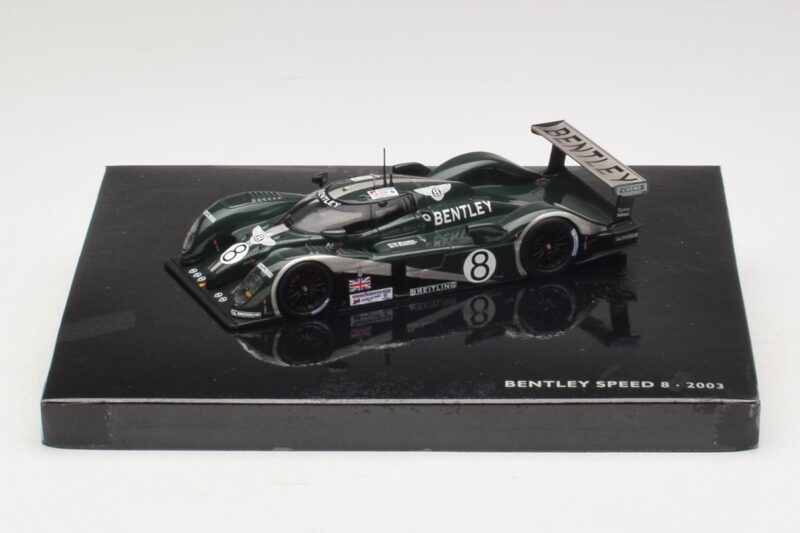
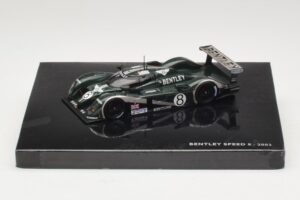
TL;DR: Minichamps' 1:43 Bentley Speed 8 reproduces the number 8 car that won the 2003 24 Hours of Le Mans with Johnny Herbert, David Brabham and Mark Blundell, in a sealed one-piece LMP900 body carrying period-correct sponsor livery. It suits collectors building a shelf around one of endurance racing's most significant British-badged results.
Bentley had not won at Le Mans since 1930, and by 2003 few expected the marque to end that drought against factory-backed prototypes from more established manufacturers. Johnny Herbert, David Brabham and Mark Blundell did exactly that in the number 8 Speed 8, and Minichamps' casting documents the car that closed a seventy-three-year gap in the marque's history.
The Speed 8's low, enclosed prototype bodywork carried Bentley's traditional green alongside the sponsor branding that defined its 2003 livery, a scheme immediately distinct from the red and blue prototypes fielded by rival manufacturers that same year. Minichamps casts the number 8 markings, driver names, and sponsor decals correctly positioned along the car's long, tapered bodywork, with the front splitter, side intakes, and rear diffuser detail reproduced without softening for the smaller scale. Getting a Le Mans prototype's aerodynamic detailing right matters more than on almost any other race subject, since the shape itself is the story, built entirely around airflow rather than styling.
The body is a sealed one-piece casting, no opening doors or engine cover, and for a closed-cockpit prototype that construction matches the real car's own philosophy: the Speed 8's bodywork was designed as one continuous aerodynamic surface, and a fixed diecast shell reproduces that continuity without a hinge line interrupting the sweep from nose to tail. The headlight covers, side mirror pods, and rear wing sit correctly proportioned against the long bodywork, and the racing wheels carry the low-profile look the car's aerodynamic package demanded. Zinc alloy gives the casting real heft, weight that suits a car whose actual racing success depended on serious underlying engineering rather than surface styling alone.
Bentley's previous Le Mans win dated back to 1930, and the marque's return to the race's winner's circle in 2003 carried weight well beyond a single result, reconnecting a historic British name with the event that had helped build its early reputation. Johnny Herbert brought Formula 1 experience to the drive, Mark Blundell added his own grand prix background, and David Brabham, son of three-time world champion Jack Brabham, contributed a family motorsport pedigree stretching back decades. Three drivers with genuinely different career paths converging on one winning car gives this model a depth of story that few single-driver liveries can match.
The LMP900 category that produced the Speed 8 sat at the top of endurance racing's prototype hierarchy in the early 2000s, before regulation changes reshaped the class structure that followed. Cars built to this specification represented the most advanced closed-cockpit prototype engineering of their era, competing directly against factory efforts from established manufacturers with far longer unbroken endurance racing histories. Bentley's win against that level of opposition, in only its second full season back at the top level, remains one of the more remarkable results in modern Le Mans history, and a model this specific keeps that context intact rather than reducing it to a generic prototype shape.
This Speed 8 anchors any collection built around British endurance racing achievement, carrying a genuine seventy-three-year story rather than a routine class result. Its low, sweeping prototype bodywork stands apart from the touring cars and rally Escorts that dominate a typical 1970s-focused British motorsport shelf, giving a collector a way to extend the same national theme into a completely different category of racing and a different era. At 1:43, it sits naturally alongside other early-2000s Le Mans prototypes, building a picture of the LMP900 era's diversity across several manufacturers rather than one marque in isolation. For anyone assembling a shelf around Le Mans winners specifically, few results carry as much built-in historical weight as a marque's first win in seventy-three years, and this model documents that moment with the specificity it deserves.


Save £14.00