Last one
Used

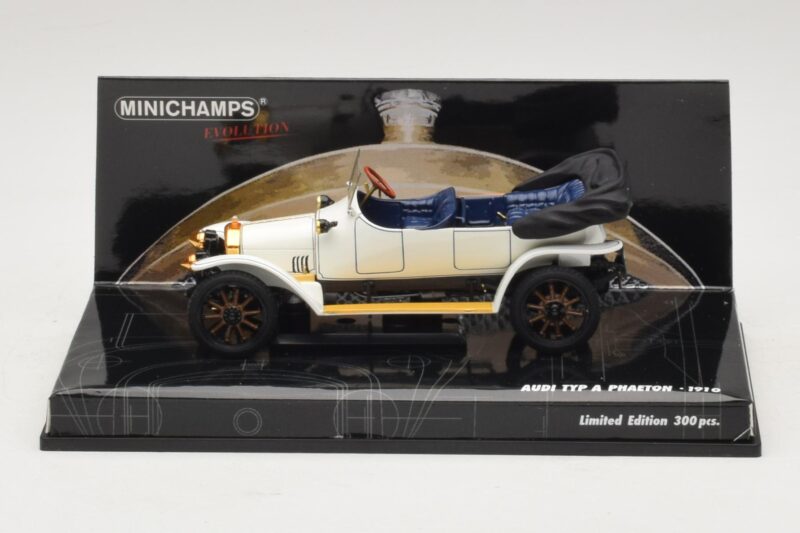
TL;DR: Minichamps' 1:43 diecast Audi Typ A Phaeton in white and blue reproduces the very first car to wear the Audi name, built in 1910 after August Horch founded a new company under the Latin translation of his own surname. The sealed one-piece casting carries the tall, upright Edwardian coachwork and spoked wheels of the original.
August Horch left the company that bore his own name and started again, and because German trademark law wouldn't let him reuse "Horch" a second time, he settled on "Audi," the Latin word for what his surname meant in German. The Typ A Phaeton was the result, and Minichamps' 1:43 casting in white and blue gives that origin story a real anchor for an Audi shelf.
The Typ A predates the four interlinked rings by more than two decades, built in an era when a car's identity came from its coachbuilder's proportions rather than a badge: tall wheels, an upright windscreen-free cabin, and a narrow, high-set body typical of 1910s touring cars. Minichamps' casting follows that Edwardian silhouette closely, with the white body panels separated cleanly from the blue lower sections and running gear, a two-tone treatment common on cars of this period before uniform paint schemes became standard. The proportions look almost nothing like a modern Audi, and that contrast is exactly the point for anyone building a full-lineage display.
This is a sealed, one-piece casting, appropriate for a car from an era when the body itself was largely open at the sides anyway, with no doors in the modern sense to render as moving parts. Brass-look detailing around the headlamps and radiator surround catches light distinctly from the painted bodywork, and the tall, thin-spoked wheels are moulded with enough definition to read as period-correct rather than generic. The upright windscreen, fitted as an early safety feature rather than a styling choice, and the folded canvas top sitting low behind the rear seats both carry enough surface detail to reward a close look under cabinet lighting.
August Horch founded his first car company under his own name, left it after a dispute with his business partners, and immediately started a second company using the same expertise. German law prevented him from calling the new firm "Horch" again, so a colleague suggested the Latin translation of the German verb meaning "to hark" or "to listen," which happens to be exactly what "Horch" means. That word was "Audi," and the Typ A Phaeton, launched in 1910, was the first car to carry it, a genuinely unusual origin story among major car brands.
Decades later, Audi, Horch, DKW and Wanderer merged to form Auto Union, the group whose four-rings badge still represents all four founding marques today. That means this Typ A Phaeton and the Horch cabriolets and roadsters covered elsewhere in Minichamps' pre-war range are, in a real sense, siblings from the same eventual corporate family, even though they were built as fierce separate competitors decades before that merger happened. Displaying an early Audi next to a Horch from the same catalogue tells that whole consolidation story on a single shelf.
For anyone tracing Audi's full history rather than starting with the post-war four-rings era, the Typ A Phaeton is close to essential, the single starting point every later Audi ultimately traces back to. Its Edwardian proportions look nothing like a modern Audi, which is precisely the value of owning it alongside more recognisable later models: the contrast tells the brand's whole story better than either extreme alone. At 1:43, the tall, narrow body sits comfortably among other brass-era subjects without needing a dedicated display case. Because the body is sealed, judge the casting on wheel spoke definition and brass-trim separation from the paintwork.









Save £14.00