Last one
Used
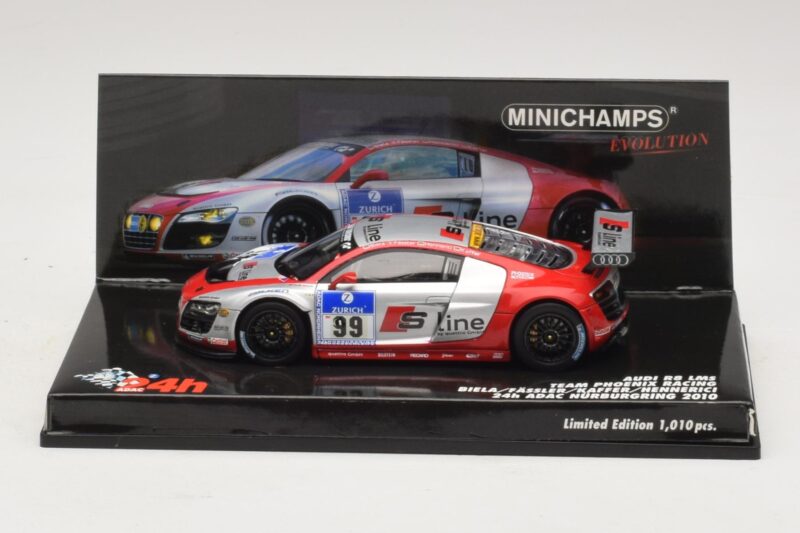
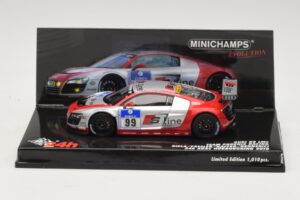
TL;DR: Minichamps' 1:43 diecast reproduces the #99 Phoenix Racing Audi R8 LMS GT3, driven by Frank Biela and Marc Fässler at the 2010 Nürburgring 24 Hours, a sealed one-piece body with tampo-printed livery and full GT3 aero. An early example of Audi's customer racing programme for a serious GT3 diecast lineup.
Frank Biela, a four-time Le Mans winner, and Marc Fässler, an Audi factory driver in his own right, shared the #99 Phoenix Racing R8 LMS GT3 at the 2010 Nürburgring 24 Hours, one of the earliest seasons for Audi's brand-new customer GT3 programme. Minichamps captures that specific pairing and livery in 1:43 diecast.
Minichamps casts the R8 LMS GT3 as a sealed, one-piece diecast body, the standard construction for this scale and the right one for a livery-driven racing subject. With no doors or engine cover designed to hinge, Phoenix Racing's colour scheme runs continuously across the bodywork, uninterrupted by the panel gaps a real racing car's shut lines would create. Tampo printing applies the sponsor branding, the number 99 and the smaller decals directly onto the surface, holding crisp edges rather than the slight lift or fading that cheaper transfer methods develop over time. Zinc alloy gives the model genuine heft, a density that keeps the wide GT3 arch extensions and the deep front splitter true to their moulded shape year after year on a shelf, unlike lighter plastic-bodied alternatives. The rear wing sits at a realistic rake, the wheels carry period-correct centre-lock detailing, and the ride height reads appropriately low, all consistent with a car developed specifically for GT3 competition rather than adapted loosely from a road car silhouette. Glazing is tinted correctly and the roof-mounted air intake, a distinctive feature of the R8 LMS GT3's silhouette, is moulded with clean, defined edges. Some cockpit detail behind the glass is simplified at this scale, as it is on any 1:43 diecast, but the exterior surfaces that carry the livery and define the car's racing identity receive the model's full attention throughout.
Audi Sport introduced the R8 LMS GT3 in 2009 with an unusually direct goal: build a GT3 car that private and semi-professional teams could buy, run and win with straight away, rather than reserving the best equipment for a factory squad alone. Phoenix Racing was exactly that kind of customer team, an independent German outfit that built its reputation on the Nürburgring's demanding 24-hour race, and pairing it with two genuinely accomplished drivers, Frank Biela's multiple Le Mans-winning pedigree and Marc Fässler's standing as an Audi factory driver, signalled how seriously the manufacturer treated its new customer programme from the outset. The Nürburgring 24 Hours itself, run on a combined circuit using both the modern Grand Prix layout and the 20-kilometre Nordschleife, has long served as the toughest proving ground in GT racing anywhere in the world, punishing unreliable cars and inexperienced crews in equal measure across a full day and night. Entering that race in only its second season of competition was a statement of confidence in the R8 LMS GT3's design, and the model established a template, strong customer support, competitive out-of-the-box pace, that Audi has followed with every GT3 generation since. For collectors, car #99 represents that formative period specifically: not a later, more refined version of the programme, but one of its earliest tests against the sport's hardest race.
At 1:43, this Audi sits comfortably alongside GT3 machinery from Mercedes, McLaren and other manufacturers that raced the same era, letting a collector build a genuine multi-marque endurance grid rather than a single-brand curiosity. Because customer racing put dozens of R8 LMS GT3s on grids across Europe through the early 2010s, this era offers plenty of scope for pairing car #99 with sister entries or rival liveries from the same seasons. The scale's small footprint means a full field, ten or fifteen cars, still fits on one modest shelf, something a 1:18 collection could never manage. For anyone tracking Audi's transition from factory-only motorsport toward genuine customer racing, this early Phoenix Racing entry marks a useful, historically grounded starting point rather than an arbitrary choice.









Save £14.00