Last one
Used

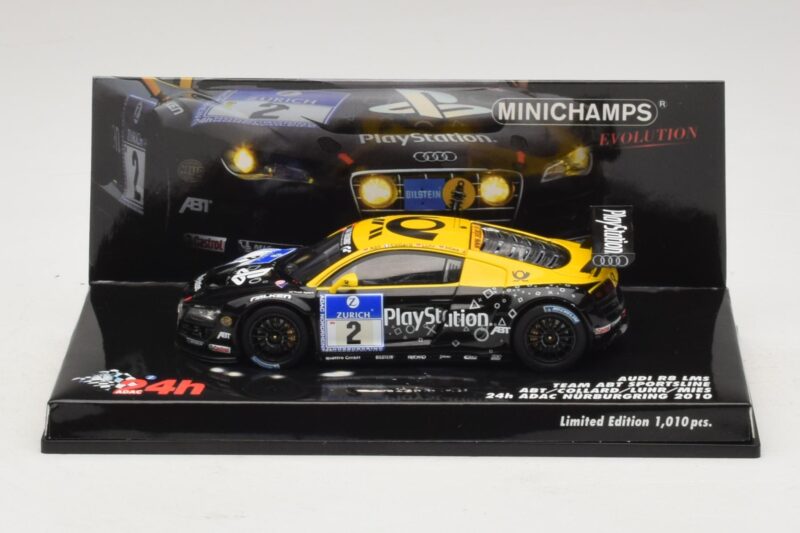
TL;DR: Minichamps' 1:43 Audi R8 LMS GT3 reproduces car #2 from the 2010 Nurburgring 24 Hours, a sealed-body diecast built on Audi's road-derived V10 GT3 platform. The livery's low car number places it among the race's larger entries on Germany's most famous endurance grid.
Not every entry at the Nurburgring 24 Hours arrives with a famous driver pairing attached. Car #2 is one of the quieter stories on the grid, and that is exactly why the livery itself, rather than a name, is what a collector should judge this model on.
Without a headline sponsor scheme to lean on, this casting has to earn its place purely on paint accuracy, and Minichamps keeps the number, class markings, and body colour split lines registered tightly along the R8's flanks. The low car number suggests an entry of some standing within the field, since organisers at endurance events typically hand early numbers to more established teams. The tampo work carries no visible bleed where the base colour meets the graphics, and the class decals sit flush rather than raised, a small but telling sign of careful print work rather than a rushed production run.
The body is a single sealed casting, doors and engine cover moulded shut, which is standard for Minichamps' 1:43 GT3 line and keeps panel gaps consistent along the R8's low waistline. Zinc alloy gives the model real heft for its size, a dense, planted feel rather than a light, hollow one, and that weight translates visually into a car that looks properly grounded on its wheels rather than perched above them. The GT3-spec front splitter and rear wing hold their thin edges cleanly, detail that a softer casting process would likely round off.
The R8 LMS GT3 shared its naturally aspirated 5.2-litre V10 with the production R8, one of the first examples of a manufacturer basing a full GT3 programme directly on a road car rather than a purpose-built racing chassis. By 2010 the platform had already demonstrated strong reliability across long-distance events, a quality that matters more at the Nurburgring than outright pace, since the race rewards cars that survive the Nordschleife's twenty-plus kilometres of unforgiving, narrow tarmac lap after lap through the night.
Grids at this event regularly exceed 150 cars across multiple classes, sharing the same stretch of German countryside road for a full day and night, watched by crowds that camp trackside for the entire event. That scale is part of what makes the race genuinely famous within European motorsport culture, distinct from a typical sprint GT3 round. A model built from one specific entry, rather than a generic GT3 casting, gives a collector a concrete way to point at one small part of that enormous field.
Car #2 works best as part of a broader Nurburgring or Audi GT3 grouping rather than as a standalone hero piece, since its appeal lies in accurate, unglamorous livery work rather than a celebrity driver line-up. Set alongside the more decorated entries from the same race weekend, it fills out a themed shelf honestly, showing the range of teams that actually make up an endurance grid this size. The sealed body and diecast weight keep it presentable at close range, which matters when a model is judged on paint rather than on a story.










Save £14.00