{"ajaxurl":"https:\/\/models118.co.uk\/wp-admin\/admin-ajax.php?lang=en_GB","nonce":"639ff23817","homeUrl":"https:\/\/models118.co.uk\/","shopUrl":"https:\/\/models118.co.uk\/shop\/","cartUrl":"https:\/\/models118.co.uk\/cart-en-gb\/","checkoutUrl":"https:\/\/models118.co.uk\/checkout\/","skipCart":true,"collectionLimit":12,"i18n":{"addedToCart":"Added to basket","addToWishlist":"Add to wishlist","addedToWishlist":"Added to wishlist","removeFromWishlist":"Remove from wishlist","removedFromWishlist":"Removed from wishlist","undo":"Undo","error":"Something went wrong","loading":"Loading...","outOfStock":"Out of stock","viewCart":"View basket","proceedToCheckout":"Proceed to checkout","addedToCollection":"Added to your collection","reserved":"Added to your collection","soldOut":"Sold out","invalidEmail":"Please enter a valid email address","connectionError":"Connection error. Please try again.","tocToggle":"On this page","close":"Close","inCartTooltip":"Already in your basket \u2013 open your basket to check out","loginToSave":"Sign in to save this model","waitlistNotify":"Notify me","waitlistOnList":"On the waiting list \u2713","waitlistJoined":"You're on the waiting list. We'll email you the moment this model is available again.","waitlistRemoved":"Done \u2014 you're off the waiting list for this model.","waitlistRateLimit":"Too many attempts \u2014 please try again shortly","waitlistTurnstile":"We couldn't complete the check \u2014 please try again","waitlistError":"Sorry, something went wrong. Please try again in a moment."},"wishlist":{"loggedIn":false,"loginUrl":"https:\/\/models118.co.uk\/my-account\/","addAction":"models118_wishlist_add","removeAction":"models118_wishlist_remove"},"waitlist":{"loggedIn":false,"subscribeAction":"models118_waitlist_subscribe","toggleAction":"models118_waitlist_toggle","stateAction":"models118_waitlist_state"},"stats":{"models":2665,"brands":215,"manufacturers":129,"collectors":10000},"product":{"id":1703969,"sku":"940120901","condition":"new","availability":"in_stock","name":"Alfa Romeo Giulia 1600 Red Maxichamps 1:43","brand":"Alfa Romeo","manufacturer":"Maxichamps","scale":"1:43","material":"Diecast","price":75,"regularPrice":75,"isOnSale":false,"savingsAmount":0,"stockQty":2,"stockStatus":"very_low","isDiscontinued":false,"image":"https:\/\/models118.co.uk\/wp-content\/uploads\/2026\/10\/alfa-romeo-giulia-1600-red-maxichamps-1-43-940120901-1-1-300x200.jpg","permalink":"https:\/\/models118.co.uk\/alfa-romeo-giulia-1600-red-maxichamps-1-43-940120901\/"}}
Cookies on Models118
We use cookies to remember your preferences, understand how the shop is used and show you models and offers that suit your interests. What you allow is up to you, and you can change it at any time.
Always active
The technical storage or access is strictly necessary for the legitimate purpose of enabling the use of a specific service explicitly requested by the subscriber or user, or for the sole purpose of carrying out the transmission of a communication over an electronic communications network.
The technical storage or access is necessary for the legitimate purpose of storing preferences that are not requested by the subscriber or user.
The technical storage or access that is used exclusively for statistical purposes.
The technical storage or access is required to create user profiles to send advertising, or to track the user on a website or across several websites for similar marketing purposes.
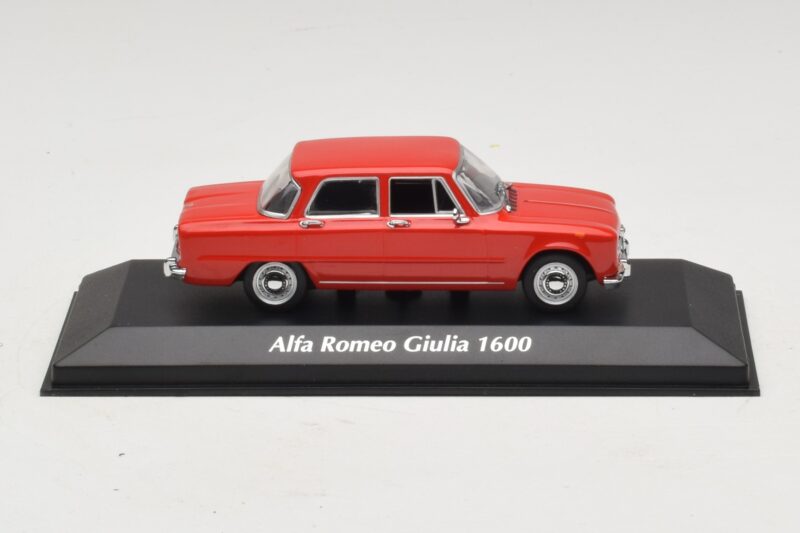
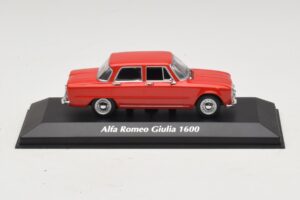
Maxichamps' 1:43 diecast Alfa Romeo Giulia 1600 in red reproduces the 1970 Italian saloon as a sealed one-piece body. The boxy, flat-sided shape exposes casting accuracy, so straight beltlines and a clean red finish carry the model. A sensible start for a run of classic Alfa Romeo saloons, and a good partner for the later 75.
About the Alfa Romeo Giulia 1600 Red Maxichamps 1:43
TL;DR: The Maxichamps Alfa Romeo Giulia 1600 Red is a 1:43 diecast replica of the 1970 Italian saloon. Its sealed one-piece body puts the focus on crisp, boxy lines, red paint depth and a correct stance. It suits collectors building a run of classic Alfa Romeo saloons or 1970s European family cars.
The Giulia saloon looks like a box, and Alfa Romeo made a point of saying the box had been shaped for the air. Underneath was a twin-cam four-cylinder engine that gave the car its sporting character. The Maxichamps Alfa Romeo Giulia 1600 in 1:43 carries that combination of plain shape and serious intent in red, the colour most people expect from an Alfa.
Maxichamps Alfa Romeo Giulia 1600 1:43 in Red Diecast
Straight Lines Show Every Fault
A boxy saloon is a test of casting accuracy. Long flat flanks, a level roofline and squared-off corners will reveal any warp or sag immediately, and the Giulia's shape gives a manufacturer no curves to hide behind. Check the side profile against a straight edge held a few millimetres away: the beltline should run true from door to tail. Because this body is a sealed one-piece casting, it avoids the slight misalignment that separate panels can introduce, and the shut lines stay uniform. Weight in the hand is also a clue, with zinc alloy giving a satisfying density for a model of this size.
Red Paint, Chrome and Period Details
Red on an Alfa is almost an expectation, and it is a colour that can drift. A slightly orange cast reads as cheerful; a cooler cherry red can look wrong on a car of this era. Judge it in daylight as well as under a lamp. Then look at the brightwork: Giulias of this period carried slim chrome bumpers and trim, and at 1:43 those fine strips are typically represented by printing or silver paint. If the lines are thin, straight and unbroken, the finishing is careful. The Alfa shield grille and badge at the nose are the details most collectors check first.
Alfa Romeo's Twin-Cam Saloon in 1970
A Saloon with a Sporting Engine
Alfa Romeo introduced the Giulia saloon in 1962, with an aluminium twin-cam four-cylinder engine that gave a family car a sports-car temperament. It combined space for four with lively performance, and the angular body was shaped with aerodynamics in mind, a claim Alfa promoted at launch. By 1970 it was a familiar sight across Italy, and Italian police fleets used Giulias, which fixed the car in popular memory. A 1600 in red recalls the civilian side of that story. That blend of practicality and mechanical interest is why collectors regard it as more than a period family car.
Place Among Alfa Romeo Models
Alfa Romeo collections often run in chronological order, and the Giulia saloon forms a natural starting point before the coupes and sports cars. Alongside the later Alfa Romeo 75 saloon, it shows how the marque's saloon philosophy moved from boxy simplicity to a more dramatic wedge shape. If you collect by marque, this red car anchors the 1970s slot. If you collect by body style, it brings a simple saloon among exotic coupes. Both can be displayed in red for a clean visual link.
Looking After a Red Saloon on the Shelf
Red pigment can fade under strong light, so keep the Giulia away from windows and bright spotlights. A lidded case limits dust, and a soft brush clears what does settle. At 1:43 the saloon is only about ten centimetres long, which means several Alfas of different eras can share one shelf. Pick it up by the base rather than the roof, because the thin pillars and mirrors are the most delicate details. A fixed body means no moving parts to loosen over time, which suits a model that will be handled when shelves are rearranged. Collectors weighing this against flashier Alfa coupes should see it as the quieter choice: honest, well-proportioned, and easy to place.
Create a free account and claim 5% off your first order — from hundreds of collectible 1:18, 1:43 and 1:12 models by Porsche, Mercedes-Benz, BMW and more.