On sale:
-23%
Last one
Used
Back in stock
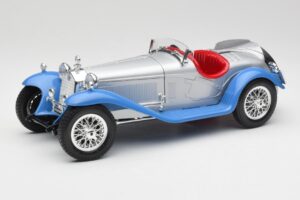
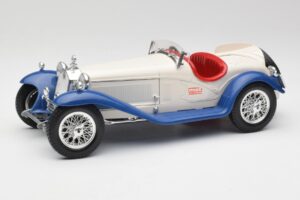
Alfa Romeo 2300 Spider Silver Blue Bburago 1:18
Only 1 left
Sale ends in: 00d 00h 00m
Price:
was
£40.00
£31.00
Save £9.00
VAT included
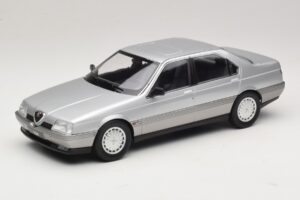
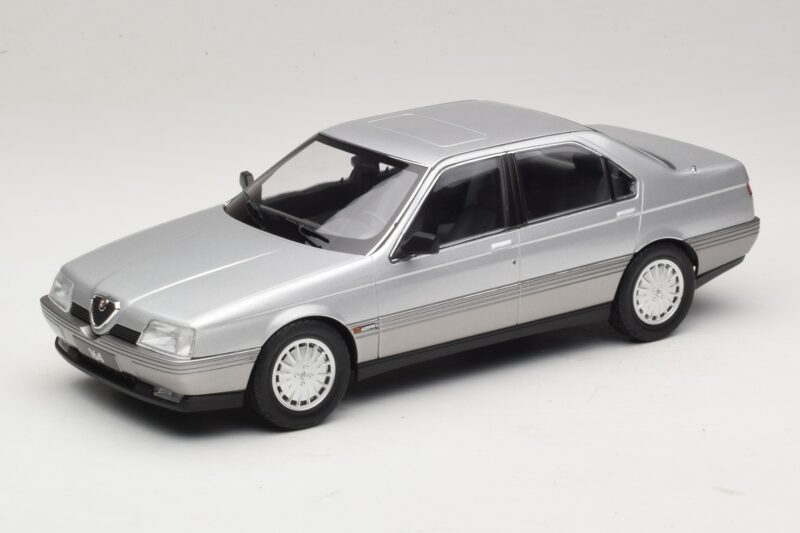
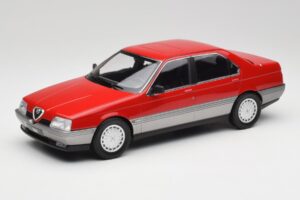
TL;DR: The Norev Alfa Romeo 164 1:18 is a zinc alloy diecast of the Pininfarina-styled Italian executive saloon, finished in Light Grey Metallic. Its body is a fixed, one-piece casting, so the interest lies in exterior stance, shut lines and paint depth. It sits in the mid tier and suits collectors of 1990s European saloons.
Most 1:18 saloons get ignored on the shelf, and that is the Alfa Romeo 164's opportunity. This Norev version in Light Grey Metallic has none of the theatre of a coupe, just a long, tidy shape that rewards close looking. Because the body is one fixed casting, every judgement comes from the outside: the stance, the glass and the flow of the shut lines.
Alfa Romeo launched the 164 in 1987 as its flagship saloon, sharing its underpinnings with the Type Four platform that also served the Fiat Croma, Lancia Thema and Saab 9000. The front-wheel-drive layout broke with the rear-drive tradition of Alfa's older saloons, yet the 164 still carried the brand's character in its engines, most famously the Busso V6, and in a Pininfarina-penned shape. It was sold in Britain in right-hand drive, going head to head with the executive saloons from Munich, Stuttgart and Ingolstadt.
A grey metallic suits this car's restrained lines. The 164's styling is a study in clean surfaces: a flat shoulder, a tidy glasshouse and the Alfa Romeo shield at the nose. A light grey makes those surfaces visible without competing with them. Light metallics also reveal casting quality honestly, because any wobble in a panel shows up as a break in the reflection long before it would register on a dark car. That makes colour choice a quiet quality test, and it is why a pale finish tends to flatter well-made models and expose weaker ones.
The product data records no opening parts, so this Alfa Romeo is a sealed, one-piece casting, and the collecting question becomes how well that single shell is finished. Sealed bodies are normal at 1:18 and carry a real advantage. With no hinge clearances to accommodate, shut lines can be drawn as clean, continuous grooves and the whole surface can be tuned for how it catches light.
Tilt the model under a lamp and follow the highlight along the shoulder from the front wing to the tail. On a well-finished casting the reflection runs unbroken, while ripples or breaks reveal soft metal or uneven paint. Light Grey Metallic makes this test easy because pale metallics scatter light widely and show every surface error. The flake should look evenly distributed, with no thick pooling around the lamps or grille. Check the door handles, wipers and badges for crisp definition, and look at the glazing for a clear, flush fit with a consistent frame. Zinc alloy provides weight and durability, and metal bodies age well on a shelf. The honest trade-off is plain: you give up interior access in exchange for surface consistency, a priority that suits a display piece built to be seen.
At 1:18 the 164 measures roughly 25 centimetres, a footprint that slots into a standard display case beside other 1:18 saloons. The scale carries enough area for readable wheel detail, badge relief and window trim, which the 1:43 format compresses into near-abstraction, though a 1:43 version would take far less cabinet width. Norev's 1:18 diecast sits in the mid tier: better finished than entry-level mass-market castings, but without the hundreds of separately fitted parts of hand-built pieces that cost much more. Expect a sound shape, tidy paint and legible badges.
To judge fidelity yourself, start with stance and wheel position, then look at the glass line, the shape of the shield grille and the way the lamps sit within the nose. View the model from above to check roofline symmetry. Display it away from window light, since sun fades paint over years. Silver and grey metallics hide dust better than black, so a pale finish suits a shelf you do not wipe over every week, though a gentle brush still beats a cloth.
Collectors tend to chase coupes and sports cars, which leaves saloons undervalued as shelf subjects. The 164 helps tell the story of the executive class. Set beside German saloons of the same period, it shows how Italian design approached the same brief with a different attitude, and in a chronological Alfa Romeo line it sits ahead of the 166 that followed.
British buyers value completeness, so keep the box and inserts, which protect condition and make any later swap simpler. This is a model for those who enjoy subtlety: a well-judged diecast whose pleasure lies in line, stance and the quality of the paint, not in moving parts. Anyone building a shelf of 1990s European saloons will find a Norev 164 a sensible, honest place to start.
Save £9.00
Save £99.17
Save £84.17
Save £9.00
Save £88.33
Save £6.00
Save £24.00
Save £8.00
Save £8.00
Save £9.00
Save £9.00

Save £10.00


Save £10.00
Save £7.00