{"ajaxurl":"https:\/\/models118.co.uk\/wp-admin\/admin-ajax.php?lang=en_GB","nonce":"c34ded2387","homeUrl":"https:\/\/models118.co.uk\/","shopUrl":"https:\/\/models118.co.uk\/shop\/","cartUrl":"https:\/\/models118.co.uk\/cart-en-gb\/","checkoutUrl":"https:\/\/models118.co.uk\/checkout\/","skipCart":true,"collectionLimit":12,"i18n":{"addedToCart":"Added to basket","addToWishlist":"Add to wishlist","addedToWishlist":"Added to wishlist","removeFromWishlist":"Remove from wishlist","removedFromWishlist":"Removed from wishlist","undo":"Undo","error":"Something went wrong","loading":"Loading...","outOfStock":"Out of stock","viewCart":"View basket","proceedToCheckout":"Proceed to checkout","addedToCollection":"Added to your collection","reserved":"Reserved!","soldOut":"Sold out","invalidEmail":"Please enter a valid email address","connectionError":"Connection error. Please try again.","loginToSave":"Sign in to save this model","waitlistNotify":"Notify me","waitlistOnList":"On the waiting list \u2713","waitlistJoined":"You're on the waiting list. We'll email you the moment this model is available again.","waitlistRemoved":"Done \u2014 you're off the waiting list for this model.","waitlistRateLimit":"Too many attempts \u2014 please try again shortly","waitlistTurnstile":"We couldn't complete the check \u2014 please try again","waitlistError":"Sorry, something went wrong. Please try again in a moment."},"wishlist":{"loggedIn":false,"loginUrl":"https:\/\/models118.co.uk\/my-account\/","addAction":"models118_wishlist_add","removeAction":"models118_wishlist_remove"},"waitlist":{"loggedIn":false,"subscribeAction":"models118_waitlist_subscribe","toggleAction":"models118_waitlist_toggle","stateAction":"models118_waitlist_state"},"stats":{"models":2226,"brands":205,"manufacturers":127,"collectors":10000},"product":{"id":856900,"sku":"100921044-O","condition":"used","name":"Audi V8 D11 #44 Team SMS H-J. Stuck DTM 1992 Minichamps 1:18","brand":"Audi","manufacturer":"Minichamps","scale":"1:18","material":"Diecast","price":142.5,"regularPrice":142.5,"isOnSale":false,"savingsAmount":0,"stockQty":0,"stockStatus":"out_of_stock","isDiscontinued":true,"image":"https:\/\/models118.co.uk\/wp-content\/uploads\/2026\/06\/audi-v8-d11-team-sms-n44-hjstuck-dtm-1992-no-outside-box-minichamps-1-18-300x200.jpg","permalink":"https:\/\/models118.co.uk\/audi-v8-d11-44-team-sms-h-j-stuck-dtm-1992-minichamps-1-18-100921044-o\/"}}
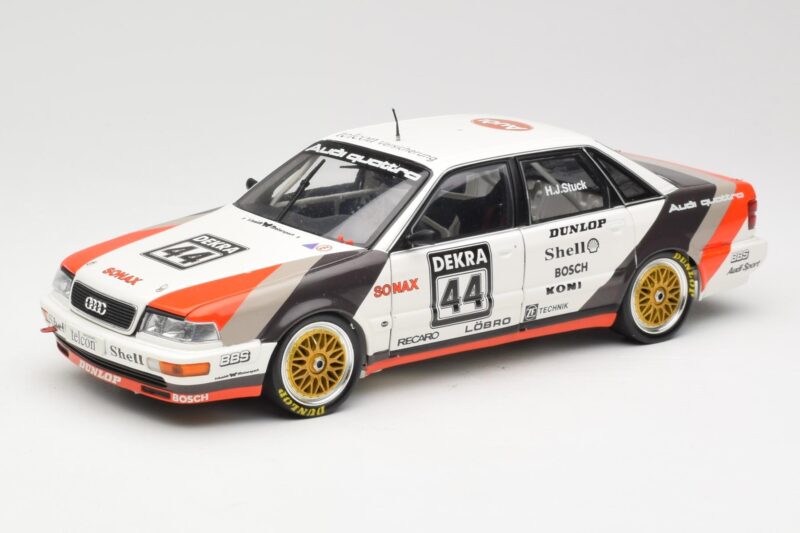
Audi V8 D11 #44 Team SMS H-J. Stuck DTM 1992 Minichamps 1:18
Sold out
1/8
Minichamps' 1:18 diecast reproduces Hans-Joachim Stuck's number 44 Audi V8 for Team SMS in the 1992 DTM season, raced after new rules restricted the quattro four-wheel-drive advantage that had defined Audi's earlier dominance. Stuck had already taken Audi's works title in 1990. Diecast construction captures the touring car's flared arches and period livery in accurate, weighty detail for a German motorsport collection.
About the Audi V8 D11 #44 Team SMS H-J. Stuck DTM 1992 Minichamps 1:18
TL;DR: Minichamps' 1:18 diecast reproduces Hans-Joachim Stuck's number 44 Audi V8 for Team SMS in the 1992 DTM season, the era after quattro all-wheel drive was restricted from German touring car racing. Stuck had already taken Audi's works title in 1990, and this diecast captures the marque's touring car programme adapting to new rules.
Audi's V8 dominated early DTM racing through quattro all-wheel drive, a technical edge the championship's rulemakers moved to curb from 1991. Stuck's 1992 Team SMS car represents Audi's touring car effort adjusting to that new landscape.
Audi's DTM Quattro Era and the Rule Change That Followed
Stuck's 1990 Title and Quattro Dominance
Audi entered DTM with the V8 quattro in the late 1980s, and its four-wheel-drive traction gave the car a clear advantage on corner exit that rear-wheel-drive rivals from BMW and Mercedes struggled to match. Hans-Joachim Stuck, an experienced German driver with a career stretching back through sports car and Formula 1 racing, won the 1990 DTM title driving for Audi's works team, a result built directly on that quattro advantage. The dominance was significant enough that it prompted the championship to restrict all-wheel drive from 1991 onward.
Racing Under the New DTM Rules
By 1992, Audi's V8 programme was racing under those revised regulations, and Team SMS represented one of the satellite operations running Audi machinery alongside the manufacturer's own works effort. Satellite teams like SMS gave Audi broader grid coverage without stretching the factory squad across every round. Stuck's number 44 car that season reflects a different competitive picture than his title-winning 1990 campaign, one where Audi's advantage had narrowed considerably, marking the point where DTM's technical rules pivoted away from four-wheel drive entirely.
Minichamps' Diecast Build and Team SMS Livery
Sponsor Graphics and Body Accuracy
Minichamps casts the Audi V8's boxy touring car silhouette in diecast metal, capturing the flared arches and low ride height that distinguished the DTM cars from their road-going namesakes. Team SMS livery and sponsor branding carry over in period-correct colours, printed with clean registration across the doors, bonnet and rear wing, and Stuck's number 44 sits correctly on the flanks and roofline.
Panel Detail and Diecast Weight
The wide DTM-specification wheel arches and roof aerial are separately detailed rather than simplified into the main body casting, small touches that matter on a subject with a boxier shape than a contemporary Formula 1 car. Diecast construction suits this kind of touring car well, giving the model genuine density on the shelf. Minichamps' touring car range sits at a standard collector tier, priced to let buyers assemble a wide DTM grid rather than a single showcase piece.
Where This Audi V8 Fits in a Touring Car Collection
This Stuck Audi V8 suits a collection tracking DTM's technical evolution as much as one built around famous drivers, since the story it tells is really about a rule change reshaping an entire championship. It pairs naturally with an earlier quattro-era Audi V8 for a direct before-and-after comparison, or alongside period BMW and Mercedes DTM diecast that benefited from the four-wheel-drive restriction. Weight in the hand is a useful shorthand for build quality here, and the V8's flatter panels show off tight diecast shut lines more readily than a curved sports car body would. At roughly 22 centimetres, it sits comfortably among other 1:18 touring car models from this era.
Create a free account and claim 10% off your first order — from hundreds of collectible 1:18, 1:43 and 1:12 models by Porsche, Mercedes-Benz, BMW and more.
We use cookies to remember your preferences, understand how the shop is used and show you models and offers that suit your interests. What you allow is up to you, and you can change it at any time.
Functional
Always active
The technical storage or access is strictly necessary for the legitimate purpose of enabling the use of a specific service explicitly requested by the subscriber or user, or for the sole purpose of carrying out the transmission of a communication over an electronic communications network.
Preferences
The technical storage or access is necessary for the legitimate purpose of storing preferences that are not requested by the subscriber or user.
Statistics
The technical storage or access that is used exclusively for statistical purposes.The technical storage or access that is used exclusively for anonymous statistical purposes. Without a subpoena, voluntary compliance on the part of your Internet Service Provider, or additional records from a third party, information stored or retrieved for this purpose alone cannot usually be used to identify you.
Marketing
The technical storage or access is required to create user profiles to send advertising, or to track the user on a website or across several websites for similar marketing purposes.
We use cookies to remember your preferences, understand how the shop is used and show you models and offers that suit your interests. What you allow is up to you, and you can change it at any time.
Functional
Always active
The technical storage or access is strictly necessary for the legitimate purpose of enabling the use of a specific service explicitly requested by the subscriber or user, or for the sole purpose of carrying out the transmission of a communication over an electronic communications network.
Preferences
The technical storage or access is necessary for the legitimate purpose of storing preferences that are not requested by the subscriber or user.
Statistics
The technical storage or access that is used exclusively for statistical purposes.The technical storage or access that is used exclusively for anonymous statistical purposes. Without a subpoena, voluntary compliance on the part of your Internet Service Provider, or additional records from a third party, information stored or retrieved for this purpose alone cannot usually be used to identify you.
Marketing
The technical storage or access is required to create user profiles to send advertising, or to track the user on a website or across several websites for similar marketing purposes.