{"ajaxurl":"https:\/\/models118.co.uk\/wp-admin\/admin-ajax.php?lang=en_GB","nonce":"221e9a437f","homeUrl":"https:\/\/models118.co.uk\/","shopUrl":"https:\/\/models118.co.uk\/shop\/","cartUrl":"https:\/\/models118.co.uk\/cart-en-gb\/","checkoutUrl":"https:\/\/models118.co.uk\/checkout\/","skipCart":true,"collectionLimit":12,"i18n":{"addedToCart":"Added to basket","addToWishlist":"Add to wishlist","addedToWishlist":"Added to wishlist","removeFromWishlist":"Remove from wishlist","removedFromWishlist":"Removed from wishlist","undo":"Undo","error":"Something went wrong","loading":"Loading...","outOfStock":"Out of stock","viewCart":"View basket","proceedToCheckout":"Proceed to checkout","addedToCollection":"Added to your collection","reserved":"Added to your collection","soldOut":"Sold out","invalidEmail":"Please enter a valid email address","connectionError":"Connection error. Please try again.","tocToggle":"On this page","close":"Close","inCartTooltip":"Already in your basket \u2013 open your basket to check out","loginToSave":"Sign in to save this model","waitlistNotify":"Notify me","waitlistOnList":"On the waiting list \u2713","waitlistJoined":"You're on the waiting list. We'll email you the moment this model is available again.","waitlistRemoved":"Done \u2014 you're off the waiting list for this model.","waitlistRateLimit":"Too many attempts \u2014 please try again shortly","waitlistTurnstile":"We couldn't complete the check \u2014 please try again","waitlistError":"Sorry, something went wrong. Please try again in a moment."},"wishlist":{"loggedIn":false,"loginUrl":"https:\/\/models118.co.uk\/my-account\/","addAction":"models118_wishlist_add","removeAction":"models118_wishlist_remove"},"waitlist":{"loggedIn":false,"subscribeAction":"models118_waitlist_subscribe","toggleAction":"models118_waitlist_toggle","stateAction":"models118_waitlist_state"},"stats":{"models":2328,"brands":213,"manufacturers":128,"collectors":10000},"product":{"id":614271,"sku":"100768406","condition":"used","availability":"out_of_stock","name":"Ford Escort II RS1800 #6 R. Clark \/ J. Pegg RAC Rally Winner 1976 Minichamps 1:18","brand":"Ford","manufacturer":"Minichamps","scale":"1:18","material":"Diecast","price":160,"regularPrice":160,"isOnSale":false,"savingsAmount":0,"stockQty":0,"stockStatus":"out_of_stock","isDiscontinued":true,"image":"https:\/\/models118.co.uk\/wp-content\/uploads\/2026\/06\/ford-escort-ii-rs1800-n6-rclark-jpegg-rac-winner-1976-minichamps-1-18-300x200.jpg","permalink":"https:\/\/models118.co.uk\/ford-escort-ii-rs1800-6-r-clark-j-pegg-rac-rally-winner-1976-minichamps-1-18-100768406\/"}}
Cookies on Models118
We use cookies to remember your preferences, understand how the shop is used and show you models and offers that suit your interests. What you allow is up to you, and you can change it at any time.
Always active
The technical storage or access is strictly necessary for the legitimate purpose of enabling the use of a specific service explicitly requested by the subscriber or user, or for the sole purpose of carrying out the transmission of a communication over an electronic communications network.
The technical storage or access is necessary for the legitimate purpose of storing preferences that are not requested by the subscriber or user.
The technical storage or access that is used exclusively for statistical purposes.
The technical storage or access is required to create user profiles to send advertising, or to track the user on a website or across several websites for similar marketing purposes.
Ford Escort II RS1800 #6 R. Clark / J. Pegg RAC Rally Winner 1976 Minichamps 1:18
Sold out
1/8
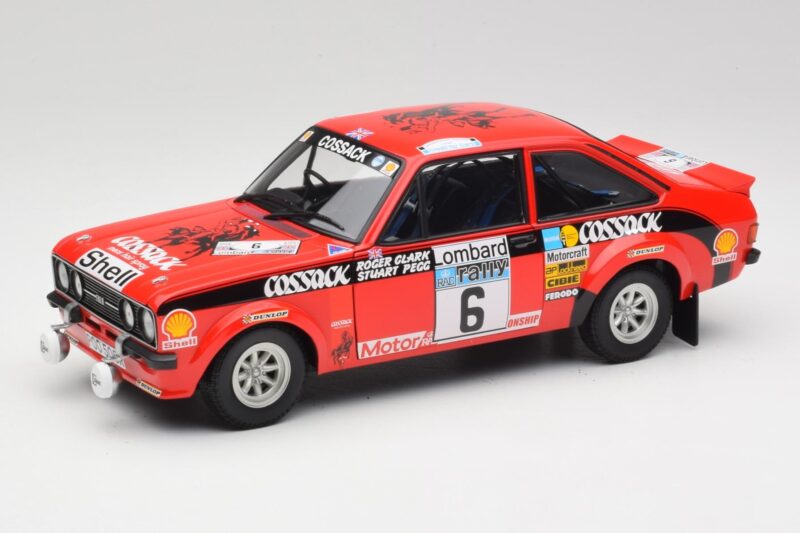
Minichamps' 1:18 diecast Ford Escort RS1800 reproduces Roger Clark's 1976 RAC Rally-winning car, race number 6, built by Ford's Boreham competition department. Clark was Britain's first home-grown RAC Rally winner, and this model carries the correct factory livery and rally-spec bodywork of that campaign. A genuine centrepiece for any British rallying or Ford Escort Mk2 display.
1 / 8
[{"index":0,"id":"584368","thumb":"https:\/\/models118.co.uk\/wp-content\/uploads\/2026\/06\/ford-escort-ii-rs1800-n6-rclark-jpegg-rac-winner-1976-minichamps-1-18-300x200.jpg","medium":"https:\/\/models118.co.uk\/wp-content\/uploads\/2026\/06\/ford-escort-ii-rs1800-n6-rclark-jpegg-rac-winner-1976-minichamps-1-18-800x533.jpg","full":"https:\/\/models118.co.uk\/wp-content\/uploads\/2026\/06\/ford-escort-ii-rs1800-n6-rclark-jpegg-rac-winner-1976-minichamps-1-18.jpg","srcset":"https:\/\/models118.co.uk\/wp-content\/uploads\/2026\/06\/ford-escort-ii-rs1800-n6-rclark-jpegg-rac-winner-1976-minichamps-1-18-800x533.jpg 800w, https:\/\/models118.co.uk\/wp-content\/uploads\/2026\/06\/ford-escort-ii-rs1800-n6-rclark-jpegg-rac-winner-1976-minichamps-1-18-64x43.jpg 64w, https:\/\/models118.co.uk\/wp-content\/uploads\/2026\/06\/ford-escort-ii-rs1800-n6-rclark-jpegg-rac-winner-1976-minichamps-1-18-300x200.jpg 300w, https:\/\/models118.co.uk\/wp-content\/uploads\/2026\/06\/ford-escort-ii-rs1800-n6-rclark-jpegg-rac-winner-1976-minichamps-1-18.jpg 1800w","sizes":"(max-width: 1023px) 400px, 640px","srcsetAvif":"https:\/\/models118.co.uk\/wp-content\/uploads\/2026\/06\/ford-escort-ii-rs1800-n6-rclark-jpegg-rac-winner-1976-minichamps-1-18-800x533.jpg.avif 800w, https:\/\/models118.co.uk\/wp-content\/uploads\/2026\/06\/ford-escort-ii-rs1800-n6-rclark-jpegg-rac-winner-1976-minichamps-1-18-64x43.jpg.avif 64w, https:\/\/models118.co.uk\/wp-content\/uploads\/2026\/06\/ford-escort-ii-rs1800-n6-rclark-jpegg-rac-winner-1976-minichamps-1-18-300x200.jpg.avif 300w, https:\/\/models118.co.uk\/wp-content\/uploads\/2026\/06\/ford-escort-ii-rs1800-n6-rclark-jpegg-rac-winner-1976-minichamps-1-18.jpg.avif 1800w","srcsetWebp":"https:\/\/models118.co.uk\/wp-content\/uploads\/2026\/06\/ford-escort-ii-rs1800-n6-rclark-jpegg-rac-winner-1976-minichamps-1-18-800x533.jpg.webp 800w, https:\/\/models118.co.uk\/wp-content\/uploads\/2026\/06\/ford-escort-ii-rs1800-n6-rclark-jpegg-rac-winner-1976-minichamps-1-18-64x43.jpg.webp 64w, https:\/\/models118.co.uk\/wp-content\/uploads\/2026\/06\/ford-escort-ii-rs1800-n6-rclark-jpegg-rac-winner-1976-minichamps-1-18-300x200.jpg.webp 300w, https:\/\/models118.co.uk\/wp-content\/uploads\/2026\/06\/ford-escort-ii-rs1800-n6-rclark-jpegg-rac-winner-1976-minichamps-1-18.jpg.webp 1800w","alt":"Ford Escort II RS1800 #6 R. Clark \/ J. Pegg RAC Rally Winner 1976 Minichamps 1:18 100768406 Diecast"},{"index":1,"id":584501,"thumb":"https:\/\/models118.co.uk\/wp-content\/uploads\/2026\/06\/ford-escort-ii-rs1800-n6-rclark-jpegg-rac-winner-1976-minichamps-1-18-1-300x200.jpg","medium":"https:\/\/models118.co.uk\/wp-content\/uploads\/2026\/06\/ford-escort-ii-rs1800-n6-rclark-jpegg-rac-winner-1976-minichamps-1-18-1-800x533.jpg","full":"https:\/\/models118.co.uk\/wp-content\/uploads\/2026\/06\/ford-escort-ii-rs1800-n6-rclark-jpegg-rac-winner-1976-minichamps-1-18-1.jpg","srcset":"https:\/\/models118.co.uk\/wp-content\/uploads\/2026\/06\/ford-escort-ii-rs1800-n6-rclark-jpegg-rac-winner-1976-minichamps-1-18-1-800x533.jpg 800w, https:\/\/models118.co.uk\/wp-content\/uploads\/2026\/06\/ford-escort-ii-rs1800-n6-rclark-jpegg-rac-winner-1976-minichamps-1-18-1-64x43.jpg 64w, https:\/\/models118.co.uk\/wp-content\/uploads\/2026\/06\/ford-escort-ii-rs1800-n6-rclark-jpegg-rac-winner-1976-minichamps-1-18-1-300x200.jpg 300w, https:\/\/models118.co.uk\/wp-content\/uploads\/2026\/06\/ford-escort-ii-rs1800-n6-rclark-jpegg-rac-winner-1976-minichamps-1-18-1.jpg 1800w","sizes":"(max-width: 1023px) 400px, 640px","srcsetAvif":"https:\/\/models118.co.uk\/wp-content\/uploads\/2026\/06\/ford-escort-ii-rs1800-n6-rclark-jpegg-rac-winner-1976-minichamps-1-18-1-800x533.jpg.avif 800w, https:\/\/models118.co.uk\/wp-content\/uploads\/2026\/06\/ford-escort-ii-rs1800-n6-rclark-jpegg-rac-winner-1976-minichamps-1-18-1-64x43.jpg.avif 64w, https:\/\/models118.co.uk\/wp-content\/uploads\/2026\/06\/ford-escort-ii-rs1800-n6-rclark-jpegg-rac-winner-1976-minichamps-1-18-1-300x200.jpg.avif 300w, https:\/\/models118.co.uk\/wp-content\/uploads\/2026\/06\/ford-escort-ii-rs1800-n6-rclark-jpegg-rac-winner-1976-minichamps-1-18-1.jpg.avif 1800w","srcsetWebp":"https:\/\/models118.co.uk\/wp-content\/uploads\/2026\/06\/ford-escort-ii-rs1800-n6-rclark-jpegg-rac-winner-1976-minichamps-1-18-1-800x533.jpg.webp 800w, https:\/\/models118.co.uk\/wp-content\/uploads\/2026\/06\/ford-escort-ii-rs1800-n6-rclark-jpegg-rac-winner-1976-minichamps-1-18-1-64x43.jpg.webp 64w, https:\/\/models118.co.uk\/wp-content\/uploads\/2026\/06\/ford-escort-ii-rs1800-n6-rclark-jpegg-rac-winner-1976-minichamps-1-18-1-300x200.jpg.webp 300w, https:\/\/models118.co.uk\/wp-content\/uploads\/2026\/06\/ford-escort-ii-rs1800-n6-rclark-jpegg-rac-winner-1976-minichamps-1-18-1.jpg.webp 1800w","alt":"Ford Escort II RS1800 #6 R. Clark \/ J. Pegg RAC Rally Winner 1976 Minichamps 1:18 100768406 Diecast \u2014 photo 2 of 8"},{"index":2,"id":584586,"thumb":"https:\/\/models118.co.uk\/wp-content\/uploads\/2026\/06\/ford-escort-ii-rs1800-n6-rclark-jpegg-rac-winner-1976-minichamps-1-18-2-300x200.jpg","medium":"https:\/\/models118.co.uk\/wp-content\/uploads\/2026\/06\/ford-escort-ii-rs1800-n6-rclark-jpegg-rac-winner-1976-minichamps-1-18-2-800x533.jpg","full":"https:\/\/models118.co.uk\/wp-content\/uploads\/2026\/06\/ford-escort-ii-rs1800-n6-rclark-jpegg-rac-winner-1976-minichamps-1-18-2.jpg","srcset":"https:\/\/models118.co.uk\/wp-content\/uploads\/2026\/06\/ford-escort-ii-rs1800-n6-rclark-jpegg-rac-winner-1976-minichamps-1-18-2-800x533.jpg 800w, https:\/\/models118.co.uk\/wp-content\/uploads\/2026\/06\/ford-escort-ii-rs1800-n6-rclark-jpegg-rac-winner-1976-minichamps-1-18-2-64x43.jpg 64w, https:\/\/models118.co.uk\/wp-content\/uploads\/2026\/06\/ford-escort-ii-rs1800-n6-rclark-jpegg-rac-winner-1976-minichamps-1-18-2-300x200.jpg 300w, https:\/\/models118.co.uk\/wp-content\/uploads\/2026\/06\/ford-escort-ii-rs1800-n6-rclark-jpegg-rac-winner-1976-minichamps-1-18-2.jpg 1800w","sizes":"(max-width: 1023px) 400px, 640px","srcsetAvif":"https:\/\/models118.co.uk\/wp-content\/uploads\/2026\/06\/ford-escort-ii-rs1800-n6-rclark-jpegg-rac-winner-1976-minichamps-1-18-2-800x533.jpg.avif 800w, https:\/\/models118.co.uk\/wp-content\/uploads\/2026\/06\/ford-escort-ii-rs1800-n6-rclark-jpegg-rac-winner-1976-minichamps-1-18-2-64x43.jpg.avif 64w, https:\/\/models118.co.uk\/wp-content\/uploads\/2026\/06\/ford-escort-ii-rs1800-n6-rclark-jpegg-rac-winner-1976-minichamps-1-18-2-300x200.jpg.avif 300w, https:\/\/models118.co.uk\/wp-content\/uploads\/2026\/06\/ford-escort-ii-rs1800-n6-rclark-jpegg-rac-winner-1976-minichamps-1-18-2.jpg.avif 1800w","srcsetWebp":"https:\/\/models118.co.uk\/wp-content\/uploads\/2026\/06\/ford-escort-ii-rs1800-n6-rclark-jpegg-rac-winner-1976-minichamps-1-18-2-800x533.jpg.webp 800w, https:\/\/models118.co.uk\/wp-content\/uploads\/2026\/06\/ford-escort-ii-rs1800-n6-rclark-jpegg-rac-winner-1976-minichamps-1-18-2-64x43.jpg.webp 64w, https:\/\/models118.co.uk\/wp-content\/uploads\/2026\/06\/ford-escort-ii-rs1800-n6-rclark-jpegg-rac-winner-1976-minichamps-1-18-2-300x200.jpg.webp 300w, https:\/\/models118.co.uk\/wp-content\/uploads\/2026\/06\/ford-escort-ii-rs1800-n6-rclark-jpegg-rac-winner-1976-minichamps-1-18-2.jpg.webp 1800w","alt":"Ford Escort II RS1800 #6 R. Clark \/ J. Pegg RAC Rally Winner 1976 Minichamps 1:18 100768406 Diecast \u2014 photo 3 of 8"},{"index":3,"id":584694,"thumb":"https:\/\/models118.co.uk\/wp-content\/uploads\/2026\/06\/ford-escort-ii-rs1800-n6-rclark-jpegg-rac-winner-1976-minichamps-1-18-3-300x200.jpg","medium":"https:\/\/models118.co.uk\/wp-content\/uploads\/2026\/06\/ford-escort-ii-rs1800-n6-rclark-jpegg-rac-winner-1976-minichamps-1-18-3-800x533.jpg","full":"https:\/\/models118.co.uk\/wp-content\/uploads\/2026\/06\/ford-escort-ii-rs1800-n6-rclark-jpegg-rac-winner-1976-minichamps-1-18-3.jpg","srcset":"https:\/\/models118.co.uk\/wp-content\/uploads\/2026\/06\/ford-escort-ii-rs1800-n6-rclark-jpegg-rac-winner-1976-minichamps-1-18-3-800x533.jpg 800w, https:\/\/models118.co.uk\/wp-content\/uploads\/2026\/06\/ford-escort-ii-rs1800-n6-rclark-jpegg-rac-winner-1976-minichamps-1-18-3-64x43.jpg 64w, https:\/\/models118.co.uk\/wp-content\/uploads\/2026\/06\/ford-escort-ii-rs1800-n6-rclark-jpegg-rac-winner-1976-minichamps-1-18-3-300x200.jpg 300w, https:\/\/models118.co.uk\/wp-content\/uploads\/2026\/06\/ford-escort-ii-rs1800-n6-rclark-jpegg-rac-winner-1976-minichamps-1-18-3.jpg 1800w","sizes":"(max-width: 1023px) 400px, 640px","srcsetAvif":"https:\/\/models118.co.uk\/wp-content\/uploads\/2026\/06\/ford-escort-ii-rs1800-n6-rclark-jpegg-rac-winner-1976-minichamps-1-18-3-800x533.jpg.avif 800w, https:\/\/models118.co.uk\/wp-content\/uploads\/2026\/06\/ford-escort-ii-rs1800-n6-rclark-jpegg-rac-winner-1976-minichamps-1-18-3-64x43.jpg.avif 64w, https:\/\/models118.co.uk\/wp-content\/uploads\/2026\/06\/ford-escort-ii-rs1800-n6-rclark-jpegg-rac-winner-1976-minichamps-1-18-3-300x200.jpg.avif 300w, https:\/\/models118.co.uk\/wp-content\/uploads\/2026\/06\/ford-escort-ii-rs1800-n6-rclark-jpegg-rac-winner-1976-minichamps-1-18-3.jpg.avif 1800w","srcsetWebp":"https:\/\/models118.co.uk\/wp-content\/uploads\/2026\/06\/ford-escort-ii-rs1800-n6-rclark-jpegg-rac-winner-1976-minichamps-1-18-3-800x533.jpg.webp 800w, https:\/\/models118.co.uk\/wp-content\/uploads\/2026\/06\/ford-escort-ii-rs1800-n6-rclark-jpegg-rac-winner-1976-minichamps-1-18-3-64x43.jpg.webp 64w, https:\/\/models118.co.uk\/wp-content\/uploads\/2026\/06\/ford-escort-ii-rs1800-n6-rclark-jpegg-rac-winner-1976-minichamps-1-18-3-300x200.jpg.webp 300w, https:\/\/models118.co.uk\/wp-content\/uploads\/2026\/06\/ford-escort-ii-rs1800-n6-rclark-jpegg-rac-winner-1976-minichamps-1-18-3.jpg.webp 1800w","alt":"Ford Escort II RS1800 #6 R. Clark \/ J. Pegg RAC Rally Winner 1976 Minichamps 1:18 100768406 Diecast \u2014 photo 4 of 8"},{"index":4,"id":584813,"thumb":"https:\/\/models118.co.uk\/wp-content\/uploads\/2026\/06\/ford-escort-ii-rs1800-n6-rclark-jpegg-rac-winner-1976-minichamps-1-18-4-300x200.jpg","medium":"https:\/\/models118.co.uk\/wp-content\/uploads\/2026\/06\/ford-escort-ii-rs1800-n6-rclark-jpegg-rac-winner-1976-minichamps-1-18-4-800x533.jpg","full":"https:\/\/models118.co.uk\/wp-content\/uploads\/2026\/06\/ford-escort-ii-rs1800-n6-rclark-jpegg-rac-winner-1976-minichamps-1-18-4.jpg","srcset":"https:\/\/models118.co.uk\/wp-content\/uploads\/2026\/06\/ford-escort-ii-rs1800-n6-rclark-jpegg-rac-winner-1976-minichamps-1-18-4-800x533.jpg 800w, https:\/\/models118.co.uk\/wp-content\/uploads\/2026\/06\/ford-escort-ii-rs1800-n6-rclark-jpegg-rac-winner-1976-minichamps-1-18-4-64x43.jpg 64w, https:\/\/models118.co.uk\/wp-content\/uploads\/2026\/06\/ford-escort-ii-rs1800-n6-rclark-jpegg-rac-winner-1976-minichamps-1-18-4-300x200.jpg 300w, https:\/\/models118.co.uk\/wp-content\/uploads\/2026\/06\/ford-escort-ii-rs1800-n6-rclark-jpegg-rac-winner-1976-minichamps-1-18-4.jpg 1800w","sizes":"(max-width: 1023px) 400px, 640px","srcsetAvif":"https:\/\/models118.co.uk\/wp-content\/uploads\/2026\/06\/ford-escort-ii-rs1800-n6-rclark-jpegg-rac-winner-1976-minichamps-1-18-4-800x533.jpg.avif 800w, https:\/\/models118.co.uk\/wp-content\/uploads\/2026\/06\/ford-escort-ii-rs1800-n6-rclark-jpegg-rac-winner-1976-minichamps-1-18-4-64x43.jpg.avif 64w, https:\/\/models118.co.uk\/wp-content\/uploads\/2026\/06\/ford-escort-ii-rs1800-n6-rclark-jpegg-rac-winner-1976-minichamps-1-18-4-300x200.jpg.avif 300w, https:\/\/models118.co.uk\/wp-content\/uploads\/2026\/06\/ford-escort-ii-rs1800-n6-rclark-jpegg-rac-winner-1976-minichamps-1-18-4.jpg.avif 1800w","srcsetWebp":"https:\/\/models118.co.uk\/wp-content\/uploads\/2026\/06\/ford-escort-ii-rs1800-n6-rclark-jpegg-rac-winner-1976-minichamps-1-18-4-800x533.jpg.webp 800w, https:\/\/models118.co.uk\/wp-content\/uploads\/2026\/06\/ford-escort-ii-rs1800-n6-rclark-jpegg-rac-winner-1976-minichamps-1-18-4-64x43.jpg.webp 64w, https:\/\/models118.co.uk\/wp-content\/uploads\/2026\/06\/ford-escort-ii-rs1800-n6-rclark-jpegg-rac-winner-1976-minichamps-1-18-4-300x200.jpg.webp 300w, https:\/\/models118.co.uk\/wp-content\/uploads\/2026\/06\/ford-escort-ii-rs1800-n6-rclark-jpegg-rac-winner-1976-minichamps-1-18-4.jpg.webp 1800w","alt":"Ford Escort II RS1800 #6 R. Clark \/ J. Pegg RAC Rally Winner 1976 Minichamps 1:18 100768406 Diecast \u2014 photo 5 of 8"},{"index":5,"id":584917,"thumb":"https:\/\/models118.co.uk\/wp-content\/uploads\/2026\/06\/ford-escort-ii-rs1800-n6-rclark-jpegg-rac-winner-1976-minichamps-1-18-5-300x200.jpg","medium":"https:\/\/models118.co.uk\/wp-content\/uploads\/2026\/06\/ford-escort-ii-rs1800-n6-rclark-jpegg-rac-winner-1976-minichamps-1-18-5-800x533.jpg","full":"https:\/\/models118.co.uk\/wp-content\/uploads\/2026\/06\/ford-escort-ii-rs1800-n6-rclark-jpegg-rac-winner-1976-minichamps-1-18-5.jpg","srcset":"https:\/\/models118.co.uk\/wp-content\/uploads\/2026\/06\/ford-escort-ii-rs1800-n6-rclark-jpegg-rac-winner-1976-minichamps-1-18-5-800x533.jpg 800w, https:\/\/models118.co.uk\/wp-content\/uploads\/2026\/06\/ford-escort-ii-rs1800-n6-rclark-jpegg-rac-winner-1976-minichamps-1-18-5-64x43.jpg 64w, https:\/\/models118.co.uk\/wp-content\/uploads\/2026\/06\/ford-escort-ii-rs1800-n6-rclark-jpegg-rac-winner-1976-minichamps-1-18-5-300x200.jpg 300w, https:\/\/models118.co.uk\/wp-content\/uploads\/2026\/06\/ford-escort-ii-rs1800-n6-rclark-jpegg-rac-winner-1976-minichamps-1-18-5.jpg 1800w","sizes":"(max-width: 1023px) 400px, 640px","srcsetAvif":"https:\/\/models118.co.uk\/wp-content\/uploads\/2026\/06\/ford-escort-ii-rs1800-n6-rclark-jpegg-rac-winner-1976-minichamps-1-18-5-800x533.jpg.avif 800w, https:\/\/models118.co.uk\/wp-content\/uploads\/2026\/06\/ford-escort-ii-rs1800-n6-rclark-jpegg-rac-winner-1976-minichamps-1-18-5-64x43.jpg.avif 64w, https:\/\/models118.co.uk\/wp-content\/uploads\/2026\/06\/ford-escort-ii-rs1800-n6-rclark-jpegg-rac-winner-1976-minichamps-1-18-5-300x200.jpg.avif 300w, https:\/\/models118.co.uk\/wp-content\/uploads\/2026\/06\/ford-escort-ii-rs1800-n6-rclark-jpegg-rac-winner-1976-minichamps-1-18-5.jpg.avif 1800w","srcsetWebp":"https:\/\/models118.co.uk\/wp-content\/uploads\/2026\/06\/ford-escort-ii-rs1800-n6-rclark-jpegg-rac-winner-1976-minichamps-1-18-5-800x533.jpg.webp 800w, https:\/\/models118.co.uk\/wp-content\/uploads\/2026\/06\/ford-escort-ii-rs1800-n6-rclark-jpegg-rac-winner-1976-minichamps-1-18-5-64x43.jpg.webp 64w, https:\/\/models118.co.uk\/wp-content\/uploads\/2026\/06\/ford-escort-ii-rs1800-n6-rclark-jpegg-rac-winner-1976-minichamps-1-18-5-300x200.jpg.webp 300w, https:\/\/models118.co.uk\/wp-content\/uploads\/2026\/06\/ford-escort-ii-rs1800-n6-rclark-jpegg-rac-winner-1976-minichamps-1-18-5.jpg.webp 1800w","alt":"Ford Escort II RS1800 #6 R. Clark \/ J. Pegg RAC Rally Winner 1976 Minichamps 1:18 100768406 Diecast \u2014 photo 6 of 8"},{"index":6,"id":585019,"thumb":"https:\/\/models118.co.uk\/wp-content\/uploads\/2026\/06\/ford-escort-ii-rs1800-n6-rclark-jpegg-rac-winner-1976-minichamps-1-18-6-300x200.jpg","medium":"https:\/\/models118.co.uk\/wp-content\/uploads\/2026\/06\/ford-escort-ii-rs1800-n6-rclark-jpegg-rac-winner-1976-minichamps-1-18-6-800x533.jpg","full":"https:\/\/models118.co.uk\/wp-content\/uploads\/2026\/06\/ford-escort-ii-rs1800-n6-rclark-jpegg-rac-winner-1976-minichamps-1-18-6.jpg","srcset":"https:\/\/models118.co.uk\/wp-content\/uploads\/2026\/06\/ford-escort-ii-rs1800-n6-rclark-jpegg-rac-winner-1976-minichamps-1-18-6-800x533.jpg 800w, https:\/\/models118.co.uk\/wp-content\/uploads\/2026\/06\/ford-escort-ii-rs1800-n6-rclark-jpegg-rac-winner-1976-minichamps-1-18-6-64x43.jpg 64w, https:\/\/models118.co.uk\/wp-content\/uploads\/2026\/06\/ford-escort-ii-rs1800-n6-rclark-jpegg-rac-winner-1976-minichamps-1-18-6-300x200.jpg 300w, https:\/\/models118.co.uk\/wp-content\/uploads\/2026\/06\/ford-escort-ii-rs1800-n6-rclark-jpegg-rac-winner-1976-minichamps-1-18-6.jpg 1800w","sizes":"(max-width: 1023px) 400px, 640px","srcsetAvif":"https:\/\/models118.co.uk\/wp-content\/uploads\/2026\/06\/ford-escort-ii-rs1800-n6-rclark-jpegg-rac-winner-1976-minichamps-1-18-6-800x533.jpg.avif 800w, https:\/\/models118.co.uk\/wp-content\/uploads\/2026\/06\/ford-escort-ii-rs1800-n6-rclark-jpegg-rac-winner-1976-minichamps-1-18-6-64x43.jpg.avif 64w, https:\/\/models118.co.uk\/wp-content\/uploads\/2026\/06\/ford-escort-ii-rs1800-n6-rclark-jpegg-rac-winner-1976-minichamps-1-18-6-300x200.jpg.avif 300w, https:\/\/models118.co.uk\/wp-content\/uploads\/2026\/06\/ford-escort-ii-rs1800-n6-rclark-jpegg-rac-winner-1976-minichamps-1-18-6.jpg.avif 1800w","srcsetWebp":"https:\/\/models118.co.uk\/wp-content\/uploads\/2026\/06\/ford-escort-ii-rs1800-n6-rclark-jpegg-rac-winner-1976-minichamps-1-18-6-800x533.jpg.webp 800w, https:\/\/models118.co.uk\/wp-content\/uploads\/2026\/06\/ford-escort-ii-rs1800-n6-rclark-jpegg-rac-winner-1976-minichamps-1-18-6-64x43.jpg.webp 64w, https:\/\/models118.co.uk\/wp-content\/uploads\/2026\/06\/ford-escort-ii-rs1800-n6-rclark-jpegg-rac-winner-1976-minichamps-1-18-6-300x200.jpg.webp 300w, https:\/\/models118.co.uk\/wp-content\/uploads\/2026\/06\/ford-escort-ii-rs1800-n6-rclark-jpegg-rac-winner-1976-minichamps-1-18-6.jpg.webp 1800w","alt":"Ford Escort II RS1800 #6 R. Clark \/ J. Pegg RAC Rally Winner 1976 Minichamps 1:18 100768406 Diecast \u2014 photo 7 of 8"},{"index":7,"id":585142,"thumb":"https:\/\/models118.co.uk\/wp-content\/uploads\/2026\/06\/ford-escort-ii-rs1800-n6-rclark-jpegg-rac-winner-1976-minichamps-1-18-7-300x200.jpg","medium":"https:\/\/models118.co.uk\/wp-content\/uploads\/2026\/06\/ford-escort-ii-rs1800-n6-rclark-jpegg-rac-winner-1976-minichamps-1-18-7-800x533.jpg","full":"https:\/\/models118.co.uk\/wp-content\/uploads\/2026\/06\/ford-escort-ii-rs1800-n6-rclark-jpegg-rac-winner-1976-minichamps-1-18-7.jpg","srcset":"https:\/\/models118.co.uk\/wp-content\/uploads\/2026\/06\/ford-escort-ii-rs1800-n6-rclark-jpegg-rac-winner-1976-minichamps-1-18-7-800x533.jpg 800w, https:\/\/models118.co.uk\/wp-content\/uploads\/2026\/06\/ford-escort-ii-rs1800-n6-rclark-jpegg-rac-winner-1976-minichamps-1-18-7-64x43.jpg 64w, https:\/\/models118.co.uk\/wp-content\/uploads\/2026\/06\/ford-escort-ii-rs1800-n6-rclark-jpegg-rac-winner-1976-minichamps-1-18-7-300x200.jpg 300w, https:\/\/models118.co.uk\/wp-content\/uploads\/2026\/06\/ford-escort-ii-rs1800-n6-rclark-jpegg-rac-winner-1976-minichamps-1-18-7.jpg 1800w","sizes":"(max-width: 1023px) 400px, 640px","srcsetAvif":"https:\/\/models118.co.uk\/wp-content\/uploads\/2026\/06\/ford-escort-ii-rs1800-n6-rclark-jpegg-rac-winner-1976-minichamps-1-18-7-800x533.jpg.avif 800w, https:\/\/models118.co.uk\/wp-content\/uploads\/2026\/06\/ford-escort-ii-rs1800-n6-rclark-jpegg-rac-winner-1976-minichamps-1-18-7-64x43.jpg.avif 64w, https:\/\/models118.co.uk\/wp-content\/uploads\/2026\/06\/ford-escort-ii-rs1800-n6-rclark-jpegg-rac-winner-1976-minichamps-1-18-7-300x200.jpg.avif 300w, https:\/\/models118.co.uk\/wp-content\/uploads\/2026\/06\/ford-escort-ii-rs1800-n6-rclark-jpegg-rac-winner-1976-minichamps-1-18-7.jpg.avif 1800w","srcsetWebp":"https:\/\/models118.co.uk\/wp-content\/uploads\/2026\/06\/ford-escort-ii-rs1800-n6-rclark-jpegg-rac-winner-1976-minichamps-1-18-7-800x533.jpg.webp 800w, https:\/\/models118.co.uk\/wp-content\/uploads\/2026\/06\/ford-escort-ii-rs1800-n6-rclark-jpegg-rac-winner-1976-minichamps-1-18-7-64x43.jpg.webp 64w, https:\/\/models118.co.uk\/wp-content\/uploads\/2026\/06\/ford-escort-ii-rs1800-n6-rclark-jpegg-rac-winner-1976-minichamps-1-18-7-300x200.jpg.webp 300w, https:\/\/models118.co.uk\/wp-content\/uploads\/2026\/06\/ford-escort-ii-rs1800-n6-rclark-jpegg-rac-winner-1976-minichamps-1-18-7.jpg.webp 1800w","alt":"Ford Escort II RS1800 #6 R. Clark \/ J. Pegg RAC Rally Winner 1976 Minichamps 1:18 100768406 Diecast \u2014 photo 8 of 8"}]
Ford Escort II RS1800 #6 R. Clark / J. Pegg RAC Rally Winner 1976 Minichamps 1:18
Current price:£160.00
Out of production
This model is currently sold out.Enter your email and we'll let you know when it's back in stock.
About the Ford Escort II RS1800 #6 R. Clark / J. Pegg RAC Rally Winner 1976 Minichamps 1:18
TL;DR: Minichamps' 1:18 diecast Ford Escort RS1800 reproduces Roger Clark's 1976 RAC Rally-winning car, race number 6, built by Ford's Boreham competition department. Clark, Britain's first home-bred RAC Rally winner, drove this Escort to victory with co-driver Pegg. A cornerstone piece for any British rallying collection.
Few British rally results carry the weight of Roger Clark winning the RAC Rally in a Ford Escort, and this diecast reproduces exactly that car from 1976, the third and final time Clark took the win in front of his home crowd.
Roger Clark, Boreham and the RAC Rally
Britain's First Home-Grown RAC Rally Champion
Roger Clark's three RAC Rally wins through the 1970s made him a defining figure in British motorsport, the driver who proved a homegrown talent could beat the strong Scandinavian and continental entries that had long dominated the event. His 1976 win, driving this Escort RS1800, came at a point when Ford's Boreham-based competition department had refined the Escort into one of the most capable rally cars in the world, its light weight and rear-wheel-drive balance suited to the loose, unpredictable surfaces the RAC Rally's forest stages demanded. That victory also came during a period when the RAC Rally drew huge public attendance to its forest stages, spectators lining routes across Wales and northern England to watch works teams battle in appalling weather, conditions the Escort's simple mechanical layout handled better than many of its more complex rivals.
The Escort RS1800 and Boreham's Development Work
The RS1800 took the Escort Mk2 shell and fitted Ford's Cosworth-developed BDA engine in 1.8-litre form, a step up in both power and reliability from the earlier RS1600, developed through Boreham's relentless testing programme across British and European rallying. Wide arches accommodated the rally-spec suspension travel needed for forest stages, and the whole package became the benchmark works rally car of the mid-1970s, the car every privateer wanted to emulate.
Minichamps' Diecast Rendering of a Works Rally Car
Rally Livery, Number 6 and Bonnet Detail
Minichamps applies the factory livery with the crisp registration a works rally car's simple, high-contrast scheme demands, race number 6 sitting cleanly on the doors and bonnet. Lifting the bonnet on this diecast reveals a detailed engine bay, a feature that matters on a rally subject since so much of a works car's story lives under the skin. The wide wheel arches and rally-spec ride height are captured accurately, giving the model the correct stance rather than the lower, road-going posture of a standard Escort.
Anchoring a British Rallying Display
This Escort RS1800 sits at the centre of any collection built around 1970s British rallying, since Clark's name and the RAC Rally win carry recognition well beyond dedicated rally enthusiasts into wider British motorsport culture. At around 22 centimetres long, it displays comfortably alongside contemporary works rally cars from Scandinavian and continental manufacturers, offering a direct comparison of how differently national rallying programmes approached the same forest-stage challenges. The Escort's motorsport pedigree also underpins its road-going reputation, since many buyers of the standard Mk2 Escort in period were drawn by exactly the competition success this model commemorates. Paired with other Boreham-built Escorts from the same era, it tells the story of Ford's dominant mid-1970s rallying programme in a way no single car can alone.
Diecast Build Quality and Care for Rally Subjects
Why Diecast Suits a Bonnet-Opening Rally Car
A rally subject like this benefits from diecast construction precisely because the opening bonnet matters so much to the story, revealing the mechanical detail that a sealed resin casting would hide entirely. The trade-off is marginally less razor-sharp panel definition than resin can achieve, a fair exchange for a car whose engineering is as much the point as its livery.
Preserving Rally Livery Under Display Lighting
High-contrast rally liveries fade unevenly under strong light, with lighter panels showing wear before darker ones, so positioning this model away from direct sun keeps the factory scheme looking correct for years. A closed cabinet also protects the wide wheel arches, among the more exposed detail on a rally-spec body, from dust and handling wear.
Create a free account and claim 10% off your first order — from hundreds of collectible 1:18, 1:43 and 1:12 models by Porsche, Mercedes-Benz, BMW and more.
{"id":614271,"name":"Ford Escort II RS1800 #6 R. Clark \/ J. Pegg RAC Rally Winner 1976 Minichamps 1:18","price":"£<\/span>160.00<\/bdi><\/span>","image":"https:\/\/models118.co.uk\/wp-content\/uploads\/2026\/06\/ford-escort-ii-rs1800-n6-rclark-jpegg-rac-winner-1976-minichamps-1-18-400x400.jpg","permalink":"https:\/\/models118.co.uk\/ford-escort-ii-rs1800-6-r-clark-j-pegg-rac-rally-winner-1976-minichamps-1-18-100768406\/","brand":"Ford"}