{"ajaxurl":"https:\/\/models118.co.uk\/wp-admin\/admin-ajax.php?lang=en_GB","nonce":"55d93b5436","homeUrl":"https:\/\/models118.co.uk\/","shopUrl":"https:\/\/models118.co.uk\/shop\/","cartUrl":"https:\/\/models118.co.uk\/cart-en-gb\/","checkoutUrl":"https:\/\/models118.co.uk\/checkout\/","skipCart":true,"collectionLimit":12,"i18n":{"addedToCart":"Added to basket","addToWishlist":"Add to wishlist","addedToWishlist":"Added to wishlist","removeFromWishlist":"Remove from wishlist","removedFromWishlist":"Removed from wishlist","undo":"Undo","error":"Something went wrong","loading":"Loading...","outOfStock":"Out of stock","viewCart":"View basket","proceedToCheckout":"Proceed to checkout","addedToCollection":"Added to your collection","reserved":"Added to your collection","soldOut":"Sold out","invalidEmail":"Please enter a valid email address","connectionError":"Connection error. Please try again.","tocToggle":"On this page","close":"Close","inCartTooltip":"Already in your basket \u2013 open your basket to check out","loginToSave":"Sign in to save this model","waitlistNotify":"Notify me","waitlistOnList":"On the waiting list \u2713","waitlistJoined":"You're on the waiting list. We'll email you the moment this model is available again.","waitlistRemoved":"Done \u2014 you're off the waiting list for this model.","waitlistRateLimit":"Too many attempts \u2014 please try again shortly","waitlistTurnstile":"We couldn't complete the check \u2014 please try again","waitlistError":"Sorry, something went wrong. Please try again in a moment."},"wishlist":{"loggedIn":false,"loginUrl":"https:\/\/models118.co.uk\/my-account\/","addAction":"models118_wishlist_add","removeAction":"models118_wishlist_remove"},"waitlist":{"loggedIn":false,"subscribeAction":"models118_waitlist_subscribe","toggleAction":"models118_waitlist_toggle","stateAction":"models118_waitlist_state"},"stats":{"models":2281,"brands":213,"manufacturers":128,"collectors":10000},"product":{"id":512205,"sku":"107054000","condition":"used","availability":"out_of_stock","name":"Volkswagen Beetle Beryl Green Minichamps 1:18","brand":"Volkswagen","manufacturer":"Minichamps","scale":"1:18","material":"Resin","price":153,"regularPrice":153,"isOnSale":false,"savingsAmount":0,"stockQty":0,"stockStatus":"out_of_stock","isDiscontinued":true,"image":"https:\/\/models118.co.uk\/wp-content\/uploads\/2026\/06\/vw-volkswagen-beetle-saloon-beryl-green-minichamps-1-18-300x200.jpg","permalink":"https:\/\/models118.co.uk\/volkswagen-beetle-beryl-green-minichamps-1-18-107054000\/"}}
Cookies on Models118
We use cookies to remember your preferences, understand how the shop is used and show you models and offers that suit your interests. What you allow is up to you, and you can change it at any time.
Always active
The technical storage or access is strictly necessary for the legitimate purpose of enabling the use of a specific service explicitly requested by the subscriber or user, or for the sole purpose of carrying out the transmission of a communication over an electronic communications network.
The technical storage or access is necessary for the legitimate purpose of storing preferences that are not requested by the subscriber or user.
The technical storage or access that is used exclusively for statistical purposes.
The technical storage or access is required to create user profiles to send advertising, or to track the user on a website or across several websites for similar marketing purposes.
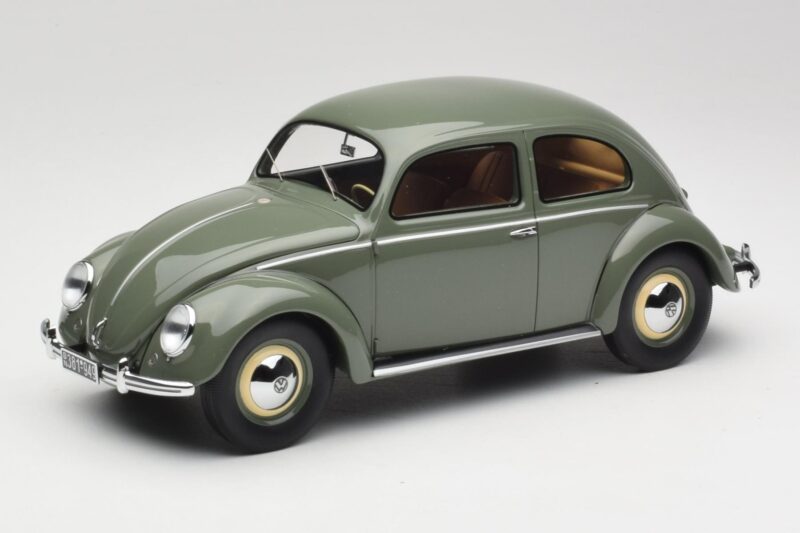
Minichamps' 1:18 resin Volkswagen Beetle reproduces the 1949 split-window saloon in a quiet beryl green shade. Sealed resin construction holds the rounded roofline and rear deck smooth, with the split window's dividing bar kept crisp and correctly dated to before the 1953 switch to a single oval pane. Built during the early post-war years at Wolfsburg, this Beetle traces the car's first steps toward becoming a global sales phenomenon, and it makes an honest, unpretentious anchor for a vintage Volkswagen shelf.
About the Volkswagen Beetle Beryl Green Minichamps 1:18
TL;DR: Minichamps' 1:18 resin Volkswagen Beetle reproduces the 1949 split-window saloon in beryl green, its sealed body holding the rounded curves of the original bodywork sharper than diecast hinges allow. Built in the early post-war years before the oval rear window replaced this split design in 1953, this Beetle traces the car's earliest steps toward global sales success.
Beryl green is a quieter shade than the black most people picture on an early Beetle, and it suits the car's rounded, almost friendly shape better than a sterner colour would, especially under a shelf's soft lighting.
Minichamps' Sealed Resin Split-Window Beetle
Why Resin Suits the Beetle's Rounded Body
The Beetle's body is almost entirely curved surfaces, from the domed roof to the rounded wings, with barely a flat panel anywhere to hide a casting seam. Resin's sealed construction plays to that shape's strengths, holding a smooth, continuous surface across the roofline and rear deck without the visible hinge lines a diecast equivalent needs for opening doors. Minichamps' casting keeps the split rear window's distinctive dividing bar crisp and correctly proportioned, a small detail that immediately signals a pre-1953 Beetle to anyone who knows the model's history.
Beryl Green Against the Era's More Common Shades
Early post-war Beetles are often remembered in black or grey, utilitarian colours suited to a car built during genuine austerity, so beryl green offers a warmer, less severe alternative on the shelf. The paint holds an even, satin-leaning gloss across the large curved panels, with the chrome bumpers and headlamp surrounds picked out cleanly against the green rather than blending into it under softer light.
A Post-War Beetle Before the Oval Window Changed the Shape
The Split Rear Window and a Simple Air-Cooled Layout
Volkswagen kept a divided, split rear window on the Beetle until 1953, when it switched to a single oval pane, which makes this dividing bar a reliable way to date any Beetle replica to the earlier, simpler era of the car's life. Underneath sat a small air-cooled flat-four engine mounted at the rear, driving the rear wheels through a straightforward, rugged mechanical layout that needed little specialist maintenance, a design philosophy that mattered enormously to a car meant for ordinary buyers rather than enthusiasts.
From Occupied Germany to a Global Sales Story
Beetle production resumed at Wolfsburg under British military administration in the years immediately after the war, before Volkswagen grew into a proper civilian manufacturer and the car began its long climb toward becoming one of the best-selling models in automotive history. A 1949 example like this one sits right at the start of that story, built while the car's eventual global success was still far from guaranteed, which gives an early split-window Beetle a genuine historical weight beyond its modest mechanical ambitions.
An Honest Entry Point Into a Vintage VW Collection
At around 18 centimetres long, this Beetle takes up less shelf space than most modern 1:18 subjects, which makes it easy to group several early post-war cars together without crowding a cabinet. Resin's sealed construction means no opening doors or bonnet here, an honest trade-off against the sharper body lines and smoother curves the material delivers on a car built almost entirely from rounded surfaces.
Judge the model's fidelity by checking the split window's dividing bar and the shape of the running boards first, since both areas change noticeably once a Beetle replica strays into later production years. The Beetle's real appeal was always its honesty rather than any claim to glamour, and a resin replica finished with genuine care reflects that same modest, unpretentious character. It sits comfortably too as a quiet counterpoint to flashier supercar subjects elsewhere in a mixed collection.
Create a free account and claim 10% off your first order — from hundreds of collectible 1:18, 1:43 and 1:12 models by Porsche, Mercedes-Benz, BMW and more.