{"ajaxurl":"https:\/\/models118.co.uk\/wp-admin\/admin-ajax.php?lang=en_GB","nonce":"221e9a437f","homeUrl":"https:\/\/models118.co.uk\/","shopUrl":"https:\/\/models118.co.uk\/shop\/","cartUrl":"https:\/\/models118.co.uk\/cart-en-gb\/","checkoutUrl":"https:\/\/models118.co.uk\/checkout\/","skipCart":true,"collectionLimit":12,"i18n":{"addedToCart":"Added to basket","addToWishlist":"Add to wishlist","addedToWishlist":"Added to wishlist","removeFromWishlist":"Remove from wishlist","removedFromWishlist":"Removed from wishlist","undo":"Undo","error":"Something went wrong","loading":"Loading...","outOfStock":"Out of stock","viewCart":"View basket","proceedToCheckout":"Proceed to checkout","addedToCollection":"Added to your collection","reserved":"Added to your collection","soldOut":"Sold out","invalidEmail":"Please enter a valid email address","connectionError":"Connection error. Please try again.","tocToggle":"On this page","close":"Close","inCartTooltip":"Already in your basket \u2013 open your basket to check out","loginToSave":"Sign in to save this model","waitlistNotify":"Notify me","waitlistOnList":"On the waiting list \u2713","waitlistJoined":"You're on the waiting list. We'll email you the moment this model is available again.","waitlistRemoved":"Done \u2014 you're off the waiting list for this model.","waitlistRateLimit":"Too many attempts \u2014 please try again shortly","waitlistTurnstile":"We couldn't complete the check \u2014 please try again","waitlistError":"Sorry, something went wrong. Please try again in a moment."},"wishlist":{"loggedIn":false,"loginUrl":"https:\/\/models118.co.uk\/my-account\/","addAction":"models118_wishlist_add","removeAction":"models118_wishlist_remove"},"waitlist":{"loggedIn":false,"subscribeAction":"models118_waitlist_subscribe","toggleAction":"models118_waitlist_toggle","stateAction":"models118_waitlist_state"},"stats":{"models":2328,"brands":213,"manufacturers":128,"collectors":10000},"product":{"id":512199,"sku":"107054001","condition":"used","availability":"out_of_stock","name":"Volkswagen Beetle Type 1 Black Minichamps 1:18","brand":"Volkswagen","manufacturer":"Minichamps","scale":"1:18","material":"Diecast","price":153,"regularPrice":153,"isOnSale":false,"savingsAmount":0,"stockQty":0,"stockStatus":"out_of_stock","isDiscontinued":true,"image":"https:\/\/models118.co.uk\/wp-content\/uploads\/2026\/06\/vw-volkswagen-beetle-type-1-saloon-black-minichamps-1-18-300x200.jpg","permalink":"https:\/\/models118.co.uk\/volkswagen-beetle-type-1-black-minichamps-1-18-107054001\/"}}
Cookies on Models118
We use cookies to remember your preferences, understand how the shop is used and show you models and offers that suit your interests. What you allow is up to you, and you can change it at any time.
Always active
The technical storage or access is strictly necessary for the legitimate purpose of enabling the use of a specific service explicitly requested by the subscriber or user, or for the sole purpose of carrying out the transmission of a communication over an electronic communications network.
The technical storage or access is necessary for the legitimate purpose of storing preferences that are not requested by the subscriber or user.
The technical storage or access that is used exclusively for statistical purposes.
The technical storage or access is required to create user profiles to send advertising, or to track the user on a website or across several websites for similar marketing purposes.
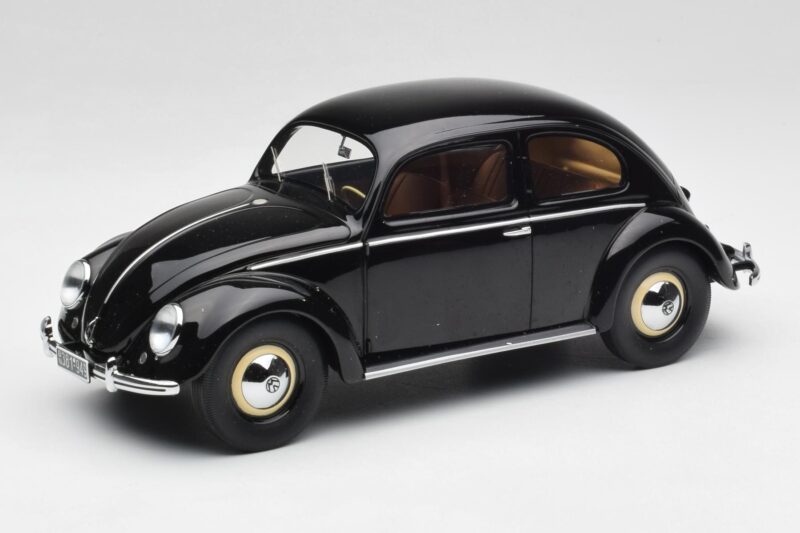
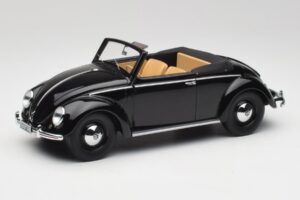
Minichamps' 1:18 diecast Volkswagen Beetle Type 1 recreates the 1949 split-window saloon in deep black, the year civilian production properly resumed at Wolfsburg. Zinc alloy construction gives real heft, with opening doors and correctly detailed chrome trim and bumpers. A straightforward, honestly priced anchor piece for anyone building an early Volkswagen or post-war European saloon collection.
About the Volkswagen Beetle Type 1 Black Minichamps 1:18
TL;DR: Minichamps' 1:18 diecast Volkswagen Beetle Type 1 reproduces the 1949 split-window saloon in black, the year civilian production resumed in earnest at Wolfsburg. Zinc alloy construction brings real weight and opening doors, with correctly detailed chrome trim. A straightforward anchor piece for early post-war European collections.
Few post-war cars carry a British chapter quite like the Beetle's. Wolfsburg's plant sat inside the British occupation zone after 1945, and this black 1949 saloon marks the point where the car properly returned to civilian hands.
Minichamps' Diecast Build and the Split-Window Shape
Zinc Alloy Weight and Opening Doors
Lift this Beetle from its tray and the zinc alloy body announces itself immediately, a dense, settled weight that plastic-bodied toys never achieve. Both doors open on metal hinges, revealing a simply trimmed cabin with a two-spoke wheel and a dashboard laid out exactly as period photographs show it. Panel gaps sit even around the doors and the split engine lid at the rear, tight enough that the diecast reads as a considered replica rather than a plaything. At this price point, Minichamps invests in the surfaces a collector actually handles, keeping the tolerances tightest where they matter most.
Black Paintwork and the Divided Rear Window
The black finish carries genuine depth under direct light rather than sitting flat, and it sets off the chrome bumpers, hubcaps and running-board trim that period Beetles wore as standard. Most tellingly, the rear window is correctly split into two small oval panes divided by a central bar, the detail that separates early split-window Beetles from the single-pane cars built from 1953 onward. Minichamps gets this right, and it is the first thing an informed collector checks on any early Type 1 replica. The wheels sit within narrow, upright arches, matching the car's plain, unadorned original stance.
Wolfsburg's Post-War Restart and the 1949 Beetle
Major Ivan Hirst and the British Occupation Years
When Allied forces reached Wolfsburg in 1945, the factory lay within the British zone of occupied Germany, and a British Army officer, Major Ivan Hirst, was given the task of getting it running again. Rather than scrapping the tooling, Hirst organised production of the Beetle for military transport and, soon after, for civilian sale, a decision now widely credited with saving the company from dismantlement. Control passed back to German management under Heinz Nordhoff as the decade closed, and by 1949 Volkswagen was operating again as a properly civilian concern, no longer under direct British administration.
The First Export Beetles
That same year marked Volkswagen's first serious push into markets beyond Germany, with export-specification Beetles reaching buyers abroad for the first time. The saloon this model reproduces sits right at that hinge point, built as the company shifted from wartime survival toward the export success that would define the following decades. Nothing about the shape was flamboyant; the appeal lay in durability and simplicity, qualities the diecast replica communicates through plain black paintwork and unfussy detailing rather than any dramatic styling flourish.
Where a Split-Window Beetle Sits in a Collection
At roughly 15cm long, this 1:18 Beetle takes up modest shelf space, making it easy to group several early Volkswagens together without crowding a cabinet. Minichamps also produces this same early saloon in resin, aimed at collectors who want the sharper, sealed-body panel lines that construction allows in exchange for opening features; this diecast version suits anyone who wants to handle the doors and inspect the simple interior first-hand. Priced at an accessible diecast level rather than a limited-edition resin premium, it works well as an entry point into post-war European saloon collecting, or as the plain, honest counterpoint to flashier company on the same shelf. Keep it away from direct sunlight and dust, as with any diecast, and the black paint should hold its depth for years without yellowing.
Create a free account and claim 10% off your first order — from hundreds of collectible 1:18, 1:43 and 1:12 models by Porsche, Mercedes-Benz, BMW and more.
{"id":512199,"name":"Volkswagen Beetle Type 1 Black Minichamps 1:18","price":"£<\/span>153.00<\/bdi><\/span>","image":"https:\/\/models118.co.uk\/wp-content\/uploads\/2026\/06\/vw-volkswagen-beetle-type-1-saloon-black-minichamps-1-18-400x400.jpg","permalink":"https:\/\/models118.co.uk\/volkswagen-beetle-type-1-black-minichamps-1-18-107054001\/","brand":"Volkswagen"}