Used
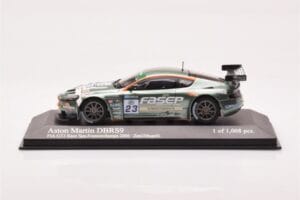
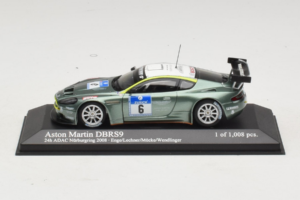
Aston Martin DBRS9 BMS Scuderia Italia #23 Zani / Mugelli FIA GT3 European Championship Spa 2006 Minichamps 1:43
Only 3 left
Price:
£32.00
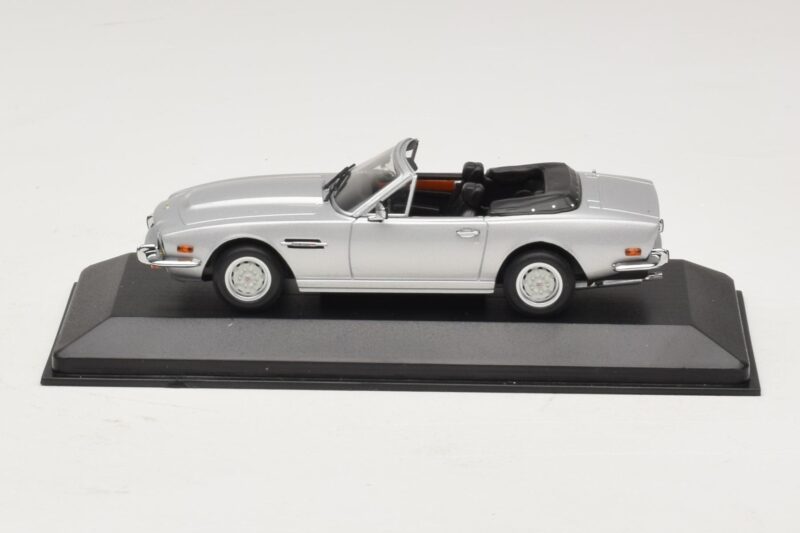
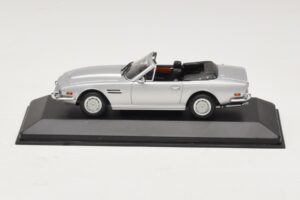
TL;DR: Minichamps' 1:43 Aston Martin V8 Volante reproduces the classic convertible in silver diecast. The body is a sealed one-piece casting, so the folded roof and low scuttle line are captured in shape and paint rather than moving parts. A compact way to add Aston's V8-era open-top motoring to a classic shelf.
Aston's V8 range replaced the six-cylinder DB cars at the turn of the 1970s, carrying a bigger engine under a shape that still traced its lines back to Touring's Italian styling. The Volante brought a folding roof to that line, and Minichamps' 1:43 silver casting keeps the low scuttle and long bonnet that made the convertible read as a proper grand tourer.
The V8 that underpins this Volante was Aston's move away from the six-cylinder DB engines that had carried the marque through the 1960s, fitting a new V8 under a body that still wore Touring of Milan's superleggera-influenced lines from the earlier DB generation. Where the DB cars had been coupes and drop-heads built in smaller numbers, the V8 range aimed to modernise Aston's flagship while keeping its silhouette recognisably continuous, and the Volante convertible extended that shape into an open-top format with a folding fabric roof rather than a fixed hardtop.
Minichamps' 1:43 casting tracks the model's proportions closely, holding the long, tapering bonnet that houses the V8, the low waistline that runs unbroken from front wing to rear haunch, and the compact rear deck where the folded roof sits. The windscreen frame keeps a period-correct rake, and the wing mirrors, cast as separate applied pieces rather than moulded lumps, sit at the right height relative to the door line. Silver paint suits this era of Aston particularly well, and the casting rewards that choice with genuinely crisp highlights along the shoulder line. Chrome-effect trim around the grille and windscreen surround is picked out cleanly, distinct from the body colour.
As with most 1:43 diecast from this era of subject, the Volante's body is cast as a single sealed shell rather than built with opening doors or a lifting bonnet. At this scale that is standard practice rather than a shortfall: a hinge mechanism small enough for 1:43 tends to widen shut lines and soften edges exactly where a convertible needs them sharpest, along the scuttle, the door tops and the folded-roof deck. Keeping the body sealed lets Minichamps hold those lines tight and lets the waistline crease run continuously without a gap interrupting it partway along the door.
The zinc alloy construction gives the model real heft for its footprint, noticeably denser than a resin casting of the same size would feel. Silver metallic paint sits directly on the primed metal, and the flake reads with a fine, even sparkle rather than clumping, visible when the model catches a display light at an angle. The interior, glimpsed through flush-fitted glazing, keeps a simplified but correctly shaped two-plus-two cabin, with a period dashboard layout and bucket seats moulded in a contrasting tone. This sits at Minichamps' familiar mid-tier finish for 1:43.
A 1:43 collection tracing Aston's convertible history gains real context from having this early V8 Volante next to later open-top Astons, since the family resemblance across decades of Touring-influenced styling becomes obvious side by side. It works equally well as a standalone classic-era piece for a British sports car shelf, where its silver finish and compact convertible silhouette read cleanly among period-correct rivals from Jaguar or Mercedes-Benz. At roughly 10cm long, the model needs little shelf space, so building out a run of Aston generations, DB through V8, remains practical even in a modestly sized cabinet, and the silver colourway gives that run a calm, understated anchor point among brighter liveries elsewhere. Aston's cross-decade design language, still recognisable from Touring's original superleggera work, is exactly the kind of thread that rewards a themed display like this.



Save £14.00