Used
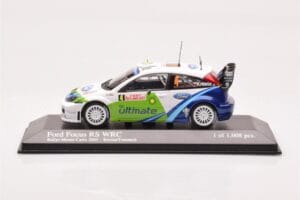
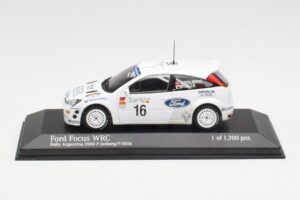
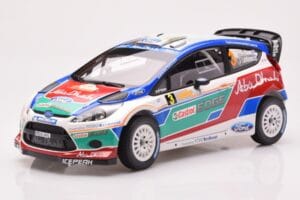
Ford Focus RS WRC #4 R. Kresta / J. Tomanek Rally Monte Carlo 2005 Minichamps 1:43
Only 2 left
Price:
£89.00
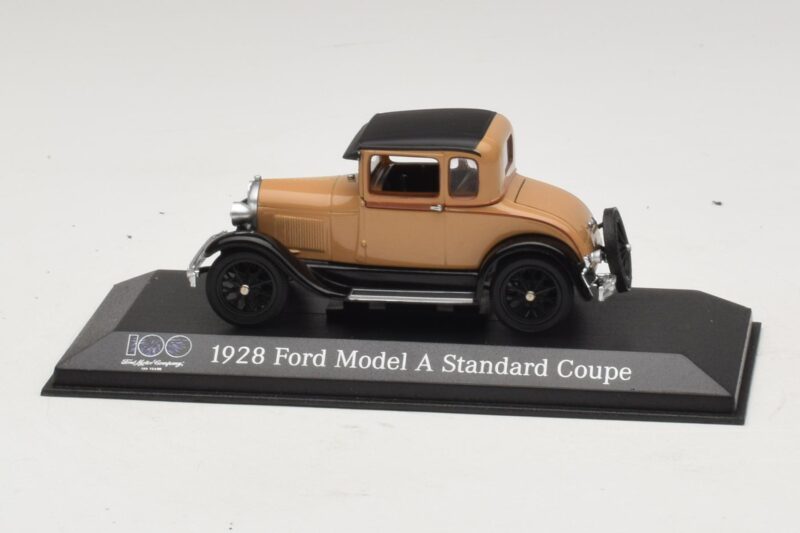
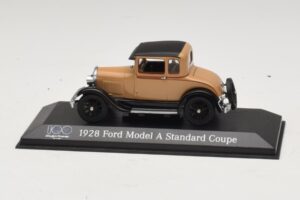
TL;DR: Minichamps' 1:43 diecast Ford Model A Standard Coupe in Bronze reproduces the 1928 car that replaced the Model T and brought Ford into the modern era. The sealed zinc alloy body holds crisp fender and running board detail rather than opening doors, an anchor piece for a pre-war vintage shelf.
Nothing Ford built before it sold in the volumes the Model T managed, and nothing after it needed to prove Ford could still innovate once that formula finally aged out. The Standard Coupe was one of several body styles offered on the same chassis, aimed at buyers wanting style over practicality.
When Ford introduced the Model A in late 1927, replacing a Model T design that had barely changed in nearly two decades, the company offered the new car across a wide range of body styles built on a shared chassis and running gear. The Standard Coupe sat among the more affordable configurations, aimed at buyers who wanted a proper closed cabin without stretching to the costlier Sport Coupe or Cabriolet variants Ford also offered. Its modest specification made it one of the best-selling body styles in the range, a workhorse choice rather than a showpiece, which is exactly why it represents the Model A's mass-market character better than a flashier alternative would.
Ford famously restricted the Model T to black for most of its run, and the Model A's arrival brought a genuine colour palette to Ford ownership for the first time, Bronze among the more distinguished period choices available. The finish on this casting carries appropriate depth for a subject this old, avoiding the flat, lifeless look that cheaper pre-war tooling sometimes applies to vintage subjects. Getting the colour right matters here specifically because colour choice was itself part of the Model A's story, a genuine step forward from the T's famous monotony.
Pre-war cars carry their character in separate, sculptural elements rather than a single flowing shape, and this casting captures that: the sweeping fenders, the running boards linking front and rear wheel arches, and the upright, narrow radiator grille all read as distinct forms rather than smoothed into a modern silhouette. With no opening doors or bonnet, every one of those elements has to be moulded convincingly rather than relying on an opening panel to add interest, and Minichamps holds crisp definition along each fender edge and running board rib. It is a demanding subject for a sealed-body casting precisely because so much of the car's appeal lives in its exterior sculpture rather than its cabin.
The zinc alloy build gives this small coupe a reassuring solidity in the hand, denser than its compact 1:43 footprint might suggest, and that weight is part of what separates a considered diecast casting from a lighter promotional toy. Paint depth on the Bronze finish holds up under close inspection, with the wire wheels and narrow tyres correctly proportioned to the era rather than borrowed from later, wider rubber. Small details like the spare wheel mounting and the split windscreen frame carry through cleanly.
A pre-war American subject like this Model A brings genuine historical weight to a collection that might otherwise skew toward 1960s and 1970s European saloons and coupes, and its compact 1:43 scale means it slots easily alongside far newer subjects without looking out of place through sheer bulk. It works well as the oldest car on a themed Ford shelf, tracing the company's history from mass-motoring pioneer through to the rally and touring car programmes represented elsewhere in a collection. Priced modestly for a diecast of this vintage specificity, it rewards collectors interested in automotive history as much as those chasing performance heritage, and it holds its own as a standalone display piece even without a wider Ford theme built around it.


Save £14.00