Used

Ford Focus RS WRC #4 R. Kresta / J. Tomanek Rally Monte Carlo 2005 Minichamps 1:43
Only 2 left
Price:
£89.00
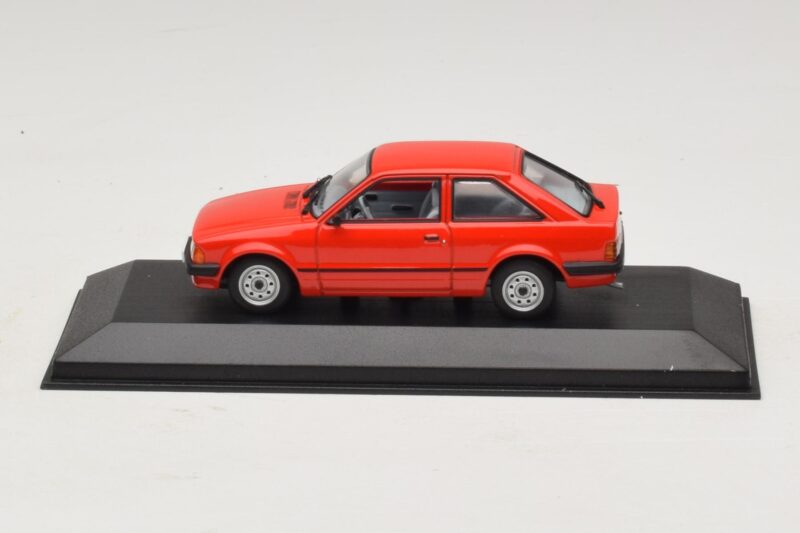
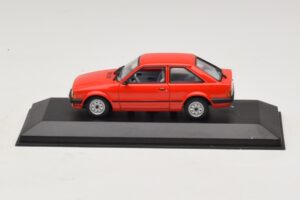
TL;DR: The Minichamps 1:43 Ford Escort Mk3 reproduces the 1981 three-door hatchback in red diecast. The sealed one-piece body carries the sharper, more aerodynamic lines that marked Ford's shift to front-wheel drive. Correct proportions and crisp trim make it a clean anchor for an early-1980s Ford shelf.
Where the Mk2 Escort had looked like a squared-off descendant of its predecessor, the Mk3 arrived in 1980 as something genuinely new, a hatchback built around front-wheel drive rather than the layout Ford had used for two generations. Minichamps renders that shift convincingly at 1:43.
This casting is a fixed, one-piece body, with the hatch, doors and bonnet moulded solid into the shell rather than hinged. That construction suits the Mk3's shape well, holding the sharply raked rear hatch and the wedge-profile nose true from every angle, with no gap left where a panel would otherwise need to swing clear. Shut lines run as fine, consistent grooves rather than functional joints, tracing the hatch outline and door edges without widening near a pivot point. The three-door body's short overhangs and steep windscreen angle read clearly, the details that made the Mk3 look genuinely modern next to the car it replaced. Glazing sits flush within its aperture rather than standing proud, an important detail on a car whose greenhouse shape was one of its most talked-about features when new.
Red paint covers the body in the flatter, brighter finish typical of early 1980s Ford colour options rather than a deep modern metallic. Black plastic bumpers and grille surrounds, a Mk3 hallmark that replaced the chrome trim of the previous generation, are picked out separately from the body colour rather than left uniform, and the door mirrors carry the more aerodynamic shape the car introduced. Badging on the tailgate and front grille stays legible under close inspection, and the wheels wear the simpler trim pattern typical of the mainstream three-door specification rather than a sportier RS-derived design.
Ford launched the Mk3 Escort in 1980 as an almost complete reinvention: front-wheel drive in place of the rear-wheel-drive layout used since the original 1968 Escort, a transverse engine, and a hatchback body in place of the traditional saloon and estate. It was a bigger technical shift than any Escort generation before or since, aligning Ford with the front-wheel-drive small-car layout that had already proven itself across much of the industry. The switch also freed up cabin space relative to the car's compact footprint, part of why the Mk3 sold so strongly across Europe despite arriving into a genuinely competitive small-car market.
The styling matched the mechanical change: a lower bonnet line, a steeply raked windscreen and a wedge-shaped profile replaced the boxier lines of the Mk2, giving the Mk3 a distinctly more aerodynamic look that suited the fuel-conscious early 1980s. The three-door hatchback body, in particular, showed off that new shape better than the five-door version, its shorter proportions emphasising the sharp nose and short tail. That shape change was not purely cosmetic either: the more aerodynamic profile measurably improved fuel economy over the outgoing Mk2, a genuinely practical benefit that mattered to buyers during a decade shaped by fuel prices.
This Mk3 works well as the hinge point in a Ford Escort collection, the model that shows exactly where the range broke from three generations of rear-wheel-drive layout and started again with a genuinely modern platform. At 1:43 it sits naturally beside an earlier Mk2 saloon or coupe, the contrast in shape doing most of the explaining without needing a caption. The sealed body asks nothing beyond routine dusting and careful handling over years on display. It also opens naturally onto later Mk4 and Mk5 hatchbacks further along the same shelf, tracing the front-wheel-drive Escort story all the way to the model's eventual replacement by the Focus.







Save £14.00