Used
Back in stock

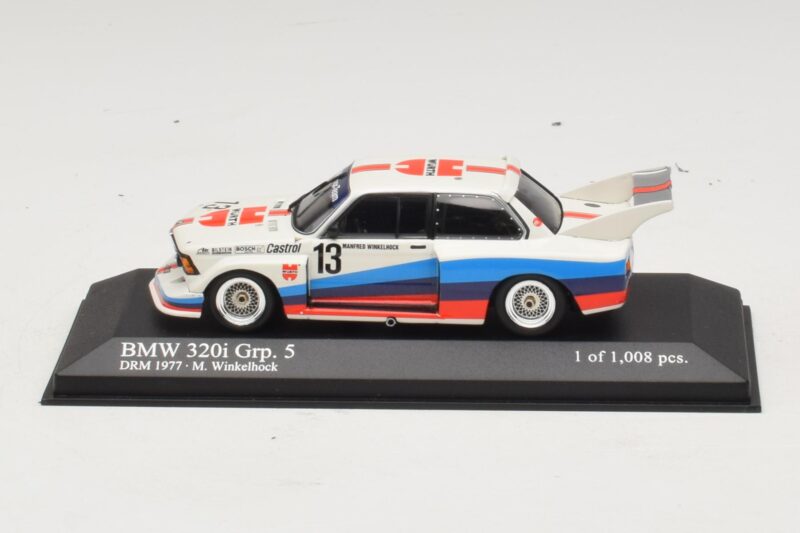
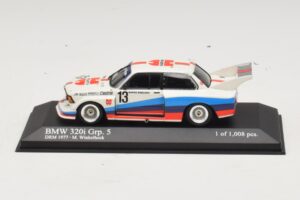
TL;DR: Minichamps' 1:43 BMW 320i Group 5 reproduces Manfred Winkelhock's number 13 car from the 1977 DRM season, in a sealed one-piece shell carrying wide-arch silhouette bodywork and period sponsor livery. It suits collectors building a shelf around Germany's most extreme era of touring-car racing.
Group 5 rules let manufacturers reinvent their touring cars almost completely, and BMW's 320i took full advantage: flared arches, deep front splitters, and a rear wing that owed more to sports prototypes than saloon cars. Manfred Winkelhock drove one in the 1977 DRM season, and Minichamps' number 13 casting captures that wild silhouette-era styling exactly.
Group 5 regulations of the mid-to-late 1970s allowed such extensive bodywork modification that the resulting silhouette cars barely resembled their showroom origins beneath the panels. BMW's 320i wore box-arch extensions wide enough to house racing rubber far beyond anything a road car could accommodate, along with a deep front air dam and a rear wing mounted high enough to work in clean air. Minichamps reproduces those exaggerated proportions faithfully rather than softening them for the smaller scale, and the wheel-to-arch relationship, the part that makes or breaks a silhouette-car casting, holds correctly across the model's width.
The body is sealed, a single diecast shell with no opening doors or bonnet, which suits a subject this visually busy: with no hinge line disrupting the surface, the sponsor decals and number 13 graphics wrap around the arch extensions and door panels without interruption. The flat window surrounds and roll cage suggestion behind the glass read clearly for a model at this scale, and the racing wheels sit at the correct offset within those box arches rather than looking tucked in. Zinc alloy gives the small casting genuine heft, and that weight helps a car this visually extreme feel substantial rather than fragile in the hand.
Manfred Winkelhock built his reputation through the DRM before moving into Formula 1, and his son Markus later followed a similar path through German motorsport decades afterward, giving the family name a lasting presence in the sport. The 320i Group 5 car sat at the smaller end of BMW's touring car efforts, overshadowed at the time by the more famous CSL and later the M1, but it gave younger drivers like Winkelhock a genuine platform to prove themselves against established names on a demanding domestic championship. That developmental role matters as much to the car's story as any single race result.
The DRM's Group 5 period, roughly 1976 through the early 1980s, produced some of the most visually extreme touring cars ever to race, a brief window before regulations reined the extremes back in. For collectors, that makes the era a genuinely rich theme: BMW, Ford, and Porsche all built silhouette cars during these same seasons, each interpreting the loose bodywork rules differently. A 320i alongside a Group 5 Escort or a contemporary Porsche silhouette car documents how differently three manufacturers solved the same regulatory puzzle, a comparison that a single-marque collection can never quite offer on its own.
This 320i works hardest as part of a wider Group 5 display rather than standing alone, because its extreme bodywork only makes full sense next to cars built under the same loose regulations. At 1:43, several silhouette cars from competing manufacturers fit comfortably along one shelf, letting a collector build out the full visual chaos of the late-1970s DRM in a way a single car cannot convey. The Winkelhock connection adds a genuine motorsport pedigree beyond the bodywork spectacle, tying the model to a driver whose career extended well beyond this one campaign. For anyone assembling a 1970s German touring car collection, this era's silhouette cars remain some of the most immediately recognisable subjects available at this scale, and this one is a strong entry point into that specific story.






Save £14.00