Used
Back in stock
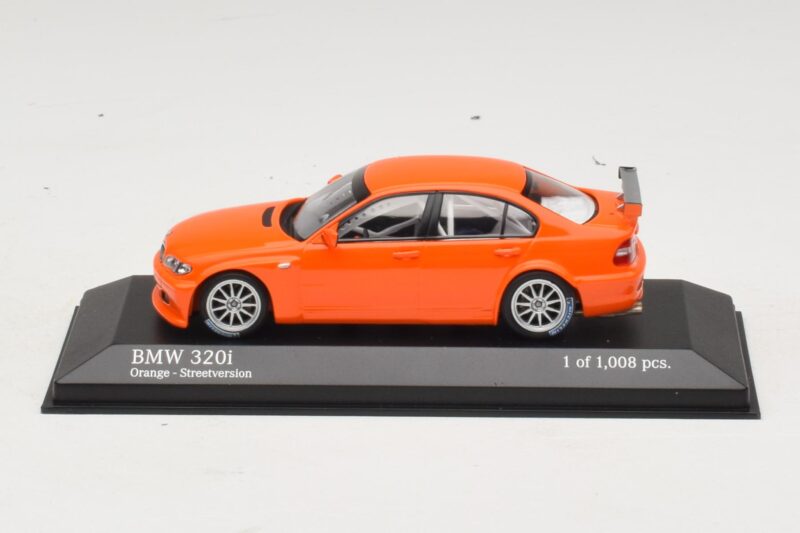
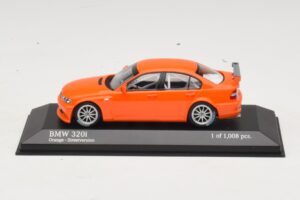
TL;DR: Minichamps' 1:43 diecast BMW 320i E46 in orange reproduces the last analogue-feel 3 Series saloon before electric steering arrived. The sealed zinc alloy body holds clean panel lines and correct saloon proportions rather than opening doors, a compact everyday piece for collectors building a complete E46 shelf.
The E46 never carried the drama of a homologation special, and that honesty is the point: it was the 3 Series that most people actually owned. Minichamps treats this orange saloon with the same care given to rarer subjects, which is exactly what makes an everyday-car collection worth building.
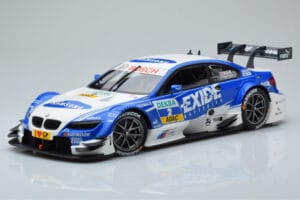
Where a racing E46 wears a roll cage, wide arches and sponsor graphics, this street version carries the saloon exactly as it left a BMW showroom in the mid-2000s: standard bumpers, factory alloy wheels and no aerodynamic addenda. That plainness is deliberate rather than a shortfall, and it matters for a collector trying to represent the full range of what one chassis code produced, from Priaulx's touring cars through to the family saloon parked on an ordinary driveway. The 320i sat in the middle of the E46 engine range, offering enough performance to feel sporting without pushing into M3 territory, and Minichamps' street casting reflects that mid-range identity rather than exaggerating it into something the car never was.
Orange was never a common factory colour on a mainstream 3 Series, and that rarity is part of what makes this casting worth a second look rather than a routine addition. The paint sits with reasonable depth on the zinc alloy shell, and the body's shut lines run as continuous grooves along the doors and boot rather than interrupted by any opening mechanism, which keeps a saloon this ordinary looking genuinely tidy up close. Wing mirrors, door handles and badge printing are all present in fine detail, the small touches that separate a considered mid-tier casting from a toy-grade one.
At 1:43, panel gaps have to read as consistent lines rather than measured tolerances, and Minichamps holds that consistency along the bonnet shut and boot edge without any softening around the wheel arches. The BMW roundel and 320i badge are printed rather than raised, sharp enough to identify under a loupe without dominating the bodywork the way an oversized decal would. Wheel design follows the factory alloy pattern fitted to this trim level, and the tyre sidewalls carry the correct proportion rather than the over-inflated look cheaper tooling sometimes produces. It is exactly the standard of finish a saloon like this deserves: careful without pretending to be something more expensive than it actually is, and consistent enough that it holds up under close inspection rather than only from across a room.
A 1:43 saloon takes up a fraction of the shelf depth a 1:18 model needs, which lets a collector run several BMW generations side by side without dedicating a whole cabinet to one marque. This E46 sits comfortably next to a Neue Klasse saloon from four decades earlier, tracing the family's saloon lineage across a single shelf rather than a single scale-specific display. The trade-off is proportional: less surface detail than a larger scale allows, but a footprint that makes building a genuine generational run realistic rather than a space-hungry ambition.
This orange 320i works best as connective tissue in a wider BMW collection rather than as a standout centrepiece, and there is genuine value in that role. It bridges older Neue Klasse saloons and later M-badged performance models, showing what an ordinary mid-2000s BMW actually looked like away from motorsport liveries. Priced at a modest, accessible level typical of street-trim 1:43 diecast, it suits collectors easing into the marque before committing to pricier race replicas or limited editions. Displayed beside the racing E46 from the same era, the pairing tells a more complete story than either model manages alone: one chassis, two entirely different lives, and a shelf that reads as a small history lesson rather than a random assortment of orange cars.
Save £14.00