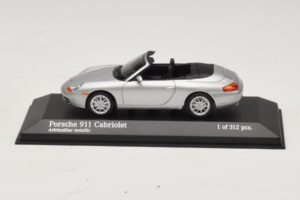
Used
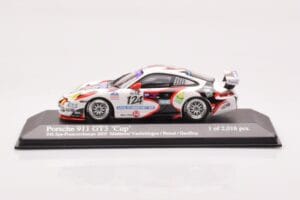
Porsche 911 997 GT3 Cup #124 Mattheus / Geoffroy / Vanbellingen / Fumal 24 Hours of Spa 2005 Minichamps 1:43
Only 3 left
Price:
£29.00
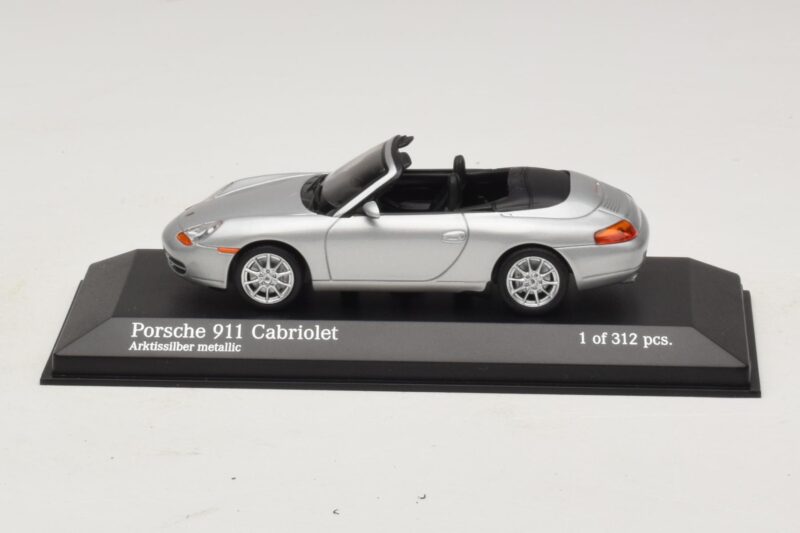
TL;DR: Minichamps' 1:43 diecast Porsche 911 996 Cabriolet arrives in silver metallic, the colour that dominated 996-era order books through the late 1990s. The sealed one-piece body carries the convertible's stowed soft-top and folding roofline as cast detail. A neutral, versatile way to add the water-cooled 911's open-top generation to a shelf.
Silver was not a safe default on the 996; it was closer to the era's uniform, the colour Porsche's own configurators pushed hardest and the one that turned up most often outside dealerships through 1998 and beyond. This cabriolet wears it correctly, a cool, slightly blue-grey metallic rather than the warmer tone some diecast runs mistakenly apply to Porsche silvers.
Silver's dominance on the 996 was partly practical: it hid the panel gaps and shutlines that early 996 build quality sometimes struggled with, and it photographed well in period brochures trying hard to sell buyers on a controversial new headlamp design. It was also simply what German luxury buyers of the late 1990s tended to order across most marques, a conservative choice for a car that was, mechanically, anything but conservative, a level of ambition well beyond what a cautious colour choice might suggest. The cabriolet followed this pattern closely, and silver soft-top 996s remain some of the most commonly found survivors on the used market today, which makes an accurately cast silver example a genuinely representative choice rather than a rare curiosity.
At 1:43, the cabriolet's lowered beltline and correctly raked windscreen sit apart from the coupe cast in the same range, and the stowed soft-top behind the rear seats holds its folded shape rather than reading as a flat lump. The scale keeps the whole roofline story, folded top, rear glass, boot lid, compact enough that a coupe and cabriolet pair take up barely more shelf space than a single 1:18 piece. Silver's lighter tone also makes the door shutlines and boot seam easier to read at a glance, and that legibility is worth something on a model whose sealed body relies entirely on line quality to prove its casting.
This casting is sealed, the same fixed shell used across the cabriolet colour run, and the approach favours a subject like this one: no hinge tolerance to widen the door or boot gaps, so the lines stay a consistent width from the sill to the waistline. The bonnet seam sits flush against the front wings rather than stepping up or down, and the wing mirrors and door handles hold crisp edges under a loupe. Zinc alloy gives the piece real weight for its size, denser in the hand than the soft-top fabric it represents would ever suggest, and that density is part of what separates a considered mid-tier diecast from a hollow-feeling toy.
Silver metallic is forgiving in one sense and unforgiving in another: forgiving because it hides minor casting texture a dark colour would expose, unforgiving because a poorly applied metallic flake reads as chalky or grey rather than bright under a lamp. This finish leans toward the correct cool tone, with fine, evenly distributed flake rather than coarse sparkle, and the paint sits deep enough on the bonnet and roof rails that reflections travel across the surface rather than sitting flat on top of it.
Set beside the black and red cabriolets from the same Minichamps run, silver reads as the honest, everyday choice, the colour most 996 cabriolets actually left the factory wearing rather than the one a brochure cover would favour. That makes it the sensible starting point for a collector building a themed run of 996-era colourways, since it establishes the baseline the louder options get compared against. At 1:43, a trio of cabriolet colours takes up little more shelf space than a single larger-scale piece, keeping a full colour study within easy reach.
Save £14.00