Used

Porsche 911 997 GT3 Cup #124 Mattheus / Geoffroy / Vanbellingen / Fumal 24 Hours of Spa 2005 Minichamps 1:43
Only 3 left
Price:
£29.00
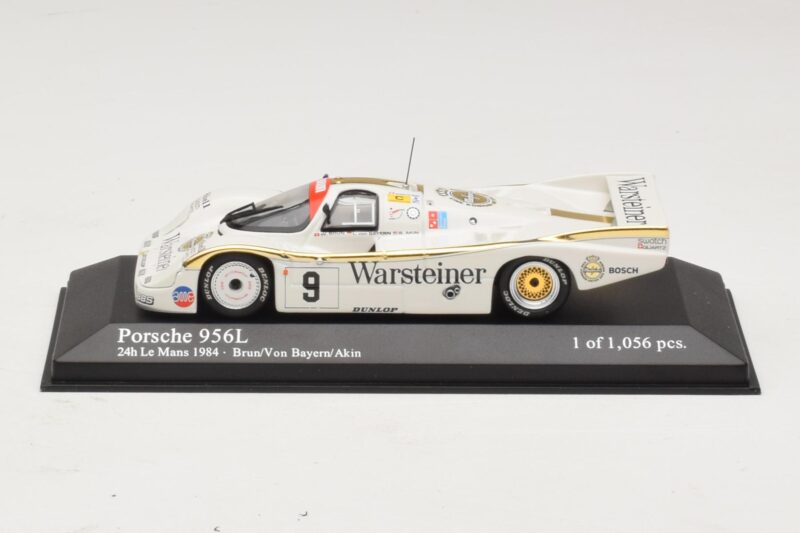
TL;DR: Minichamps' 1:43 Porsche 956L reproduces the long-tail Group C prototype run by Brun Motorsport under Warsteiner colours at the 1984 24 Hours of Le Mans, car number 9. The diecast body is a sealed one-piece shell, its low, elongated tail shaped for Mulsanne-straight speed rather than downforce.
Group C prototypes were built for one number that mattered more than any other: top speed down the Mulsanne. The 956L, its 'L' standing for Langheck, or long-tail, is the version Porsche and its customer teams reached for at Le Mans specifically, and this Brun Motorsport entry under Warsteiner sponsorship is exactly that specialist car.
Porsche built the 956 as a Group C prototype from 1982, and it dominated the category almost immediately, but the standard-tail body was tuned for a balance of downforce and drag that suited most circuits rather than Le Mans specifically. The 956L stretched and reshaped the tail section, trading some cornering downforce for a meaningfully lower drag figure down the Sarthe circuit's famous straight, at the time still unbroken by chicanes. Customer teams running the works-supported programme, Brun Motorsport among them, specified the long-tail configuration for exactly this race and rarely used it anywhere else on the calendar, which is part of why a correctly liveried 956L carries more specific history than a standard-bodied 956 ever could.
Minichamps casts this 956L in zinc alloy, and the weight is immediately obvious against any resin prototype on the same shelf, a genuine density that comes from pressure-cast metal rather than a lighter material. The body is a sealed, one-piece shell with no opening panels, which suits a Group C prototype better than it might suit a road car: these were low, flat racing shapes with bodywork removed entirely for pit stops rather than hinged doors, so a fixed casting is the honest way to reproduce the silhouette without a seam breaking the tail's low profile.
The white body with Warsteiner's bold lettering and black-and-gold accents was one of the more visually distinctive liveries in a Group C field otherwise dominated by Rothmans' works Porsches and Martini's factory colours. Reproducing that scheme accurately at 1:43 depends on tampo-printed graphics rather than decals, since a printed finish sits flat against the casting and keeps sponsor lettering crisp along the doors and rear deck where a curved surface would otherwise distort a transfer. The number 9 sits within a clean roundel on the door and nose, positioned to match period photography of the Brun entry rather than a generic placement.
Behind the small cockpit glazing, Minichamps picks out the roll cage structure and driver's seat in a contrasting finish rather than leaving the interior a single moulded colour, one of the details separating a considered Group C casting from a basic one. The wheels carry the correct period tread pattern and centre-lock detail, set within arches shaped to the 956's low, wide stance. From above, the elongated tail is the single most identifying feature against a standard-bodied 956, and Minichamps holds that shape faithfully rather than compromising it to fit a generic prototype tooling.
A 956L on its own tells one car's story; a small run of them, in different liveries from the same 1984 race, starts to look like a grid. This Warsteiner-liveried number 9 pairs naturally with other privateer and works entries from the same event, letting a collector reconstruct a slice of that Le Mans field rather than owning a single isolated model. Group C prototypes reward that kind of thematic collecting more than most racing subjects, and Minichamps' small-scale detailing is exactly what makes those differences worth chasing. For anyone building a 1980s endurance-racing shelf, this is a genuine specialist's choice rather than a generic prototype filler.




Save £14.00