Used

Porsche 911 997 GT3 Cup #124 Mattheus / Geoffroy / Vanbellingen / Fumal 24 Hours of Spa 2005 Minichamps 1:43
Only 3 left
Price:
£29.00
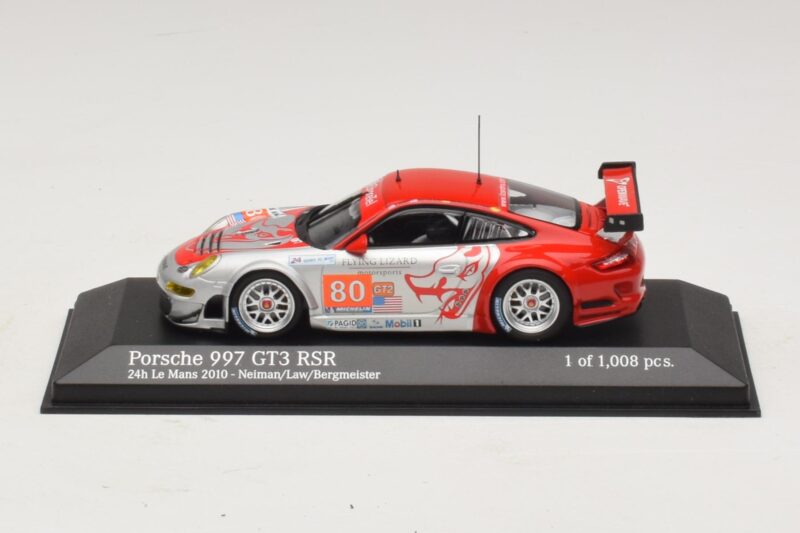
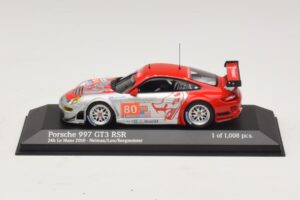
TL;DR: Minichamps' 1:43 diecast Porsche 997 GT3 RSR reproduces car #80, driven by S. Neiman and D. Law in the GT2 class at the 2010 Le Mans 24 Hours. A sealed zinc alloy casting with tampo-printed livery, this modern GT racer sits four decades on from Porsche's Group 4 934.
Four decades separate the 934 from this GT3 RSR, yet both raced Le Mans's GT class under broadly similar principles: take a road-going 911, adapt it within the rules, and let privateer and semi-factory teams campaign it against similar machinery. Minichamps' 1:43 model reproduces the #80 car from 2010, driven by Neiman and Law, at the modern end of that long lineage.
Minichamps builds this GT3 RSR the same way it builds its older 934s, as a single sealed casting with no doors, bonnet or engine cover designed to open. That continuity of approach makes sense: at 1:43, a fixed body still holds tighter, more consistent panel lines than an opening mechanism could manage regardless of which decade the subject comes from. The GT3 RSR's aggressive aerodynamic package, its deep front splitter, prominent rear wing and wide vented arches, all needed for genuine GT2-class downforce, is cast with sharp definition rather than softened for ease of moulding. The zinc alloy build carries real weight for its footprint, giving this modern racer the same settled, substantial feel on the shelf as its older 934 counterparts, despite the four decades separating their original competition seasons.
The #80 livery is applied through tampo printing rather than waterslide decals, keeping the sponsor graphics and race number flat against the modern GT3 RSR's aerodynamic bodywork with no risk of lifting or silvering over time. Registration across the door panels, splitter and rear wing endplates holds consistently, a level of precision that matters more on a car with this many separate aerodynamic surfaces than it would on a smoother-bodied road-derived shape. The colour scheme reads clearly at a glance, distinct from the older 934 liveries in this collection through its more contemporary sponsor graphics and numbering style, a visual marker of just how far both livery design and the underlying racing regulations had moved between the 934's Group 4 era and this GT2-class 997.
The GT3 RSR line evolved from Porsche's earlier GT3 Cup and RS racing programmes, developed specifically for the GT2 class regulations that governed production-based sports car racing through the 2000s and into the following decade. Based on the 997-generation 911, the RSR carried a wide aerodynamic kit, a sequential racing gearbox and a stripped, roll-caged interior, built to compete against similarly-derived GT cars from other manufacturers rather than against Porsche's own prototype efforts higher up the Le Mans grid. By 2010, the GT2 class had become one of the most competitive categories in international sports car racing, with multiple manufacturers fielding serious factory and semi-factory efforts, making a class finish considerably harder to achieve than it might once have been in less contested eras.
Set alongside the 934s in this collection, the GT3 RSR shows just how far Porsche's GT racing philosophy travelled between 1976 and 2010. Both cars started from a road-going 911 and adapted it within the rules of their era, but the tools available for that adaptation changed enormously: composite bodywork, computer-aided aerodynamic design and vastly more sophisticated racing gearboxes separate this GT3 RSR from the comparatively simple 934 by a wide margin. What hasn't changed is the underlying idea, a production-based 911 turned into a genuine Le Mans competitor without becoming an unrecognisable prototype, a thread running through every generation of Porsche GT racing from the 934 through the GT3 RSR and beyond it into the cars campaigned today.
For a collector who has gathered several of Minichamps' 1970s and 1980s 934 entries, this GT3 RSR is the natural piece that brings the story into the modern era, the same basic idea of a road-derived 911 racing at Le Mans, executed with three more decades of technology behind it. At 1:43, adding a single modern GT2 car to an otherwise vintage-focused shelf costs little in space while adding real visual and historical range, the flared, downforce-hungry 997 sitting in obvious contrast to the comparatively understated 934s beside it. This #80 entry doesn't need to be the fastest or most famous car from 2010 to earn its place; it only needs to represent, honestly and in convincing detail, what Porsche's Le Mans GT effort had become by the time this generation raced.



Save £14.00