Used
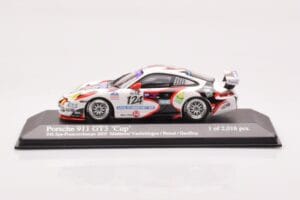
Porsche 911 997 GT3 Cup #124 Mattheus / Geoffroy / Vanbellingen / Fumal 24 Hours of Spa 2005 Minichamps 1:43
Only 3 left
Price:
£29.00
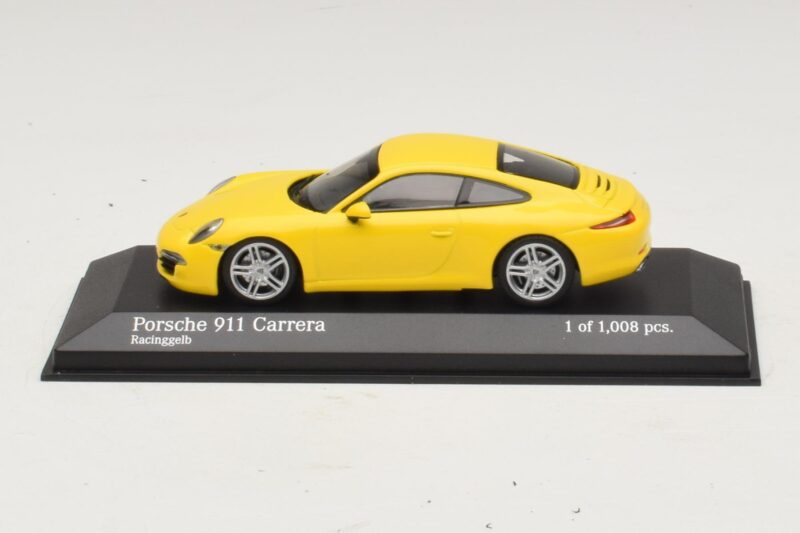
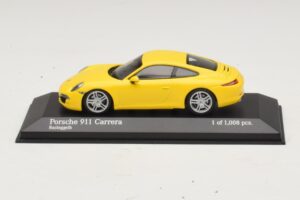
TL;DR: Minichamps' 1:43 diecast Porsche 911 996 in yellow reproduces the 1998 coupe as a sealed zinc alloy casting with fixed panels. Praised for chassis dynamics even as its styling divided opinion, this generation gives a classic Porsche shelf a genuinely bright, distinctive colour option.
Strip away the headlight debate and the 996 was, by most measures, a better car to drive than the 993 it replaced: lighter, stiffer and more capable in corners. Minichamps' 1:43 yellow coupe puts that underrated engineering case on the shelf in a colour bright enough to stand out among darker classic 911s.
Like Minichamps' other 1:43 911s from this era, the 996 arrives as a single sealed body, with no doors, bonnet or boot designed to open. At this scale that construction pays off directly: panel lines around the doors and rear deck stay perfectly even, unaffected by the wider tolerances a hinge mechanism would need to function reliably in a casting this small. The zinc alloy build gives the model genuine weight for its footprint, noticeably denser than a resin equivalent, and that density is part of why a shelf full of 1:43 diecast has real presence despite the compact size of each individual piece. Wheel design, mirror housings and the badge on the boot lid all hold crisp definition, cast rather than moulded with the softer edges a hinge cavity would otherwise force.
Yellow was a genuine factory option across much of the 911 range through the late 1990s, and it flatters the 996's smooth, rounded body language differently than red or silver would, catching light continuously along the fender curves rather than in sharp highlights. The finish sits deep and even on the hard metal shell, the gloss that a zinc alloy casting allows a painted surface to hold under a display lamp. Against this bright base colour, smaller cast details, door handles, the rear badge, the headlight lens surrounds, stand out with more contrast than they would on a darker example, making the model easier to inspect closely for anyone judging cast quality before buying. It also makes a distinctly different visual statement from a red or silver 996 sitting alongside it.
Whatever the headlight debate did to the 996's reputation, the underlying engineering told a different story: Porsche built a lighter, stiffer chassis than the outgoing 993, with a wider track and a fully new platform that would carry the 911 forward for two more generations. Independent testing at the time consistently praised the 996's handling balance and its willingness to change direction, qualities that mattered more to drivers than headlight shape ever did. That gap between critical reception and driving reality is a familiar pattern in car history, and it's part of why the 996 has aged into a more respected car than the reaction at its launch might have suggested. A yellow coupe like this one is a reminder that a car's shape and its engineering merit are two separate arguments, worth judging on their own terms.
Enthusiast culture tends to argue about appearance first and dynamics second, especially with a car as visually distinctive as a 911, and the 996 suffered from that ordering more than most. Shared headlights with the cheaper Boxster read, fairly or not, as Porsche cutting a corner on its flagship, and that narrative crowded out serious discussion of what the platform actually achieved underneath. Decades on, with the following 997 and 991 generations having long since resolved the styling complaint, the conversation around the 996 has shifted toward its genuine engineering merits. Collectors assembling a diecast lineup today are often the ones best positioned to separate the two arguments, since a model on a shelf doesn't have to justify its price the way a used car does, only its presence.
Set beside a red 996 or an earlier air-cooled generation, this yellow coupe does real work as a shelf anchor, its brightness pulling the eye first regardless of what else surrounds it. That's a genuinely useful role in a themed 911 display, where too many similarly dark liveries can blur together at a glance. At 1:43, colour variety across several 996s, or across generations entirely, costs little in shelf space compared with doing the same at 1:18, making this scale a practical way to build genuine visual range. For a collector building out the divisive-but-important middle chapter of 911 history, yellow is the version that refuses to be overlooked, exactly the opposite of how the 996 itself was often treated at launch, when Porsche itself seemed unsure how loudly to promote it.
Save £14.00