Used
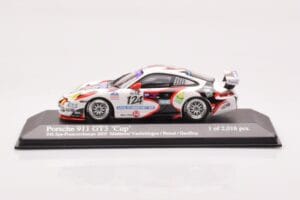
Porsche 911 997 GT3 Cup #124 Mattheus / Geoffroy / Vanbellingen / Fumal 24 Hours of Spa 2005 Minichamps 1:43
Only 3 left
Price:
£29.00
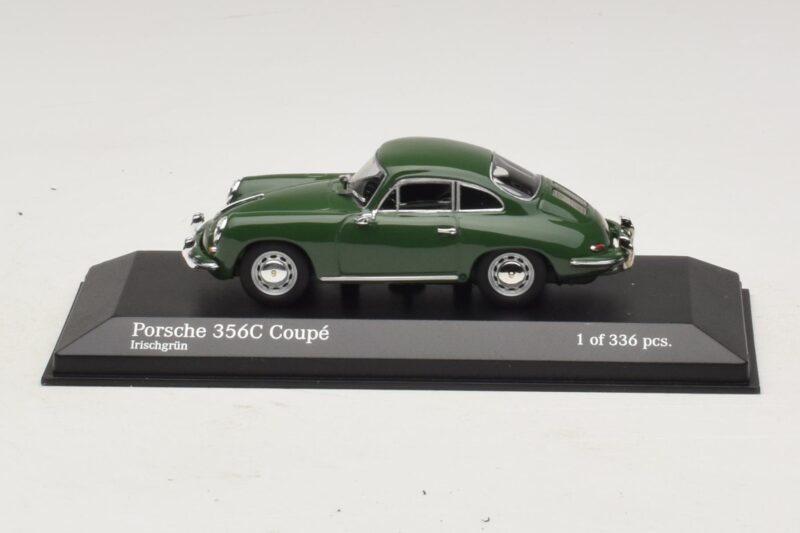
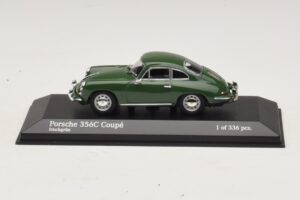
TL;DR: Minichamps' 1:43 diecast Porsche 356C in dark green reproduces the final development of Porsche's original road car, built in 1963 with the model's first disc brakes. Sealed one-piece body, correctly proportioned coupe roofline. An early-Porsche anchor piece for a classic sports car shelf.
Before the 911 defined Porsche, the 356 was the marque's entire road car range, and the C-series represents its most refined form. Minichamps casts this dark green coupe at 1:43, capturing the rounded, hand-formed lines that Porsche's early design language favoured, a shape collectors of early Porsche history return to again and again.
By 1963, Porsche had refined the 356 through four major revisions, and the C-series arrived as the most capable version yet, fitted with disc brakes on all four corners for the first time in the model's history. Production continued into 1965, running in parallel with the early development of the 911, which meant the 356C effectively closed out an eighteen-year run of Porsche's founding road car. Buyers who wanted the most modern brakes and the most settled chassis Porsche had built to that point chose the C-series over any earlier 356 variant, and that final-word status is exactly why the car still draws serious early-Porsche collectors today.
Minichamps chooses a deep, understated dark green for this release, a colour more common on period 356s than the brighter reds collectors often expect from Porsche's later catalogue. At 1:43, the coupe's compact, rounded proportions come through clearly, the sloping rear deck and narrow greenhouse rendered without exaggeration. It is a subtler piece than a 911 or a prototype racer, and that restraint fits the car's own character: the 356 was never about drama, it was about a small, well-balanced sports coupe done properly, and the model reflects that quiet confidence rather than overselling it.
The body is a sealed one-piece diecast shell with no opening doors or bonnet, and on a car this rounded, that construction choice pays off in the way light travels across the surface. The door and bonnet lines run as single, unbroken grooves rather than working seams, keeping the coupe's curved flanks visually continuous from the front wing to the rear haunch. Chrome-effect trim around the windscreen and bumpers is picked out separately from the dark green paint, and the glazing sits flush in its aperture rather than standing proud, a small but telling sign of careful tooling at this scale.
Dark green is a demanding colour to reproduce well, since it can read almost black under weak light and lose all its depth. Minichamps keeps enough tonal warmth in the finish that the metallic flake, where present, still catches a display lamp from a normal viewing angle, rather than disappearing into a flat, single-note surface. The zinc alloy body underneath gives the casting real weight in the hand, a density that plastic promotional models never achieve, and that heft alone tells an experienced collector this is diecast before they even check the base for a maker's mark.
A 356C makes most sense sitting at the start of a Porsche shelf rather than the end of it, the quiet predecessor to everything that followed. Next to a 911 from any generation, the family resemblance in the roofline and rear-engine stance becomes obvious, even though six decades separate the two cars' engineering. Because the 356 rarely carries a racing livery or a limited-edition number, it tends to be judged purely on shape and finish, which is exactly where this Minichamps casting holds up best. For collectors tracing Porsche's road car lineage from its earliest form through to modern GT models, the 356C is less a headline purchase than a necessary one, the piece that makes the rest of the display make sense.

Save £14.00