Used
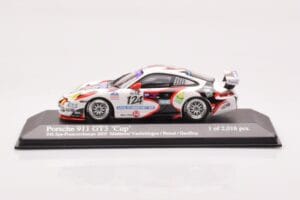
Porsche 911 997 GT3 Cup #124 Mattheus / Geoffroy / Vanbellingen / Fumal 24 Hours of Spa 2005 Minichamps 1:43
Only 3 left
Price:
£29.00
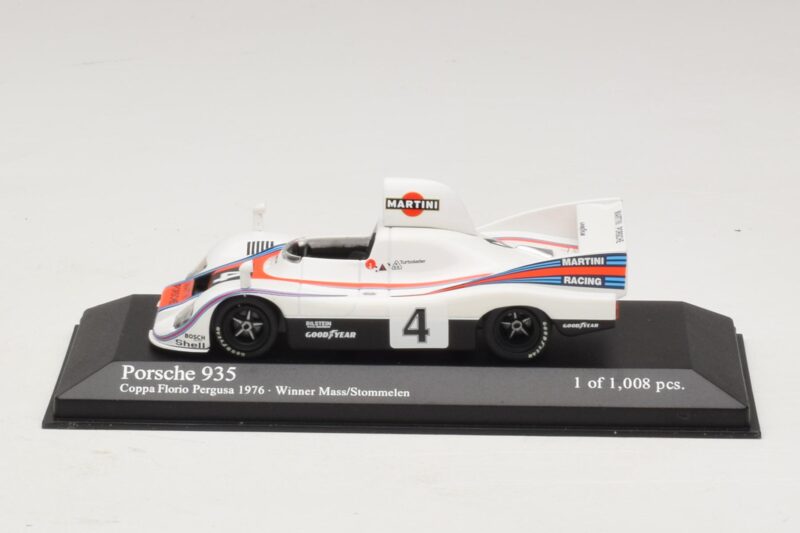
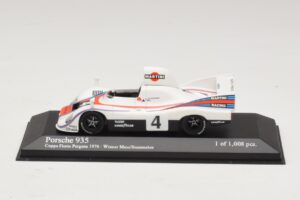
TL;DR: Minichamps' 1:43 diecast Porsche 936/76 reproduces the Martini Racing number 4 car Jochen Mass and Rolf Stommelen drove to victory in the 1976 Coppa Florio at Pergusa. The sealed zinc-alloy body carries Martini's striped livery, built as a display casting rather than an opening-panel model.
By 1976 the Coppa Florio had moved away from its old open-road Targa Florio roots to a shorter, purpose-built circuit at Pergusa, but it still carried real prestige within the World Championship for Makes. Minichamps' 1:43 diecast marks Mass and Stommelen's win there in Porsche's factory Group 6 prototype, a car built specifically to win Le Mans and its supporting championship rounds.
The Coppa Florio traces back to one of Sicily's oldest motor races, but by the mid-1970s the event had shifted from the legendary open-road Madonie circuit to the purpose-built Autodromo di Pergusa, a shorter, more controllable venue better suited to modern sportscar prototypes. That move reflected wider changes across endurance racing as safety concerns closed off the old road circuits that had defined events like the Targa Florio. Even relocated, the event retained a round of the World Championship for Makes and genuine prestige among the teams competing for the title.
Porsche developed the 936 specifically to win Le Mans outright, built to Group 6 prototype regulations with a turbocharged flat-six engine and an open cockpit designed purely around aerodynamic efficiency and minimum weight. The car carried Martini Racing's factory backing and delivered exactly what it was designed for, taking Le Mans victories in the mid-1970s alongside strong results across the wider championship calendar. Running it at Pergusa in 1976 put a car built for 24-hour endurance racing against a shorter sprint-style format, and Mass and Stommelen's win demonstrated the 936's flexibility beyond its headline Le Mans role.
Minichamps casts this 936 as a single sealed zinc-alloy shell, representing the open cockpit, long tail section and prominent rear wing as one continuous casting rather than a build with separately hinged panels. That construction lets the model hold sharp, consistent lines along the car's low, aerodynamic bodywork, a shape defined by curves and vents that a multi-part build would need to manage across several separate pieces. The rear wing's mounting struts are rendered with real precision rather than the thickened, simplified look lower-tier tooling can produce on this kind of open-top prototype shape.
Martini Racing's stripes run across a far more complex surface on the 936 than on a conventional GT car, curving over the long engine cover, around the rear wing supports and along the car's tapered tail section. Minichamps keeps that striping in tight registration throughout, with no visible break or misalignment where the tampo-printed graphics cross a body seam. Race number 4 sits cleanly on the nose, and the cockpit surround and roll hoop are picked out with enough definition to read clearly at this scale.
At around 10cm, this 936 makes a strong centrepiece for a 1:43 collection focused on Porsche's Group 6 prototype era or Martini Racing's factory programme through the mid-1970s. Because the body is sealed, the model's appeal comes down to livery precision, aerodynamic shape fidelity and casting crispness, and it holds up well against comparable 1:43 diecast from the period. A genuine factory prototype winner, rather than a customer-spec car, gives this model a stronger claim to the centre of a Porsche endurance display.
Save £14.00