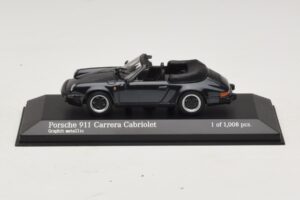
Used
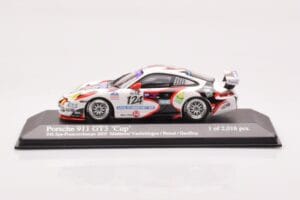
Porsche 911 997 GT3 Cup #124 Mattheus / Geoffroy / Vanbellingen / Fumal 24 Hours of Spa 2005 Minichamps 1:43
Only 3 left
Price:
£29.00
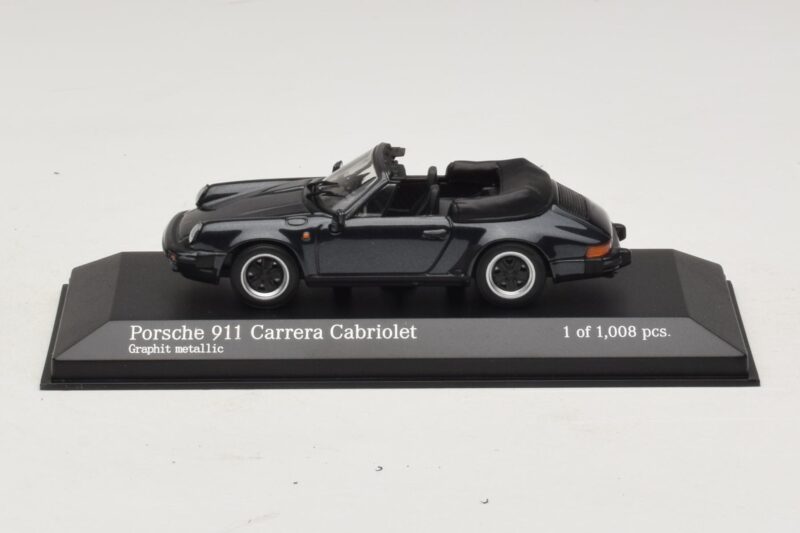
TL;DR: Minichamps' 1:43 diecast Porsche 911 930 Carrera Cabriolet in Grey Metallic marks the 1983 model year, when Porsche brought back a factory-built open-top 911 after years of Targa-only convertibles. The casting is a sealed, one-piece shell, with the folded soft-top and wide-body detailing rendered as fixed exterior surface rather than moving parts.
For most of the 911's first two decades, open-top buyers had only the Targa's roll hoop and lift-out panel. A true drop-top didn't return to Porsche's factory line-up until 1983, when the Cabriolet arrived on the 930-series body, complete with a fully retractable soft-top and the flared wheel arches that had by then become part of the 911's visual identity.
Because the body is a fixed casting, the soft-top sits permanently folded behind the seats, moulded and painted as part of the shell rather than left loose to lift or lower. That is the honest way to render a folded top at this scale: the fabric-look creases, the boot line where the top tucks down, and the roll-over bar behind the seats all read as continuous surface rather than a separate piece that could sit slightly proud or crooked. The wide rear arches that came with the 930-series Turbo-look body are cast in with the same confidence, giving the car its correct, slightly aggressive stance even in Cabriolet form.
Grey Metallic paint on a hard zinc alloy shell takes on a cool, slightly reflective quality that reads differently across a room depending on the angle of the display light, a trait particular to metallic finishes on metal bodies rather than resin. The shut lines around the doors and rear deck lid hold their width consistently since there is no hinge tolerance pulling on them, and the wheel arch flares meet the body at a clean, unbroken edge. At 1:43, checking that edge closely is one of the fastest ways to judge whether a casting has held its tooling detail or softened it over a long production run.
Porsche's factory line had offered the Targa's removable roof panel since 1967 as the open-air option, but a genuine soft-top convertible was absent from the catalogue for the better part of two decades. The 1983 Cabriolet closed that gap, engineered on the 930-series platform with a fully retractable roof rather than a lift-out section, and it arrived as the wide-body 911 had already settled into its flared-arch identity. That combination, a proper convertible on the more aggressive body, made the Cabriolet an immediate, distinct addition to the range rather than a simple variation on the Targa.
Grey Metallic is a more restrained choice than the brighter shades Porsche offered on the same body during the 1980s, and it displays differently under light: metallics read as texture rather than flat colour, shifting subtly as the viewing angle changes, where a solid shade stays static. A buyer choosing between finishes on this casting is really choosing a display mood rather than a more or less accurate model, since both a subdued metallic and a bolder period colour are equally faithful reproductions of options Porsche actually offered. Grouped together, the two finishes make a useful before-and-after study in how 1980s Porsche colour choices could change a car's presence on the same body shell.
A Grey Metallic Cabriolet slots naturally alongside a Targa and a fixed-roof Carrera from the same era, forming a three-way body-style study of what the 930-series 911 offered open-air buyers across a single generation. It also stands well on its own, since the return of the true convertible was a genuinely significant moment in the 911's history rather than a footnote. Because the body is sealed, there is nothing to adjust before display, just a finished casting ready to place on the shelf. At the 1:43 diecast tier, it offers accurate stance and colour fidelity without the cost step of a larger-scale piece, a sensible way to cover this specific chapter of air-cooled history.
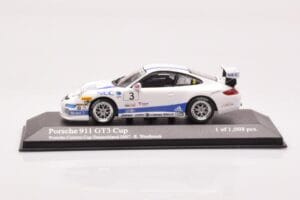
Save £14.00