Used
Porsche 911 997 GT3 Cup #124 Mattheus / Geoffroy / Vanbellingen / Fumal 24 Hours of Spa 2005 Minichamps 1:43
Only 3 left
Price:
£29.00
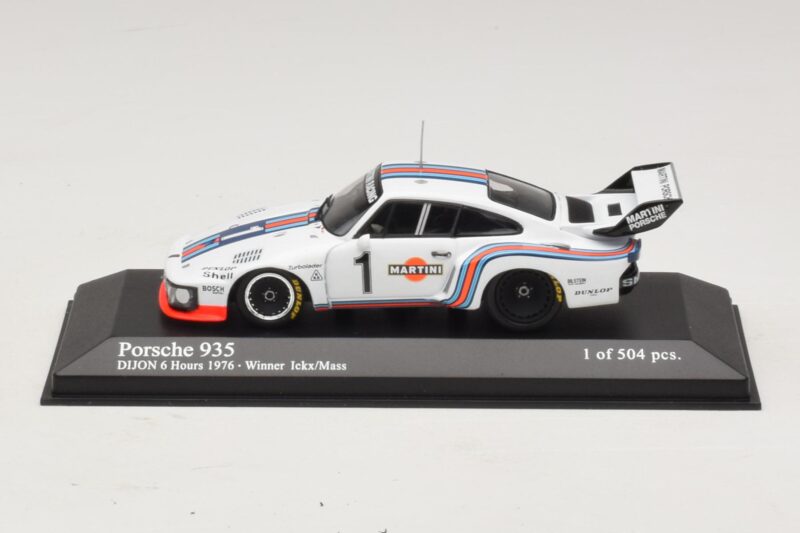
TL;DR: Minichamps' 1:43 diecast Porsche 935 reproduces the Martini Racing number 1 car Rolf Stommelen and Manfred Schurti drove to victory in the 1976 Dijon 6 Hours, a round of that season's World Championship for Makes. The sealed zinc-alloy body carries Martini's striped livery, built as a display casting rather than an opening-panel model.
Martini Racing's striped livery is one of motorsport's most recognisable colour schemes, and this 935 carries it during a genuinely winning season rather than as decoration on a mid-pack finisher. Minichamps' 1:43 diecast marks Stommelen and Schurti's Dijon victory, a result that came as Porsche's 935 was establishing itself as the car to beat in Group 5 sportscar racing.
Porsche built the 935 to Group 5's silhouette regulations, taking the 911 turbo platform and reworking its bodywork, aerodynamics and turbocharged engine into a car that dominated sportscar racing through the second half of the 1970s. Dijon-Prenois hosted a round of the 1976 World Championship for Makes, and the 6-hour format demanded a balance of raw turbocharged pace and enough reliability to survive the distance without the boost pressure or brakes failing. A win at Dijon that season confirmed what many in the paddock already suspected, that the 935 had arrived as the benchmark car in its class.
Rolf Stommelen and Manfred Schurti were both established Porsche factory drivers by 1976, experienced in exactly the kind of turbocharged, aerodynamically demanding machinery the 935 represented. Stommelen in particular had raced everything from Formula 1 to endurance prototypes, and that breadth of experience suited a car that combined outright speed with the driveability challenges early turbo lag introduced. Sharing the number 1 factory entry at Dijon put two of Porsche's most trusted drivers in the car most likely to win.
Minichamps casts this 935 as a single sealed zinc-alloy shell, with the doors, engine cover and the car's distinctive rear wing represented without any hinged, moving parts. That construction lets the casting hold consistent shut lines around every panel edge, and the model carries genuine weight that signals metal construction. The 935's flared arches and low, slab-sided profile come through with real presence, and the whale-tail rear wing sits correctly proportioned rather than oversized, a common failing on lower-tier tooling of this subject.
Martini Racing's stripes are applied in tampo print, holding sharp, straight edges across the body's curves rather than the slight waviness a printed decal can develop over complex bodywork. The registration between the red, blue and light-blue stripes is tight, and race number 1 sits cleanly within its designated panel. Minichamps keeps the wheel offset correct for the 935's flared arches, and the front splitter and rear wing endplates hold their shape without the softening lower-tier casting sometimes shows.
At roughly 10cm long, this 935 anchors a 1:43 collection built around Martini Racing's motorsport history or Porsche's Group 5 dominance through the second half of the 1970s. Because the body is sealed, the model's value comes down to livery precision, panel-line consistency and stance, and on those measures it stands up well against comparable 1:43 diecast. A genuine round-winning car in one of motorsport's most recognisable liveries makes for a stronger centrepiece than a similarly styled also-ran.
Save £14.00