Used

Porsche 911 997 GT3 Cup #124 Mattheus / Geoffroy / Vanbellingen / Fumal 24 Hours of Spa 2005 Minichamps 1:43
Only 3 left
Price:
£29.00
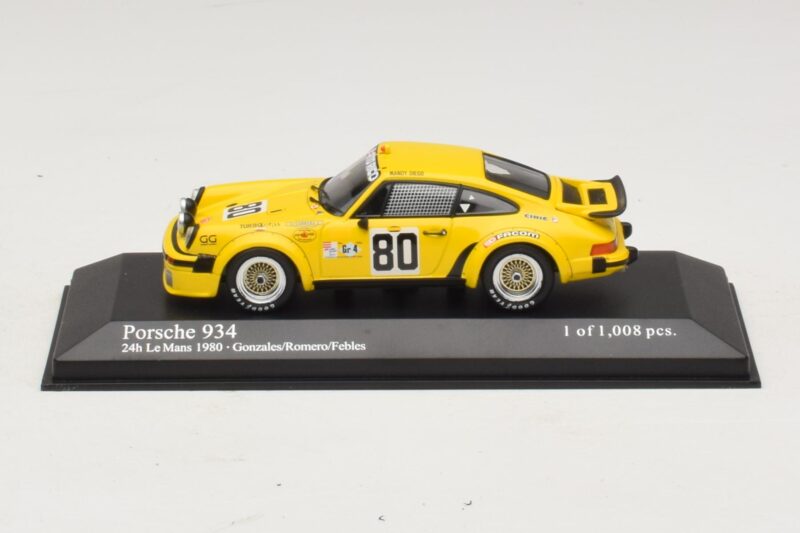
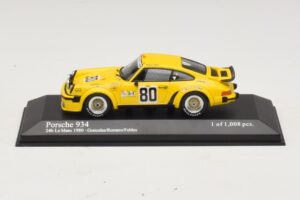
TL;DR: Minichamps' 1:43 diecast Porsche 934 reproduces car #80, driven by Gonzalez and Romero at the 1980 Le Mans 24 Hours, its sealed body carrying tampo-printed team livery. Four years after its Group 4 homologation, the 934 still filled the GT class grid, giving privateer teams a proven car against the era's faster prototypes.
By 1980 the 934 was no longer new, four seasons removed from its Group 4 homologation, yet privateer teams kept entering it at Le Mans because it remained a genuinely capable GT car. This #80 entry, carrying Gonzalez and Romero's colours, is exactly that kind of dependable, unglamorous campaign, and Minichamps' 1:43 model preserves it faithfully.
Minichamps casts this 934 as a single sealed body, with no doors, bonnet or engine cover designed to move. At 1:43 that decision keeps every panel line uniform across the flared arches and rear wing supports, a level of consistency an opening mechanism would compromise at such a small size. The zinc alloy construction gives the model real heft for its footprint, distinctly denser in the hand than an equivalent resin piece, and that weight makes it feel like a serious object rather than a toy. Because nothing on the body needs to hinge or latch, Minichamps can hold tighter tolerances around the wheel arches and rear wing mounts, the areas where a 934's silhouette is most immediately recognisable, and where a wider tolerance would be most noticeable to a practiced eye.
The #80 livery is applied through tampo printing, a process that bonds the graphics directly to the shell rather than laying a separate decal over it, so sponsor panels and the race number sit perfectly flat against the bodywork. At this scale that flatness matters: any raised edge or misaligned print becomes obvious under a display light, and Minichamps holds registration consistently across the door panels, bonnet and rear wing endplates. The colour scheme reads clearly at a glance, each block of colour separated with a clean edge rather than bleeding into its neighbour, and smaller printed details like the windscreen banner remain legible even at 1:43. Set beside other 934 entries from different Le Mans years, the variety of liveries becomes the real draw, each car identical underneath but individually dressed.
Porsche homologated the 934 for Group 4 competition in 1976, and unlike a prototype built to chase the latest regulations, a homologated GT car doesn't become obsolete the moment a newer model appears. Its specification stays legal for as long as the class rules allow, which meant privateer teams could keep campaigning 934s well into the new decade, long after the factory's attention had shifted to the more radical 935. That longevity is part of what makes GT class racing distinct from the prototype battle at the front of the field: reliability and driver consistency count for as much as outright pace, and a well-prepared four-year-old car in the right hands could still see out 24 hours competitively.
At Le Mans, GT cars have always raced their own class rather than chasing the outright winner, and the 934 was built for exactly that kind of battle: consistent lap times, minimal mechanical drama, and a car simple enough for a small team to keep running through the night. Where the leading prototypes gambled on outright pace and often paid for it with retirements, a well-driven 934 offered a realistic path to a finish, which for most privateer teams was the actual goal rather than a consolation. That distinction is easy to miss decades later, when overall winners dominate the history books, but it's exactly what a model like this #80 car represents: not a footnote to the main event, but a legitimate contest running alongside it.
Collecting 934s from different Le Mans years, this #80 entry alongside others from 1978 and 1979, builds something a single hero model never could: a genuine field. At 1:43, that ambition stays realistic, since a dozen sealed-body castings take up roughly the shelf space of one or two 1:18 pieces, and the sealed construction means every car holds identical panel-line quality regardless of which season or livery it represents. For a collector who finds the GT class more interesting than another rendition of an overall winner, this is the honest way to build depth: not the fastest car on track, not the most famous name, but a genuine competitor from an era when finishing the 24 Hours was itself a considerable achievement, one worth remembering long after the chequered flag fell.







Save £14.00