Used
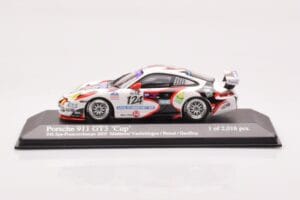
Porsche 911 997 GT3 Cup #124 Mattheus / Geoffroy / Vanbellingen / Fumal 24 Hours of Spa 2005 Minichamps 1:43
Only 3 left
Price:
£29.00
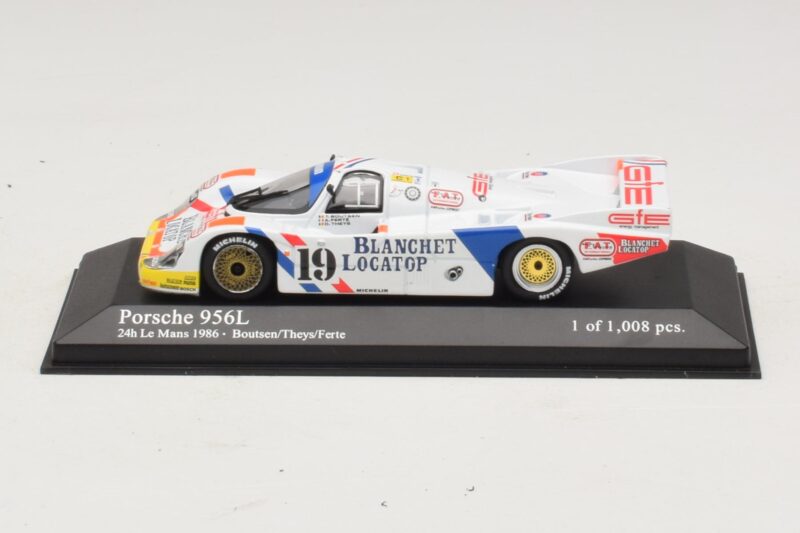
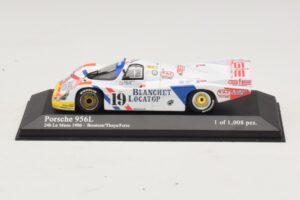
TL;DR: Minichamps' 1:43 diecast reproduces the #19 Porsche 956L that Thierry Boutsen and Didier Theys campaigned at the 1986 24 Hours of Le Mans. Sealed one-piece body, Group C prototype shape, tampo-printed livery. A genuine piece of Porsche's dominant 1980s endurance racing era.
Group C defined endurance racing through the 1980s, and the 956 sat at the centre of Porsche's dominance in the category. Minichamps' 1:43 diecast reproduces the long-tail #19 entry that carried Thierry Boutsen, later a Formula One race winner, and Didier Theys through the 1986 24 Hours of Le Mans, a genuine slice of the era's deepest talent pool.
Thierry Boutsen went on to win grand prix races in Formula One later in his career, but in the mid-1980s he was building his reputation partly through European sports car racing, where a strong Le Mans result carried genuine professional weight. Sharing the #19 956L with the experienced Didier Theys gave the car a driver pairing that combined raw single-seater speed with sports prototype racecraft, a common formula among the strongest Group C entries of the period. Le Mans in the mid-1980s attracted a genuinely deep field, and a car needed both pace and a driver line-up capable of managing twenty-four hours without costly mistakes to finish competitively.
The 956L designation refers to Porsche's long-tail bodywork, a configuration built specifically for the high-speed Le Mans circuit rather than shorter, twistier tracks where the standard-length car handled better. The longer tail reduced drag along the Mulsanne Straight at the cost of some cornering stability, a trade-off teams accepted because Le Mans rewarded top speed more than any other round on the calendar. Underneath, the 956's aluminium monocoque and flat-six turbo engine had already proven themselves as one of the defining prototype packages of the Group C era, and the long-tail variant represents that package tuned specifically for its most famous race.
Group C liveries of this period often combined a manufacturer's base colours with multiple sponsor decals across the nose, flanks and rear wing, and getting all of that legible at 1:43 scale is no small task. Minichamps tampo-prints the graphics directly onto the shell, keeping text and logos sharp rather than blurring into illegible colour blocks, which matters enormously on a car carrying this much sponsor detail. The #19 roundel and number font follow the period's typography closely, and colour registration between the base livery and the accent stripes holds cleanly along every curve of the long-tail bodywork.
This model has no opening bodywork, the entire shell cast as one sealed piece, an approach that suits a low, wide prototype particularly well since it keeps the roofline and rear wing supports reading as a single continuous shape rather than a series of separate panels. The rear wing itself is moulded with fine end-plates, and the glazing across the low windscreen sits flush rather than proud, both details that matter on a car whose silhouette is as much the story as its livery. Casting a shape this aerodynamically specific as one piece also protects the delicate wing mounts from the wear a hinge mechanism would introduce over time.
The 956 and its successor remain the backbone of any serious Group C collection, and the sheer number of liveries Porsche's customer teams ran through the mid-1980s means a shelf built around this era rarely runs short of genuinely distinct subjects. This particular long-tail #19 entry, carrying a driver who would later make his name in Formula One, adds a talking point beyond the livery itself. At 1:43, several 956 variants sit comfortably across one display tier without visually competing, since the low, wide prototype shape reads clearly even in a crowded row. For collectors tracing Porsche's Group C dominance through its individual entries rather than just its overall results, this is a well-chosen addition.
Save £14.00