Used

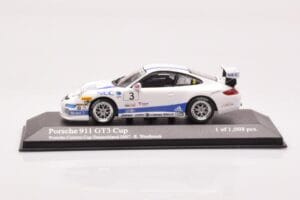
Porsche 911 997 GT3 Cup #124 Mattheus / Geoffroy / Vanbellingen / Fumal 24 Hours of Spa 2005 Minichamps 1:43
Only 3 left
Price:
£29.00
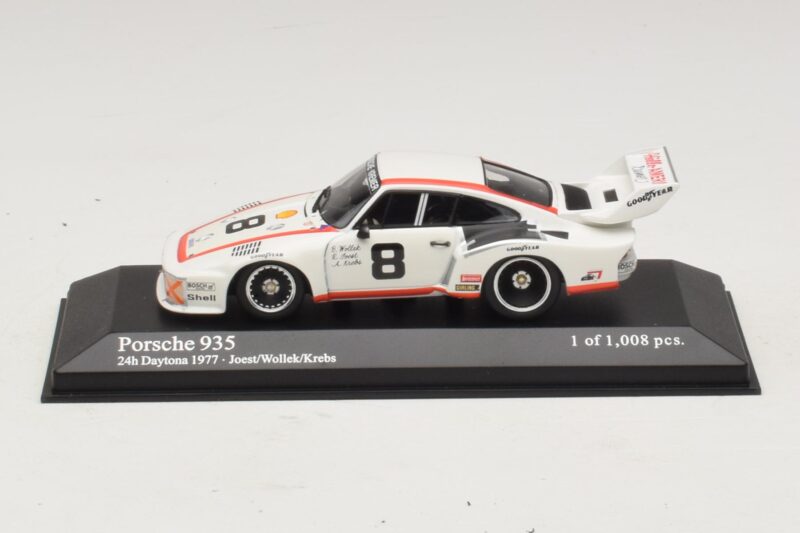
TL;DR: Minichamps' 1:43 diecast Porsche 935 reproduces the Kremer Racing number 8 car Reinhold Joest and Bob Wollek drove at the 1977 24 Hours of Daytona, a proving ground for the German tuner's growing reputation. The sealed zinc-alloy body carries Kremer's team livery, built as a display casting rather than an opening-panel model.
Kremer Racing built its name modifying and racing Porsches out of Cologne, eventually developing the 935 further than the factory itself in later years, and this 1977 Daytona entry captured the team early in that rise. Minichamps' 1:43 diecast reproduces Joest and Wollek's number 8 car, pairing two drivers who would each go on to shape endurance racing's future.
Kremer Racing operated out of Cologne as a Porsche dealer and racing team through the 1970s, building a reputation for detailed technical work on the 935 platform that eventually culminated in the team's own K3 development, a car that would go on to win Le Mans outright in later years. In 1977 that reputation was still being established, with Kremer running competitive customer-spec 935s at major endurance events including Daytona, going up against factory Porsche entries and other well-funded privateer teams. The team's technical thoroughness, rather than factory backing, was what let a German customer outfit compete credibly on American soil.
Reinhold Joest would later found his own team and become one of the most successful entrants in Le Mans history, running factory Porsche and Audi programmes to multiple outright victories over subsequent decades. Bob Wollek built one of the longest and most respected careers in endurance racing, competing at the top level across four decades in prototypes and GT cars alike. In 1977 both were still building the reputations that would define their later careers, and this Kremer entry captures two future giants of endurance racing sharing a cockpit.
Minichamps casts this 935 as a single sealed zinc-alloy shell, representing the doors, engine cover and rear wing as one continuous casting rather than a build with separate hinged panels. That construction keeps shut lines tight and consistent along the body, and the flared arches that define the 935's silhouette hold sharp, clean edges rather than the blunted look lower-tier tooling sometimes produces. The turbocharged flat-six's associated intercooler ducting and rear bodywork changes are rendered with genuine precision.
Kremer's team livery is applied in tampo print, holding crisp, flat edges across the bodywork rather than the raised or discoloured look an ageing decal can develop. Race number 8 sits cleanly on the doors, and sponsor markings follow the period-correct placement for the team's 1977 Daytona entry. Minichamps keeps the wheel offset correct for the flared arches, and the whale-tail rear wing holds its proportions without appearing oversized, a detail that separates a careful reproduction from a generic 935 casting.
At roughly 10cm, this 935 fits naturally alongside other Daytona and IMSA-era liveries in a 1:43 collection, and it pairs particularly well with other Kremer Racing entries or later Le Mans-winning cars connected to Joest and Wollek's later careers. Because the body is sealed, the model's appeal rests on livery precision, flared-arch fidelity and casting crispness, and it compares favourably with comparable 1:43 diecast from the period. For collectors who follow how today's biggest names in endurance racing built their reputations, this early Kremer entry offers a genuine starting point.


Save £14.00