Used
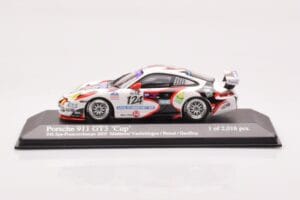
Porsche 911 997 GT3 Cup #124 Mattheus / Geoffroy / Vanbellingen / Fumal 24 Hours of Spa 2005 Minichamps 1:43
Only 3 left
Price:
£29.00
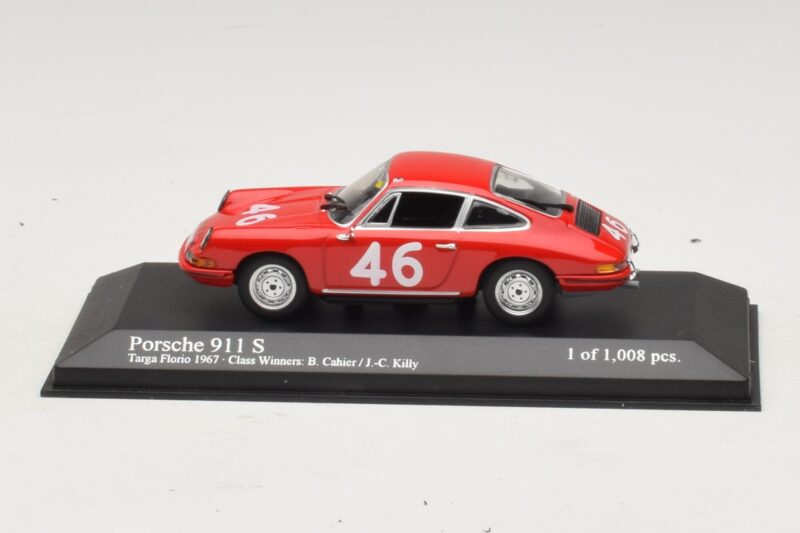
TL;DR: Minichamps' 1:43 diecast reproduces the #46 Porsche 911 S that Cahier and Killy drove to a class win at the 1967 Targa Florio. Sealed one-piece body, period race livery, tampo-printed number and sponsor detail. A genuine slice of Porsche's Sicilian road-racing history.
Targa Florio demanded a car that could survive over 40 miles of Sicilian mountain road per lap, and the early 911 S proved itself exactly that kind of machine. Minichamps' 1:43 diecast reproduces the #46 class winner in full period livery, a compact piece of history for anyone tracing Porsche's road-racing exploits beyond Le Mans and the Nürburgring.
The Targa Florio ran on closed public roads through the Sicilian mountains, a circuit that punished fragile cars and rewarded reliability as much as raw speed. Cahier and Killy's #46 911 S took a class victory there in 1967, a result built on the early 911's inherent balance and its drivers' ability to place the car precisely on roads that offered no run-off and little forgiveness for a mistake. Class wins at Targa Florio carried real weight within Porsche's competition programme of the period, since the event served as a genuine proving ground for improvements that would filter into the marque's road cars.
The 911 S introduced a more powerful flat-six and firmer suspension over the standard 911, changes that suited endurance road racing far better than the base car's softer set-up. Stripped of unnecessary weight and fitted with the auxiliary lighting and roll protection period regulations demanded, the competition 911 S kept the road car's recognisable silhouette while sharpening everything underneath it. That balance between usable road-going shape and genuine competition capability is precisely what makes the early 911 S such a satisfying subject for a 1:43 model, and why liveried versions like this one hold lasting appeal.
The race number 46 sits within a painted roundel on the doors, a common period marking style that Minichamps reproduces with clean edges and accurate colour separation against the body paint beneath. Sponsor and class markings follow the small, understated style typical of 1960s road racing, tampo-printed directly onto the shell rather than left as raised decal film that would catch light unevenly. Getting this kind of restrained period livery right is arguably harder than a modern, graphic-heavy scheme, since any wobble in a hand-painted-style roundel is instantly obvious against the car's otherwise clean bodywork.
This model carries no opening doors, bonnet or bootlid, cast instead as a single fixed shell, a construction approach entirely typical of 1:43 diecast at this price point. On a subject this size, that sealed construction actually helps: the door and engine cover lines stay as fine, consistent grooves rather than gaps that would widen visibly at such a small scale if hinges were built in. The wheels carry period-correct detailing at the centre caps, and the glazing sits neatly within its aperture, small touches that reward a close look under a display light.
Targa Florio liveries remain relatively underrepresented compared with the flood of Le Mans and Nürburgring subjects on most collectors' shelves, which makes this #46 911 S a genuinely useful addition rather than a duplicate of something already owned. Paired with other early 911 competition liveries, it fills in a chapter of Porsche's motorsport history that predates the marque's Group C and Le Mans dominance by more than a decade. At 1:43, several such road-racing 911s sit comfortably across a single shelf tier, and the compact scale suits a subject built around a narrow, twisting mountain circuit rather than a long straight. It is a considered purchase for anyone building out Porsche's competition history in full.
Save £14.00