Last one
Used
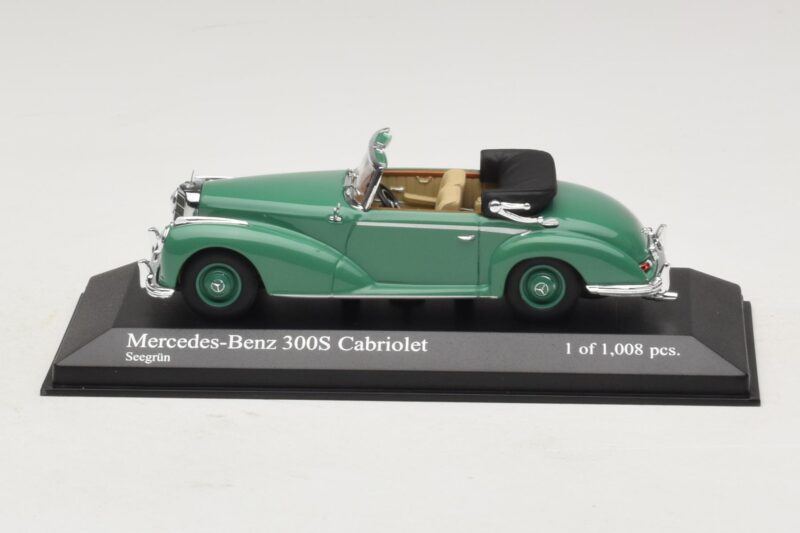
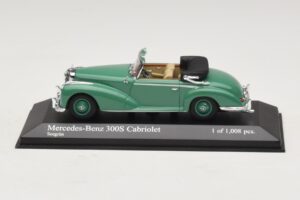
TL;DR: Minichamps' 1:43 Mercedes 300S Cabriolet reproduces the 1950s luxury convertible, built on the same running gear as the larger 300 saloon but wrapped in a lower, sportier open body. Cast as a sealed diecast body in green with crisp shut lines and deep period paint, it anchors a postwar Mercedes cabriolet collection.
Mercedes built the 300S as the sporting, short-wheelbase relation to its formal 300 saloon, the car that carried German heads of state through the 1950s. Where the saloon prioritised presence and rear legroom, the 300S offered a lower stance and open bodywork for buyers who wanted the same badge with genuine driving appeal, and this Minichamps casting reproduces that distinction faithfully.
The 300S used the same 3.0-litre straight-six and much of the chassis engineering that underpinned Mercedes' larger 300 saloon, the car later nicknamed the Adenauer after the German chancellor who favoured it. But where the saloon carried a long, formal body built for rear-seat comfort, the 300S rode on a shorter wheelbase and wore coachwork designed at Sindelfingen for a lower, more athletic stance. It sat closer to a grand tourer than a limousine, aimed at wealthy private buyers rather than official transport, and the cabriolet version, roof folded or raised, remained one of the most expensive cars any European manufacturer offered through the 1950s.
Where the 300 saloon was built to be driven in, the 300S was built to be driven, and Mercedes marketed it accordingly to owners who wanted to sit behind the wheel themselves rather than in the back seat. Production numbers stayed low throughout the model's run, reflecting both the car's price and its position above the mainstream 300 line, and that scarcity is part of why a well-executed 300S model holds genuine appeal today. Minichamps' casting keeps the car's long bonnet and low, rounded tail in correct proportion, the shape that separated it visually from its more upright saloon relation.
Minichamps casts this 300S as a single sealed body, with doors and boot fixed in place rather than hinged, the folded-hood profile moulded directly into the shell rather than built as a separate opening piece. That construction choice suits a cabriolet particularly well, since the fabric roof's stowed shape stays exactly as tooled rather than depending on how carefully a moving part gets closed. The shut lines along each door run as single crisp grooves rather than jointed seams, and the low windscreen frame and folded hood line read correctly against the rest of the body at 1:43, the silhouette that made the 300S instantly distinguishable from its saloon sibling.
The green finish carries real depth on the hard diecast shell, the kind of gloss that catches a display lamp cleanly along the car's long flanks. Chrome trim around the windscreen, bumpers and headlamp surrounds separates cleanly from the body colour, and the wheels carry a whitewall-style finish appropriate to the period rather than a plain black tyre. Badge script on the bonnet and boot lid holds its edges under close inspection, and the overall stance sits low and long in a way that immediately reads as a 1950s grand tourer rather than a generic vintage saloon shrunk to open-top form.
This 300S sits comfortably alongside the larger 300 saloon on a 1950s Mercedes shelf, the two cars together telling the full story of the marque's postwar recovery, one built for state occasions, the other for private pleasure. At 1:43 the cabriolet's low, long proportions still read clearly without demanding the shelf space a 1:18 casting would need, making it easy to build a run of period Mercedes cabriolets and saloons side by side. Given the sealed body and the subject's genuine scarcity in period production, this sits toward the upper end of Minichamps' mid-tier diecast range, a fair reflection of a car that was itself one of the most expensive things on the road when new.



Save £14.00