Last one
Used
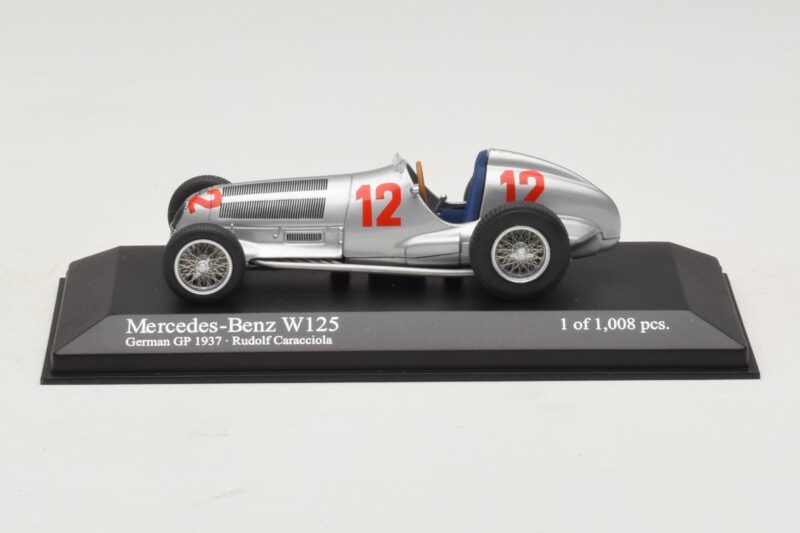
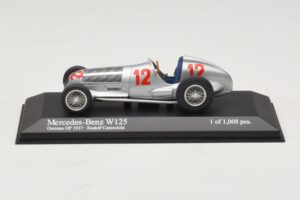
TL;DR: Minichamps' 1:43 diecast reproduces Rudolf Caracciola's Mercedes W125 from the dominant 1937 German Grand Prix season, a sealed one-piece body with exposed cycle wings, louvred bonnet and narrow open cockpit. The most powerful pre-war grand prix car built, and a foundational Silver Arrow for any pre-war racing collection.
By 1937, Mercedes-Benz had built the most powerful grand prix car the world had ever seen, and Rudolf Caracciola, already a two-time European Champion, drove the W125 to a season so dominant it reshaped how the sport's governing body wrote its rules for the following year. Minichamps captures that car, silver bodywork and all, in careful 1:43 diecast.
Pre-war grand prix cars were built around exposed mechanics and minimal bodywork, and Minichamps' W125 reflects that honestly: cycle-style wings sit clear of the wheels rather than merging into a smooth modern fender line, the long bonnet carries rows of cooling louvres along its flanks, and the narrow, open cockpit sits low between the car's slender, exposed chassis rails. Zinc alloy gives the casting real weight, a density that suits a subject built for raw straight-line speed rather than aerodynamic refinement, and it keeps the long, tapering tail and the exposed exhaust pipes running along the flank dimensionally accurate over years of display. The famous unpainted aluminium finish, the origin of the Silver Arrow name after Mercedes reportedly stripped white paint from the cars to meet a weight limit before a 1934 race, is reproduced here with a convincing brushed-metal look rather than a flat, uniform grey. Because the body is sealed as a single casting, the panel lines around the bonnet and cockpit surround run as fine, consistent grooves rather than the wider gaps an opening bonnet would need, a treatment well suited to a car whose original engineering was almost entirely visible from the outside anyway. Wheel spokes are finely moulded, the narrow period tyres sit correctly within the wings, and the driver's seating position, exposed and unprotected by modern standards, comes through clearly even at this compact scale.
Rudolf Caracciola arrived at the 1937 season already established as one of grand prix racing's finest drivers, having won the European Championship, the era's equivalent of a modern world title, in 1935. Mercedes-Benz built the W125 specifically for that year's largely unrestricted formula, which allowed engine capacities up to 750cc for supercharged cars, and the factory's engineers responded with a supercharged straight-eight producing output so far beyond anything else on the grid that the car's power figures reportedly went unmatched by any grand prix car for roughly the next four decades, until the turbocharged Formula 1 era of the early 1980s. Caracciola took that machine to the 1937 European Championship, driving with the smooth, calculating style that had already earned him the nickname Regenmeister, rain master, for his ability to dominate in treacherous wet conditions when rivals struggled for grip. The German Grand Prix that year, held on the Nürburgring's original full-length circuit, formed part of a season so overwhelming for Mercedes that the sport's governing body rewrote the technical regulations for 1938 specifically to rein in cars like the W125. That regulatory response is itself a measure of how far ahead the car had pulled: rules rarely change because a car is merely good, only when it has made the competition genuinely irrelevant. Owning a faithful replica of that specific car and driver pairing means owning a small piece of one of grand prix racing's most one-sided seasons.
At 1:43, the W125's long, narrow proportions suit the scale particularly well, giving a genuine sense of the car's exposed, purposeful engineering without demanding the shelf space a larger format would need. It sits naturally alongside other Silver Arrow subjects from the same golden pre-war era, tracing Mercedes' grand prix dominance through the mid-to-late 1930s in one coherent run. For collectors building a pre-war motorsport display around genuine turning points rather than simply famous names, the 1937 W125 marks one of the clearest: a car so dominant it forced the sport to change its own rulebook. Few subjects offer that combination of documented historical weight and striking, honest period engineering in a single, accessible model. It is a genuinely foundational choice for that era's story.



Save £14.00