Last one
Used
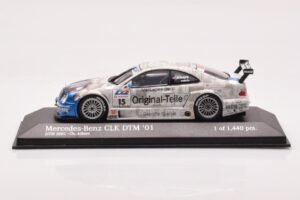
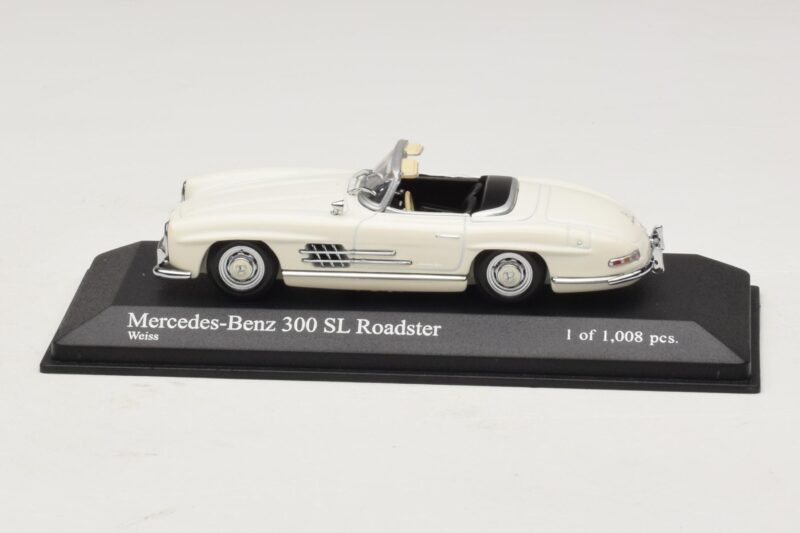
TL;DR: Minichamps' 1:43 Mercedes 300 SL Roadster reproduces the 1957 open-top successor to the Gullwing coupe, finished in white diecast with a sealed one-piece body. Conventional doors replaced the coupe's dramatic upward-hinging panels on the real car, and this model captures that shift within one of Mercedes-Benz's most significant post-war sports cars.
The Gullwing coupe made the 300 SL famous, but Mercedes-Benz sold the Roadster in far greater numbers, and it remained in production years after the coupe was discontinued. Minichamps' 1:43 white rendition represents that longer-lived version, the one most 300 SL buyers actually drove rather than the one collectors most often picture.
Minichamps casts the 300 SL Roadster in zinc alloy diecast, and the model carries genuine weight for its size, a quality that matters on a subject whose low, curved bodywork can look flimsy in a lighter material. The body is a sealed, one-piece casting with no opening doors or bonnet, so the panel lines along the flanks run as single, consistent grooves rather than the wider gaps a hinged assembly requires, and the exposed engine bay louvres and grille surround stay crisply defined without a separate opening panel to interrupt them.
White paint sits cleanly over the Roadster's long, low bonnet and gently curved rear haunches, showing off the car's proportions more clearly than a darker colour would, and the chrome trim around the windscreen surround, bumpers and wire-style wheels stays sharply separated from the body colour. At 1:43, the Roadster's open cockpit reads convincingly even without a removable soft top, since the low beltline and simple dashboard shape are captured accurately within the sealed casting.
The Gullwing coupe's upward-hinging doors existed for a specific engineering reason: the car's tubular space-frame chassis ran high door sills that made conventional doors impractical, so Mercedes-Benz's engineers designed the roof-hinged panels as a solution rather than a styling flourish. When Mercedes developed the Roadster version from 1957, they reworked the chassis with lower sills specifically to allow conventional doors, trading some of the space-frame's rigidity for everyday practicality and easier entry, a change that made the car noticeably more usable for buyers who wanted a genuine sports car rather than a showpiece.
The Roadster remained in production into the early 1960s, considerably longer than the Gullwing coupe's brief run through the mid-1950s, and it outsold the coupe substantially across its lifetime. That longer production run and higher volume mean surviving Roadsters are more common today than Gullwings, which shaped how each version is now perceived: the coupe as the rare, dramatic collector's piece, the Roadster as the more attainable, more usable expression of the same underlying sports car. This model documents that second, longer chapter of the 300 SL's story.
A white 300 SL Roadster works as a genuine centrepiece in a 1950s Mercedes-Benz display, one of the decade's most significant sports cars regardless of which door design a buyer prefers, and it pairs naturally with a Gullwing coupe from the same era to show the model's full evolution on one shelf. At 1:43, the Roadster's low, wide stance still reads clearly despite the compact scale, and diecast construction keeps its delicate details, wire wheels, chrome trim, the low windscreen, intact over years of handling in a way a lighter material might not.






Save £14.00