Last one
Used
This model is currently sold out. Enter your email and we'll let you know when it's back in stock.
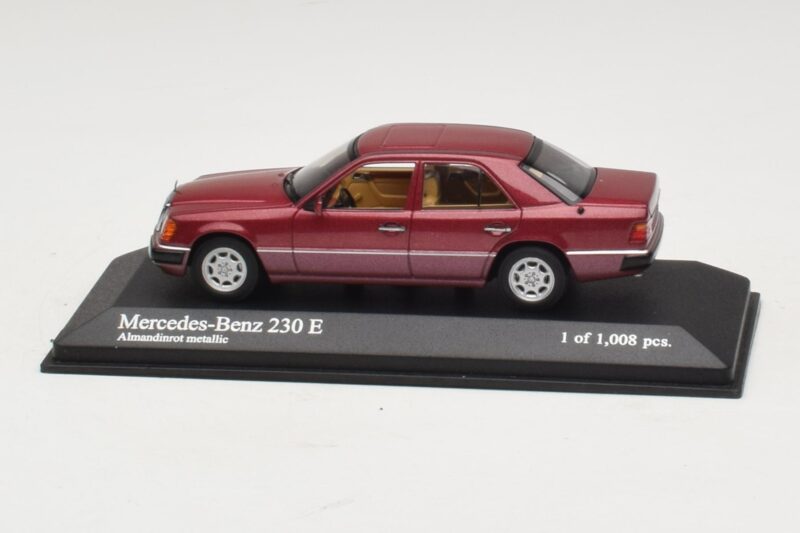
TL;DR: Minichamps' 1:43 Mercedes 230E W124 reproduces the executive saloon in red metallic diecast, a sealed one-piece body with crisp grille and lamp detail. Built during the W124 generation's celebrated run for durability and engineering restraint, this replica suits collectors tracing Mercedes' understated 1990s saloon lineage rather than chasing motorsport glamour.
The W124 earned a reputation few saloons manage: built to outlast its intended service life by a wide margin, with a knack for surviving high mileage that turned it into something of a cult classic long after production ended. Minichamps' 1:43 230E in red metallic represents that generation at its most ordinary, and that ordinariness is exactly the point.
Minichamps casts the 230E in zinc alloy diecast, giving the model real heft for its size and a stable base on a display shelf. The W124's proportions, a long bonnet, a formal three-box saloon silhouette and a relatively upright greenhouse, translate accurately at 1:43, with the body sitting neither too low nor too high on its wheelbase the way some third-party castings can misjudge. The sealed one-piece construction keeps door and boot shut lines running as single, consistent grooves along the flanks, without the wider gaps a hinged assembly would need to accommodate.
The red metallic finish sits with genuine depth over the diecast shell, catching light differently across the bonnet and boot compared with a flat colour, and it suits the W124's clean surfacing better than a busier metallic would. Chrome detail around the grille, headlamp surrounds and door handles stays sharply defined rather than blurring into the body colour, and the wheel design carries the boxy, understated look Mercedes favoured through the early 1990s. Because the body never opens, every one of those exterior details has to do its job convincingly, and here it does.
Mercedes-Benz engineers reportedly built the W124 to standards well beyond what contemporary competitors required, from anti-corrosion protection to the sheer mass of the door structures, a philosophy that produced a car more expensive to manufacture than its sales price justified. That reputation became one of the W124's defining traits among enthusiasts decades after production ended, with well-maintained examples still covering enormous mileages on original mechanical components. It is a very different kind of automotive legend from a racing pedigree, built on durability and restraint rather than lap times or podium finishes.
The 230E designation identifies the four-cylinder petrol variant within a W124 lineup that spanned four-cylinder saloons through to six-cylinder and later AMG-tuned versions, positioning this specific model as the accessible, high-volume end of the range rather than a flagship trim. That mainstream positioning is precisely why the W124 built such a broad following: most buyers encountered the range through cars like this one rather than through its rarer, faster siblings, and it is that everyday familiarity a red 230E on a shelf is built to recall.
A W124 saloon rarely commands the same attention as a contemporary Mercedes coupe or a period AMG special, and that honest assessment matters when deciding where it fits: this is a car for collectors interested in Mercedes' engineering culture and everyday model history rather than headline performance. At 1:43, the 230E occupies a compact footprint that pairs naturally with other German executive saloons from the same decade, and it works well as a quieter counterpoint next to flashier motorsport liveries, giving a themed Mercedes display some grounding in the everyday alongside the exceptional.
Save £14.00