Last one
Used

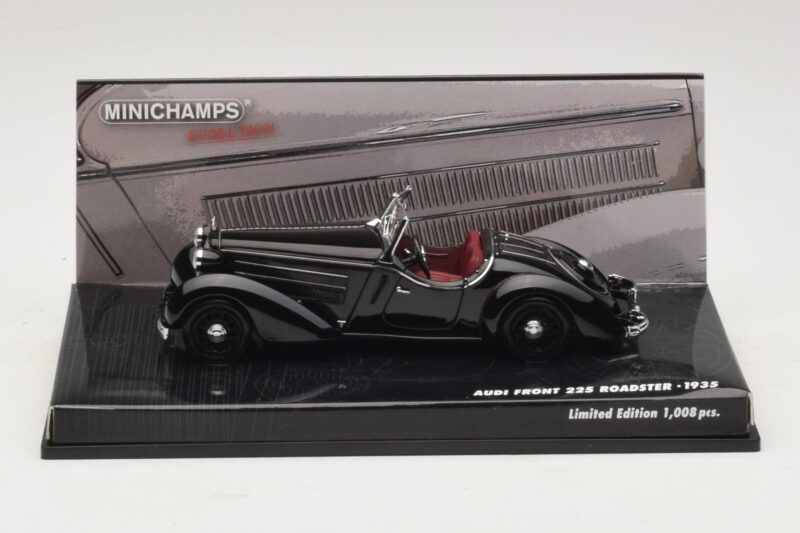
TL;DR: Minichamps' 1:43 diecast Audi Front 225 Roadster in black reproduces one of Europe's earliest front-wheel-drive production cars, built by Audi inside the Auto Union group during the 1930s while most luxury rivals still relied on rear-wheel drive. The sealed one-piece casting carries the roadster's long bonnet and low stance accurately.
Front-wheel drive feels routine today, but in the 1930s it was a genuine engineering gamble, and Audi's Front range was among the first production cars in Europe to take it. Minichamps' 1:43 casting of the 225 Roadster in black gives that engineering history real presence, a car that looked conventional but worked differently underneath from its rear-driven contemporaries at Horch or Mercedes-Benz.
Removing the driveshaft that a rear-wheel-drive car needs running the length of its chassis let Audi's engineers drop the Front's floor and lower its whole silhouette, and the 225 Roadster shows that benefit clearly in its long, low bonnet and reduced overall height compared with rear-driven rivals of similar size. Minichamps' casting captures that lowered stance accurately, with the bonnet running longer relative to the passenger compartment than on a conventional layout of the same period. For a collector who knows what to look for, that proportion difference is the visual signature of the Front's unusual mechanical layout, visible even without any badge confirming what's underneath.
This casting is a sealed, one-piece body, consistent with how Minichamps treats its pre-war range generally, so the model's story is told entirely through surface detail rather than any opening mechanism. Black paintwork holds an even, deep gloss along the long bonnet, a genuinely demanding surface for any casting to get right since flat panels this size show every inconsistency in the tooling. Chrome trim around the radiator grille and headlamps separates cleanly from the black bodywork, and the folded canvas roof sits correctly low behind the seats rather than bulking up the rear deck unrealistically.
Within Auto Union, Audi's Front range pursued a genuinely different engineering path from its sister marque Horch, which stayed firmly committed to conventional rear-wheel-drive straight-eights through the same period. That divergence inside a single corporate group is unusual and worth noting, since it shows Auto Union hedging its bets across two very different approaches to luxury motoring rather than settling on one house philosophy. The Front's front-wheel-drive layout wouldn't become common across the wider industry for decades, making Audi's early commitment to it a genuinely forward-looking decision relative to most 1930s competitors.
A collector drawn to engineering history rather than pure styling finds more to appreciate in the Front 225 than its coachwork alone suggests, since the real story here is mechanical rather than visual. Displayed next to a conventional rear-driven Horch from the same decade, the Front makes a genuinely interesting technical counterpoint, two Auto Union products solving the same luxury-roadster brief in fundamentally different ways. Minichamps modelling both sides of that divide gives a collector the tools to build that comparison directly on their own shelf.
The Front 225 Roadster suits a pre-war shelf organised around engineering firsts as much as one organised by marque or body style, since its front-wheel-drive layout puts it in genuinely rare company among 1930s production cars. Black paintwork keeps the focus on that long, low silhouette rather than on colour, letting the proportion itself do the work of signalling what's different underneath. Because the body is sealed, judge the casting on how convincingly it captures the lowered stance and extended bonnet relative to a conventional rear-driven car of the same period.










Save £14.00