Used

McLaren 12C GT3 #82 Russian Team A. Vasiliev / D. Vasiliauskas / M. Asmer / B. Spengler Spa 24 Hours 2014 Minichamps 1:43
Only 2 left
Price:
£39.00
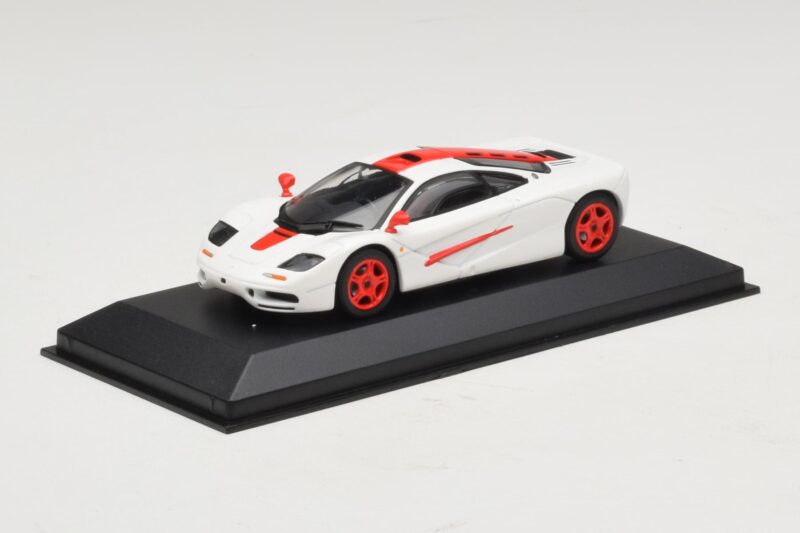
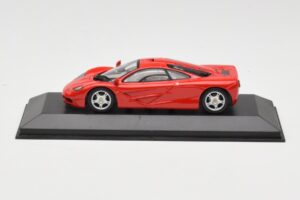
TL;DR: Minichamps' 1:43 McLaren F1 in white with red stripes reproduces Gordon Murray's 1996 road car, a sealed diecast shell holding the F1's compact, low-slung proportions. Built around a central driving position and a naturally aspirated V12, the F1 remains one of the few road cars to have spawned an outright Le Mans-winning racer.
Gordon Murray designed the McLaren F1 with almost no compromise, a central driving seat flanked by two passenger positions, a lightweight carbon structure, and a BMW-built V12 with no turbocharging to blunt its response. Minichamps captures that shape at 1:43, a compact rendering of a car whose racing derivative won Le Mans outright in 1995.
Gordon Murray, fresh from a career designing Formula 1 cars for Brabham and McLaren, applied a racing engineer's priorities to a road car with almost no dilution. The driver sits in the centre of the cabin, slightly ahead of two passenger seats either side, a layout chosen purely for visibility and weight distribution rather than convention. Power came from a bespoke BMW V12, naturally aspirated rather than turbocharged, chosen specifically for throttle response over outright peak output. Every panel used the lightest material available for its job, gold foil even lining the engine bay to manage heat, the kind of detail that marked the F1 as an engineering exercise first and a luxury object second.
McLaren built a racing version of the F1, the F1 GTR, for GT competition, and in 1995 that car won the 24 Hours of Le Mans outright, not merely in its class, against dedicated prototype racers built with none of the F1's road-car compromises. It remains one of the very few instances of a homologated road car's racing derivative taking overall victory at Le Mans, a result that still defines how the F1 is remembered decades later. That single achievement is a large part of why the road car this model reproduces carries the significance it does among collectors.
The F1's real body measures a little over 4.2 metres, which at 1:43 comes down to roughly ten centimetres, a size that suits a themed hypercar or 1990s supercar run more than a single standalone display. Minichamps casts it as a sealed, one-piece diecast shell, with no opening doors or engine cover on this model, a construction choice entirely typical of small-scale diecast at this level. The zinc-alloy body gives real weight to a compact footprint and holds the F1's distinctively low, tapered shape dimensionally stable across years of handling, with tight, consistent shut lines running the length of each panel since no hinge tolerance needs building into the tooling.
Wing mirrors, the central roof scoop and the distinctive rear diffuser mould into the shell as one continuous casting, and the wheels carry the F1's period-correct multi-spoke design with visible detail behind them. Interior detail, including that famous central driving position, stays simplified at this scale, glimpsed through the glazing rather than examined closely, the honest trade-off a compact format makes in exchange for its shelf-friendly footprint. What the casting delivers instead is the F1's low, uninterrupted silhouette and a white finish with red striping that stays crisp under cabinet lighting rather than yellowing over years of display.
For anyone building a shelf around 1990s hypercars, this F1 sits at the genre's origin point rather than as one entry among many, a car whose engineering approach shaped how every subsequent hypercar has been judged. At 1:43, it pairs comfortably with contemporaries from the same decade without demanding the shelf space a larger scale would need, letting a compact hypercar theme grow one car at a time. Few road cars carry a racing story as directly relevant to the model itself as this one does.