Last one
Used
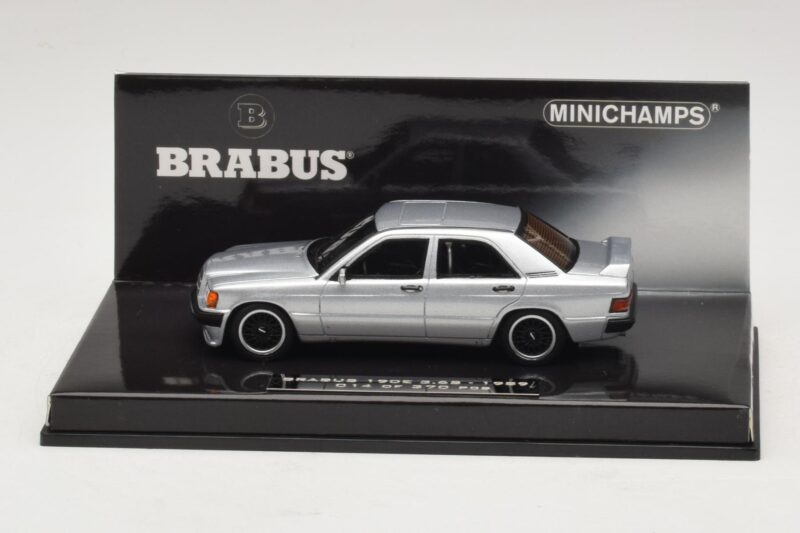
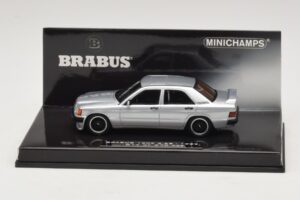
TL;DR: Minichamps' 1:43 diecast Brabus 3.6S reproduces the tuner's landmark late-1980s 190E W201 conversion in silver, the car that established Brabus's reputation for enlarging Mercedes engines rather than just restyling bodywork. The sealed zinc alloy body carries deep factory-style gloss and Brabus's own period wheel pattern.
Long before Brabus built 850-horsepower saloons, it made its name stretching the 190E's four-cylinder engine out to 3.6 litres, a conversion that turned Mercedes-Benz's compact executive saloon into a genuine performance car. Minichamps' silver rendering keeps that period's understated silhouette intact, letting the wheels and badging do the talking rather than any added bodywork.
The W201-generation 190E was Mercedes-Benz's first compact executive saloon, introduced in the early 1980s as a smaller, sportier counterpart to the brand's larger saloons, and it became an unlikely canvas for one of Brabus's most significant projects. The 3.6S conversion enlarged the 190E's engine well beyond anything Mercedes itself offered on the model, and the badge became a shorthand within tuning circles for what an independent workshop could achieve without a factory's resources. It mattered because it proved Brabus's approach worked on a mainstream saloon, not just on flagship models, and that broadened the tuner's customer base considerably. Reproducing this specific car captures the moment Brabus's business model was proven.
Minichamps casts the 190E in zinc alloy, and the sealed, one-piece body suits a subject whose original appeal was mechanical rather than visual. Panel gaps run consistently along the doors and boot lid, the glazing sits flush rather than proud, and the metal shell gives the model genuine heft compared with a lighter plastic casting at the same scale. Diecast construction also holds its shape over years of display far better than a softer material would, which matters for a subject collectors tend to keep for decades rather than trade quickly. None of the engineering that made the real car significant shows on the outside, so the model's job is simply to get the saloon's correct, unadorned proportions right, and it does.
The silver Minichamps applies here sits close to a standard Mercedes-Benz shade rather than a tuner-specific colour, which is period-accurate: 3.6S customers in the late 1980s often specified their cars to look closer to a factory 190E than to an obviously modified one. The paint carries an even, factory-depth gloss across the bonnet and boot, with trim and window surrounds picked out in contrasting finishes rather than moulded in a single colour. Badging on the boot lid holds sharp printed edges under close inspection, a detail that matters more on a subtle subject like this than it would on a car already shouting for attention.
Brabus's period wheel design is the clearest visual signal that this is not a standard 190E, and Minichamps reproduces it with the correct spoke count and offset filling the arches properly. Getting that stance right matters more here than on a flashier subject, since the wheels carry most of the visual argument for the car's identity. At 1:43, the W201's compact three-box saloon proportions translate into a small, dense footprint, well suited to a themed shelf run of 1980s German saloons where several models need to sit together without crowding a display case. That compactness also makes the model easy to rotate through different display groupings, whether alongside other Brabus saloons or a broader run of 1980s German executive cars.
For anyone assembling a run of Brabus-tuned Mercedes models, this 3.6S belongs at the beginning of the shelf rather than in the middle of it: it predates the V12 conversions of the early 1990s and the six- and seven-figure power outputs of later decades, and it shows the more modest engineering ambitions Brabus started with. The sealed zinc alloy body means the model needs no maintenance beyond routine dusting, and its compact 1:43 footprint lets it sit comfortably alongside larger, later Brabus subjects without needing extra shelf depth. Compared with the flashier gold or matt-black finishes Brabus later adopted, this silver 190E is a quieter piece, and that quietness is exactly the point: it is a record of where the tuner's reputation actually began.
Save £14.00