Last one
Used
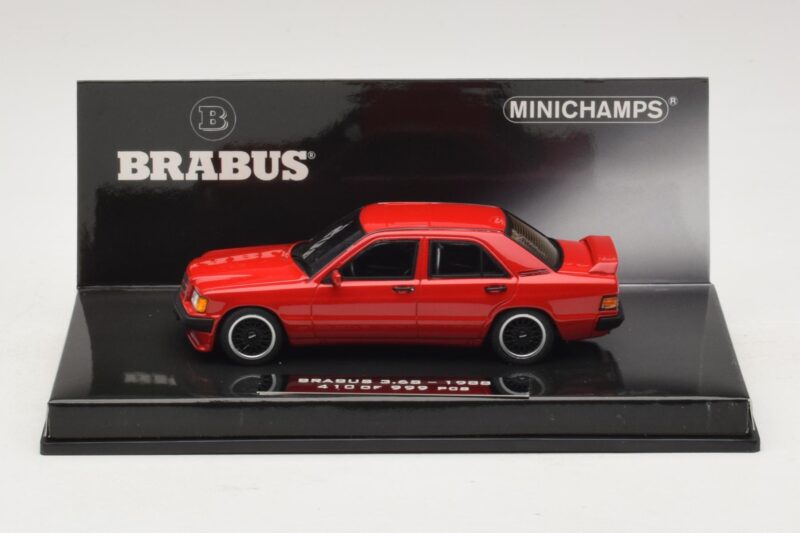
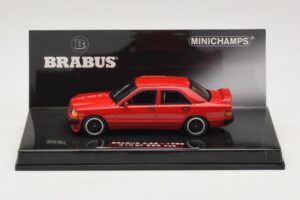
TL;DR: Minichamps' 1:43 Brabus 3.6S 190E is a sealed-body zinc alloy diecast in red, reproducing tuner Brabus' engine-enlarged version of Mercedes' compact W201 saloon from 1988. Best known within the era as the Baby Benz, the 190E gained genuine displacement and body addenda under Brabus, and this casting suits collectors pairing tuner specials with factory saloons.
Mercedes' 190E carried the compact executive saloon into a new decade, and Brabus saw an opportunity to push that platform well past its factory limits. Minichamps' red casting reproduces the 3.6S specifically, a Brabus variant built around enlarging the engine's displacement rather than simply adding a body kit, which sets it apart from lighter cosmetic tuner treatments of the same era.
The red finish sits bold and glossy under direct light, and it lets Brabus' wider sills, deeper front splitter and specific wheel arch extensions stand out clearly against the W201's otherwise compact, upright saloon shape. Zinc alloy gives the casting genuine weight for its size, and that density helps the model's lowered stance and wider wheel fitment sit convincingly rather than looking like a standard 190E with cosmetic add-ons stuck on top. Because the body is a single sealed casting, the transition between the factory saloon shape and Brabus' bodykit reads as one deliberate, continuous silhouette rather than a series of separately moulded panels bolted awkwardly together.
The W201 was always a genuinely compact saloon, smaller than the E-Class it sat below in Mercedes' range at the time, and Minichamps holds those tight, upright proportions accurately even with Brabus' wider bodykit applied over them. The specific Brabus wheel design and the deeper front air intake are reproduced with real definition rather than simplified into a generic aftermarket shape, a level of finish that separates a genuine collector-grade tuner casting from a toy-shop equivalent. Brabus badging on the boot and grille is picked out cleanly rather than left as an afterthought.
Brabus built its early reputation partly on taking Mercedes' four-cylinder and six-cylinder engines and increasing their displacement well past what the factory offered, and the 3.6S applied exactly that approach to the 190E's engine bay. That kind of mechanical work, rather than only cosmetic bodywork, is what separated Brabus from tuning houses that focused purely on appearance. Later Brabus projects on larger Mercedes saloons built directly on lessons learned from cars exactly like this one.
The 190E earned the nickname Baby Benz for sitting as the smallest, most accessible saloon in Mercedes' range through the 1980s, which made it an unlikely but popular canvas for independent tuning houses looking to prove their engineering credentials on a genuinely mainstream car. Brabus' work on the platform helped establish the tuning house's reputation well before it moved on to larger Mercedes models, a period worth recognising rather than skipping past toward the company's later, more famous work.
A Brabus 3.6S works well displayed beside a standard 190E, since the contrast in stance, wheel fitment and bodywork tells the tuning story more clearly than the Brabus casting alone ever could. At 1:43, both versions sit comfortably on one shelf without demanding extra floor space, letting a collector show exactly how far an independent tuner pushed a genuinely mainstream Mercedes saloon during the 1980s. The red finish holds its gloss evenly under consistent lighting, and the sealed body's crisp panel transitions between factory shape and Brabus addenda will not loosen or gap with handling over time.
Save £14.00