Last one
Used
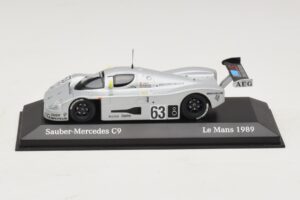
TL;DR: Minichamps' 1:43 diecast Sauber C9 arrives in an unusual matt black finish rather than the silver Sauber-Mercedes livery that won Le Mans in 1989, a sealed one-piece body with crisp Group C bodywork, sized to anchor a prototype racing shelf built around the marque's dominant era.
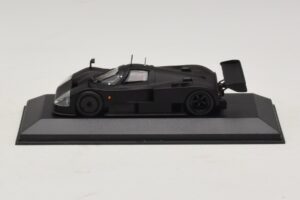
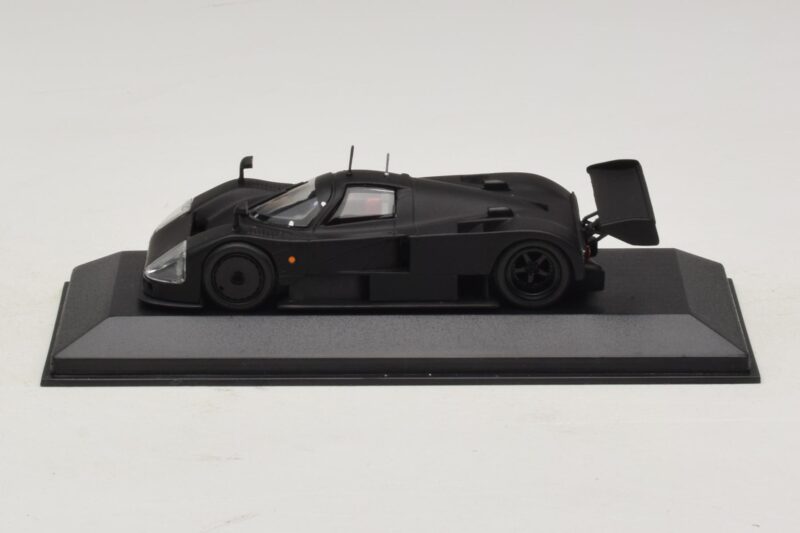
The Sauber C9 stands among Group C's most dominant designs, its Mercedes-powered, flat-nose silhouette a fixture at the front of the grid through the late 1980s. This Minichamps casting swaps the famous silver for a matt black scheme, a factory or test livery variant that gives the model its own identity apart from the race-winning cars.
Group C prototypes are long, low and defined by an unbroken underbody built to generate ground effect, and a sealed diecast shell suits that shape well. Minichamps casts the C9 as a single zinc alloy body, so the sweeping nose, the flat flanks running back to the rear wing mounts and the closed cockpit canopy all sit as one continuous surface rather than breaking around opening panels that a car this shape rarely needed for display. The weight in the hand is unmistakably metal, dense enough to feel substantial even in a footprint smaller than a mobile phone, and that density keeps a low, wide prototype planted rather than perched on the shelf.
Sauber's Mercedes-backed cars are remembered above all in silver, the colour that gave the partnership its "Silver Arrow" nickname and linked it directly to Mercedes-Benz's earlier racing heritage. A matt black finish sits well outside that identity, closer to a development mule or a photography car than anything that saw a starting grid. Minichamps applies its printed markings with the same tampo technique used across its racing range, keeping badges and trim flush against the matt surface rather than raised or glossy, a deliberate finish choice that suits a car built to look purposeful rather than showy.
Sauber built the C9 around a turbocharged Mercedes-Benz V8, a partnership that grew from technical support into a full works effort by the late 1980s and revived the Silver Arrow name that Mercedes had carried in grand prix racing decades earlier. The C9's flat, wide body and long tail were shaped as much by aerodynamic efficiency as outright power. Group C's fuel-consumption formula rewarded exactly that balance, forcing manufacturers to chase efficiency alongside raw speed, a discipline that suited a manufacturer with Mercedes' engineering depth.
1989 marked the high point of that partnership, when a Sauber C9 won the 24 Hours of Le Mans outright, one of several dominant results that season for the Mercedes-backed effort. That winning car was shared by Jochen Mass, Manuel Reuter and Stanley Dickens, a lineup that gave Mercedes an outright Le Mans victory decades after its earlier motorsport heyday and closed the loop on the Silver Arrow revival Sauber had started years before. This black-liveried example does not claim that race-winning identity, but it carries the same underlying engineering that made 1989 the year Group C's prototype era reached its peak.
A matt black C9 works best displayed alongside the silver race cars it never quite matches, the contrast doing more to tell Group C's story than a second silver casting ever could. At 1:43, several Group C prototypes sit comfortably on a single shelf, their long tails and low noses reading clearly even at this reduced size, which makes the scale a practical choice for anyone building a full Group C grid rather than a single hero model. Judge this casting on the same terms as any small-scale prototype: panel-line discipline along that unbroken underbody, paint depth across a large flat surface that shows every imperfection, and how convincingly the aerodynamic details survive the shrink to 1:43, details that separate a genuinely accurate casting from a rough approximation.

Save £14.00