Last one
Save £4.00
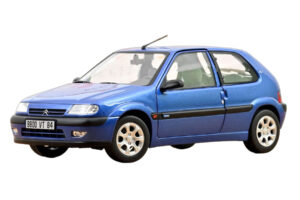
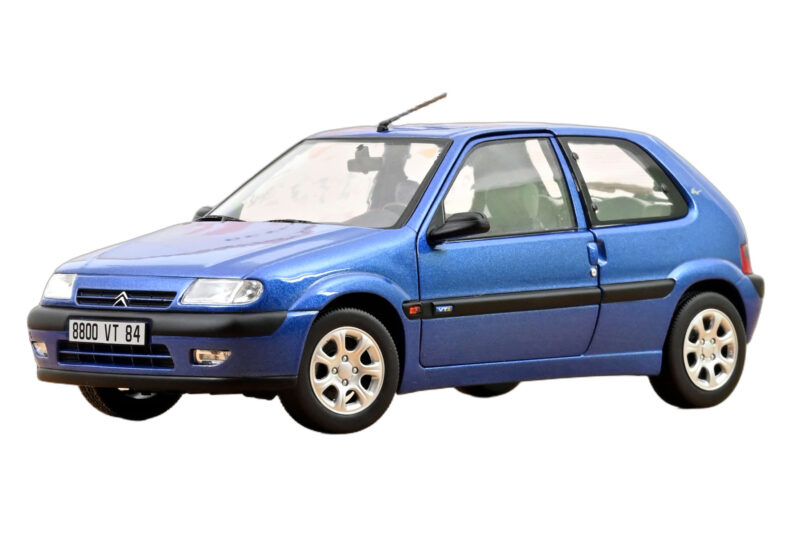
TL;DR: Norev's 1:18 Citroen Saxo VTS reproduces the 1996 hot hatch in Grand Pavois blue diecast, with doors and bonnet that genuinely open for close inspection. Sharing its 1.6-litre 16-valve engine with the Peugeot 106 GTi under PSA's badge-engineering, the Saxo VTS became one of the most sought-after French hot hatches of its era.
The Saxo VTS earned its reputation the hard way, through insurance-group arguments and countless magazine group tests pitting it against the Peugeot 106 GTi it shared an engine with. Norev's Grand Pavois blue diecast opens its doors and bonnet properly, letting a collector inspect the compact engine bay that made this small hatchback punch so far above its size, and the finish captures a special-edition colour rarely seen on ordinary road-going survivors today.
Norev builds this Saxo VTS with doors and a bonnet that genuinely open, a detail that matters more on a hot hatch than it might on a more sedate saloon, since so much of the VTS's appeal always lived under that bonnet rather than in its modest exterior dimensions. Lifting it reveals an engine bay laid out for the 1.6-litre 16-valve unit that gave the VTS its reputation, packaged tightly into a shell barely larger than the entry-level Saxo it was based on. The doors swing to reveal a cabin trimmed with the sportier detailing the VTS carried over the standard car, and each panel settles with a deliberate action rather than swinging loosely on the hinge.
Grand Pavois blue is a distinctive special-edition colour, brighter and more assertive than the whites and reds more commonly associated with hot hatches of this era, and it suits the Saxo's compact, purposeful shape well. Under direct light, the finish should hold an even, deep gloss across the car's simple, unadorned panels, panels that were never meant to carry elaborate creases or sculpting in the first place. Zinc alloy construction gives the small model genuine weight in the hand, a quality that flatters a car whose real-world appeal always came from substance over showroom glamour.
PSA Peugeot Citroen built the Saxo and the 106 on shared underpinnings, and the VTS shared its hottest engine directly with the 106 GTi, a 1.6-litre 16-valve unit that made both cars genuinely quick for their size and weight. That shared mechanical package fuelled one of the decade's most persistent hot hatch rivalries, with buyers and magazine testers endlessly debating which badge delivered the sharper drive despite the two cars being mechanically almost identical underneath. For collectors today, that shared history makes a Saxo VTS a natural companion piece to a 106 GTi from the same period, two badges telling one story.
The Grand Pavois name refers to a major French boat show held annually in La Rochelle, and Citroen used the association for a special-edition livery on certain Saxo models, giving buyers a colour choice distinct from the standard VTS palette. That kind of themed special edition was common practice for French manufacturers through the 1990s, tying an everyday model to a recognisable cultural event rather than relying on trim badges alone. For a collector, a named special edition like this one carries a little more story than a standard colour option would, even on a car already well known on its own merits.
The 1990s produced an unusually strong crop of French and wider European hot hatches, and the Saxo VTS sits comfortably among the best of them, alongside the Peugeot 106 GTi, the Renault Clio Williams and Britain's own Vauxhall Corsa and Ford Fiesta performance variants. Displayed together, these cars tell the story of a genuinely competitive segment where manufacturers across several countries fought hard for the same young, budget-conscious performance buyer, each bringing a slightly different mechanical answer to a very similar brief. The Saxo VTS's answer, a light body and a genuinely eager engine, still reads as one of the segment's most honest solutions decades later.
At 1:18, the Saxo's compact dimensions keep its footprint modest, making it easy to gather several period hot hatches on one shelf without needing a large display cabinet. The opening doors and bonnet add genuine interactive value here too, letting a collector show off the engine bay during a display rather than leaving it as a static shape, which suits a car whose entire appeal always centred on mechanical substance rather than visual drama alone.
This Grand Pavois blue Saxo VTS offers something a standard-colour version cannot: a genuinely uncommon livery on a car that already earned its reputation honestly, through performance and value rather than marketing alone. It suits a collector who already knows the Saxo VTS story and wants a colour option beyond the usual white or red.
Paired with a Peugeot 106 GTi from the same era, or displayed among a wider 1990s hot hatch shelf, this model rewards buyers who value genuine mechanical history over headline rarity, at a price that reflects its mainstream hot hatch origins rather than any artificial scarcity. That honest positioning is exactly what made the original car worth its price, and it still is today.